The Hidden Biology of Everyday Life
INPUT 08 · The Living World · Question it answers: What is the world actually like? · What it restores: The curriculum for the one system that arrived unfinished on purpose.
Input 8 of 10 in Ancient Biology, Modern Life.
Almost every organ you own arrived finished. Your heart needed no instruction in how to beat; your liver was never shown what a toxin looks like.
One system arrived unfinished on purpose. Your immune system shipped with extraordinary hardware and almost no content — it knew how to learn, and little about what it would need to know. The curriculum had to come from the world outside you.
Which sets up a natural experiment nobody designed. Two North American farming communities, similar in ancestry, family structure, diet, and vaccination rates. One difference: the Amish work single-family farms using horses, barns close to the home; the Hutterites farm communally and industrially, quarters set apart from animals.
Asthma prevalence among Amish schoolchildren was roughly four times lower. Allergic sensitization, roughly six times lower.
Then researchers collected dust from homes in both communities and delivered extracts into the airways of mice. The Amish dust protected against airway responses. The Hutterite dust did not.
Two genetically similar populations, different microbial environments — and a mechanism you could carry into a lab in a bag.
What Your Immune System Actually Does All Day
The popular image is an army — sentries, invaders, a war in the bloodstream. It gets the emphasis backwards.
Attack is the rare event. The overwhelming majority of immune work is restraint — encountering something and deciding to let it be. Every breath brings in spores and pollen; your gut holds trillions of microbes that are not you and must not be attacked. Get that judgment wrong one way and infection takes hold; wrong the other way, and the system attacks pollen, peanuts, or your own joints.
So tolerance isn’t passive. It’s a learned achievement — and learning requires material.
Pick up a handful of healthy soil and you’re holding tens of billions of organisms from thousands of species — and for nearly all of human history, that was simply the medium people lived in.
Immunologist Graham Rook named the principle: what matters is not exposure to infection but sustained contact with the old friends — the ancient, largely harmless organisms that accompanied human evolution.
The Part That Gets Misread
We need to be exact, because this topic sits one careless sentence from real public health harm.
None of this is an argument against hygiene.
The old label — the “hygiene hypothesis” — has done genuine damage, because the name suggests cleanliness is the culprit. Leading researchers have called for abandoning the term. Handwashing, food safety, clean water, and vaccination prevent disease. They are not what reduced your microbial education, and reversing them would harm you while teaching your immune system nothing.
The exposures that matter are environmental: soil, plants, animals, green space, outdoor air. The ones hygiene targets are pathogenic. Different things — and one is not the price of the other.
Nor is dirt a treatment. No study here shows gardening cures allergy or soil prevents asthma in an individual — what the evidence supports is a population-level pattern and a plausible mechanism. There’s more than we have room for, including an intervention in which changing what children played on shifted their microbiota within about a month.
So How Much Do You Actually Need?
Nobody can give you a dose, and the reason is genuinely interesting.
The strongest intervention evidence changed the environment, not the exposure time. Children played as they always had; what differed was what they played on. Contact matters — but that says nothing usable about minutes per week.
What the evidence establishes is that quality outranks quantity. A managed lawn is not a meadow, and two identical hours in two different green spaces are not the same input.
Which makes the practical question not how long but where — and how to increase contact safely, since soil carries real risk for some. Both live in the book.
The living world on its own is a data point — real, but narrow. Read against the other nine it becomes a pattern. Read within its question it becomes a direction: this input missing alone is a different situation from it missing alongside bare feet and scent, all three answering the same question badly at once.
And read whatever you find as feedback rather than a grade. A life spent mostly indoors doesn’t mean something is wrong with you — a curriculum went quiet, and the system reading it is still enrolled.
Where This Input Sits in the Pattern
Ten inputs, and the structure is the point rather than the number. They answer four questions your biology asks: Is it safe here? Can I survive here? What is the world actually like? How big am I in this?
The living world belongs to the third, alongside bare feet and scent — but it differs from every other input in the set, and this is the most interesting thing here.
The other nine are read by a nervous system. This one is read by an immune system. Two separate systems — one built to sense the world, one to defend against it — both developed in conversation with the same environment.
It’s why we say your biology, not your nervous system. Notice too how tightly this sits against Part 6: bare feet on soil is simultaneously a proprioceptive input and a microbial one — one act, feeding two systems at once.
What Actually Restores It
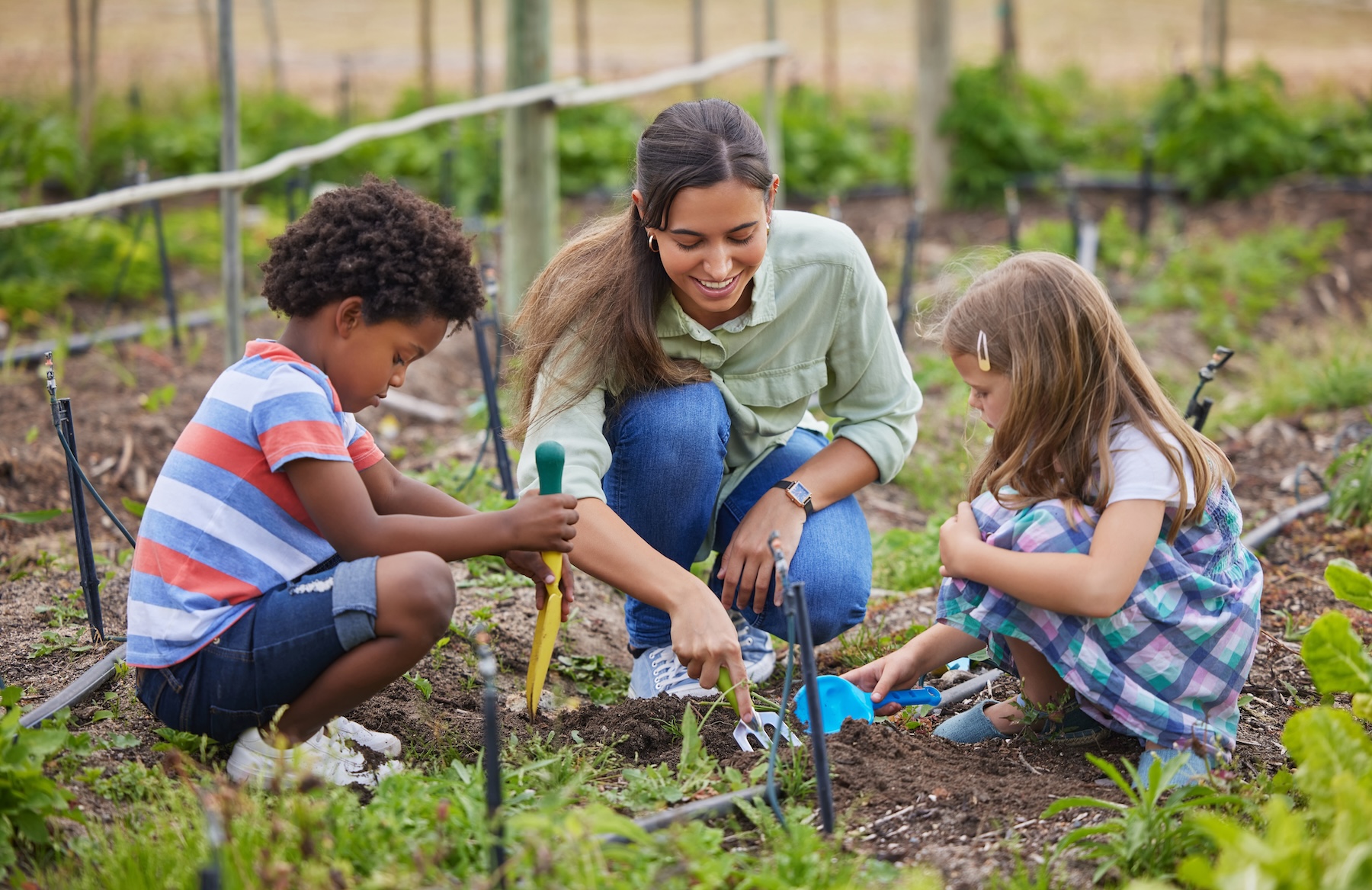
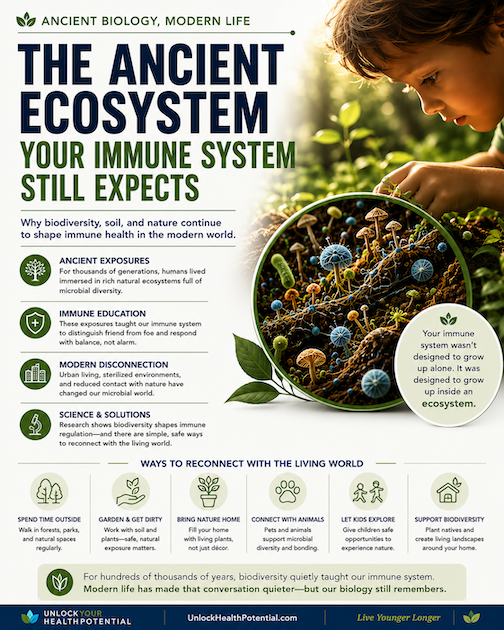
The levers are ordinary. Get outdoors somewhere genuinely alive — woodland, unmown grass, a wild corner of a park — because plant diversity is the visible proxy for microbial diversity. Put your hands in soil. Let children be children outdoors — the group with the strongest evidence behind it. Open the window, because indoor air in a sealed building is microbially impoverished.
And keep washing your hands — before eating, after the bathroom, when ill, around anyone vulnerable. Nothing above changes that, and an article implying otherwise would be doing harm.
Cautions worth reading before you dig. Soil carries genuine risk for some. Keep tetanus vaccination current and clean any cut that happens outdoors. If you’re pregnant, wear gloves and avoid handling cat litter — toxoplasma is a real concern. If you’re immunocompromised, on immunosuppressive medication, or living with a chronic lung condition, speak with your physician before increasing soil or compost exposure; organisms harmless to most people are not harmless to everyone. Wash hands and produce after gardening. And never drink untreated water from a stream, however clean it looks.
Where This Leaves You
Early life is the most influential window, and the strongest findings involve children. But immune regulation is shaped throughout life, and the adult microbiome responds to exposure. The system didn’t stop learning when you did.
Which is about as far as print will take you. Where to go, and how to build contact around the cautions rather than despite them, depends on what’s near you — so in the book each input’s practice is worked against that, and against the other nine, since several arrive in the same act rather than as ten separate obligations.
Then keep going, because one input is never the whole picture.
In Part 9 we reach the last of the four questions, and it starts somewhere unexpected — with a fern, a coastline, and the branching structure of your own lungs.
Your biology never stopped asking. It is time you answered.
New to this blog series? Start with the series overview →
Get the Book
Ancient Biology, Modern Life — the new book from Ronit Mor, ND and Russell Skinner, MD — gives you a full chapter on each of the ten inputs, the research behind every one, and simple steps for restoring it. Then it shows you how the ten fit together — which arrive in the same act, in what order, and which of your four questions has gone unanswered longest — so you finish with roughly fifteen minutes a day built around your own life.
This is Book Two in the Live Younger Longer series — short books you can finish in an afternoon, each focused on the small changes that make the biggest difference to how you age. Its companion volume, The Longevity Scorecard, measures the ten signals your body sends outward. This book restores the ten inputs your body receives. Read them in either order.
FAQs
It proposes that contact with a wide variety of harmless environmental microorganisms — from soil, plants, animals, and other people — helps train immune regulation, and that reduced contact is associated with poorer regulation in some individuals. It builds on the “old friends” framing developed by immunologist Graham Rook, which emphasizes ancient, largely harmless organisms rather than infections.
It is the successor, and the name change matters. The original term proved misleading because it implied cleanliness itself was harmful, and leading researchers have explicitly called for abandoning it. The exposures that appear to matter are environmental and largely harmless; the ones hygiene targets are pathogenic.
No, and this is the single most common misreading. Handwashing, food safety, clean water, and vaccination prevent disease and are not implicated. What the research points to is reduced contact with environmental biodiversity: soil, plants, animals, green space, outdoor air. You can maintain excellent personal and food hygiene while substantially increasing contact with the living world, and that is exactly what the evidence supports.
Researchers compared two farming communities with similar ancestry, family structure, diet, and vaccination rates but very different farming practices. Asthma prevalence was roughly four times lower among Amish children, and analysis of house dust and immune profiles found substantial differences in innate immune activity between the groups.
Early life appears to be the most influential window, and the strongest findings involve children. But immune regulation is shaped by ongoing interaction with the environment throughout life, and the adult microbiome responds to exposure. The honest answer is that the childhood evidence is stronger and the adult evidence is developing.
Not without some care. Keep tetanus vaccination current and clean any cuts. If you are pregnant, wear gloves and avoid cat litter due to toxoplasma risk. If you are immunocompromised, on immunosuppressive medication, or living with a chronic lung condition, speak with your physician first — soil organisms harmless to most people are not harmless to everyone. Wash hands and produce afterward.
No. That figure originated in a rough 1970s estimate and was revised in 2016; the ratio is closer to one to one. That still means roughly thirty trillion resident bacteria living in and on you, which is remarkable enough without the inflation.
This content is for educational purposes only and is not intended as medical advice. Nothing here should be taken as a reason to reduce hygiene practices, decline vaccination, or delay medical care.
Scientific References
Stein MM, Hrusch CL, Gozdz J, et al. Innate immunity and asthma risk in Amish and Hutterite farm children. N Engl J Med. 2016;375(5):411-421.
Roslund MI, Puhakka R, Grönroos M, et al. Biodiversity intervention enhances immune regulation and health-associated commensal microbiota among daycare children. Sci Adv. 2020;6(42):eaba2578.
Ege MJ, Mayer M, Normand AC, et al. Exposure to environmental microorganisms and childhood asthma. N Engl J Med. 2011;364(8):701-709.
Rook GA. Regulation of the immune system by biodiversity from the natural environment: an ecosystem service essential to health. Proc Natl Acad Sci U S A. 2013;110(46):18360-18367.
Engemann K, Pedersen CB, Arge L, et al. Residential green space in childhood is associated with lower risk of psychiatric disorders from adolescence into adulthood. Proc Natl Acad Sci U S A. 2019;116(11):5188-5193.
Bloomfield SF, Rook GA, Scott EA, et al. Time to abandon the hygiene hypothesis. Perspect Public Health. 2016;136(4):213-224.