
The Hidden Biology of Everyday Life
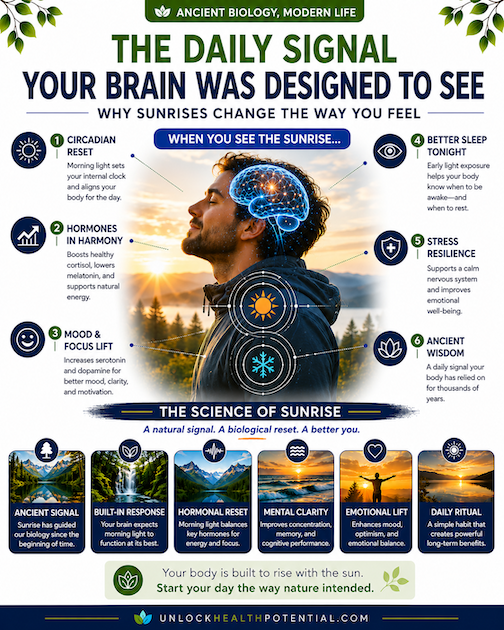
INPUT 01 · Morning Light · Question it answers: Is it safe here? · What it restores: A predictable, well-timed day — one of the oldest signals of safety a body can receive.
Input 1 of 10 in Ancient Biology, Modern Life.
There is a third kind of cell in your retina, and it has nothing to do with seeing. It isn’t wired to the visual cortex at all. It runs instead to a cluster of neurons just above where your optic nerves cross — the master clock of the human body.
Here’s the proof it’s a genuinely separate system. Some people who are completely blind, with no conscious sight at all, still keep normal daily rhythms of sleep, alertness, and hormone release, provided those cells are intact.
The image is gone. The timekeeping continues.
Sight and time run on different wires, and you’ve been using the second one every day of your life without knowing it was there.
A Week Without Electric Light
In 2013, a team led by Kenneth Wright took volunteers into the Rocky Mountains for a week. No lamps, no screens, no phones — just daylight and a campfire.
Seven days later their internal clocks had shifted roughly two hours earlier. Confirmed night owls were waking near dawn without alarms, apparently having changed their minds about who they were.
The follow-up is the one that should give you pause: a single weekend produced about two-thirds of that shift.
Two days, two-thirds of the effect. Lovely news if you’re going camping — and an uncomfortable description of what an ordinary indoor weekend does in the other direction.
There’s more evidence than we have room for — including the largest test yet, nearly ninety thousand people wearing wrist sensors. The chapter covers what it found.
Same Light, Opposite Directions
Light doesn’t simply help. Its effect depends on when it arrives — and it reverses. Morning light nudges your clock earlier, making it easier to wake and easier to feel sleepy at a reasonable hour. The same light late in the evening does exactly the opposite.
Which means that if you get no bright light in the morning and hours of screen light at night, you aren’t missing a good habit.
You’re pushing your clock the wrong way. Twice a day. Every day.
There’s a name for the result, and it’s oddly perfect: social jetlag — a permanent, low-grade time-zone lag you never actually traveled for.
The Gap Your Eyes Are Hiding From You
Nobody decided to stop getting morning light. It was simply what happened when the day began, until electric light made every hour available and it quietly stopped.
Consider what your eyes are concealing. A well-lit office runs in the low hundreds of lux. An overcast morning outdoors delivers several thousand.
Indoors and outdoors feel roughly comparable. They aren’t. You can spend a whole day feeling surrounded by light while your master clock receives almost nothing it recognizes as daytime — then spend the evening in what it reads as a mild, endless dawn.
The exact inversion of the pattern it was built to read.
So How Much Do You Actually Need?
Less than you’d think, and earlier than you’d think.
There are worked figures, and they’re specific — shifting with the sky, the season, and your latitude. There’s a matching set for the evening half, which most people skip entirely.
Those figures live in the book, and there’s a reason beyond selling copies.
Morning light on its own is a data point — real, but narrow. Read against the other nine it becomes a pattern. Read within its own question it becomes a direction: light missing alone, among nine healthy inputs, is a different situation entirely from light missing alongside birdsong and distance, all three answering the same question badly at once.
The first is worth fixing. The second tells you where your week has gone wrong.
And read whatever you find as feedback rather than a grade. Wherever you’re starting is simply your starting line — getting almost no morning light doesn’t mean something is wrong with you. It means your body is pointing at a place where a little consistency pays off out of all proportion to the effort.
Where This Input Sits in the Pattern
Morning light is one of ten inputs, and the ten aren’t a list. They resolve into four questions your biology asks continuously, beneath any awareness of yours: Is it safe here? Can I survive here? What is the world actually like? How big am I in this?
Morning light belongs to the first, which surprises people who expect it filed under sleep. But a predictable, well-timed day is among the oldest safety signals a body can receive.
Its closest sibling is Part 2. The dawn chorus arrived on exactly the same schedule as first light and told your nervous system the same reassuring thing — so stepping outside early collects two ancient safety signals in a single act, precisely as they were meant to be delivered.
What Actually Restores It
The levers are simple to name. Outdoor light into your eyes early. Outside rather than near a window, because glass strips the wavelengths these cells prefer. Not just on sunny days. And protect the other end — doing only the morning half is like pushing a swing and then catching it.
One firm safety rule. Never look directly at the sun to get this benefit. You don’t need to and you never should — the clock-setting cells respond to bright ambient light from the open sky, not to staring at the source, which can cause permanent and irreversible retinal damage. Face the sky, the horizon, or the lit world around you.
The harder questions are how long, given the sky you’ve actually got, how the evening half works without turning your house into a cave at seven, and what to do if you wake before sunrise.
Before you start: if you have bipolar disorder, the timing of light exposure can affect mood episodes and should be managed with your physician. If you take photosensitizing medications, have retinal disease, or have had recent eye surgery, ask your eye care provider. If low mood is persistent, it deserves proper evaluation. Light is a genuine tool, not a replacement for care.
Where This Leaves You
Your clock is exquisitely responsive to the one input it was designed around. You don’t have to manage cortisol or melatonin directly — set the timing signal at the front of the day and the downstream systems tend to organize themselves.
So tomorrow, before the phone and before the news, open the door and step outside.
Which is where an article reaches its limit. How long, and how the evening half fits around it, depends on your latitude and the season — so in the book each input’s practice is worked against those, and against the other nine, because several of these arrive in the same act rather than as ten separate obligations. Restore all ten and that resolves into roughly fifteen minutes a day built from your own life.
Then keep going, because one input is never the whole picture.
In Part 2 we take up birdsong — the other thing arriving at your window at dawn, answering the same question by an entirely different route, and doing something measurable to nearly three hundred people in six minutes. Whether your first two inputs are both missing matters more than either one alone.
Your biology never stopped asking. It is time you answered.
Get the Book
Ancient Biology, Modern Life — the new book from Ronit Mor, ND and Russell Skinner, MD — gives you a full chapter on each of the ten inputs, the research behind every one, and simple steps for restoring it. Then it shows you how the ten fit together — which arrive in the same act, in what order, and which of your four questions has gone unanswered longest — so you finish with roughly fifteen minutes a day built around your own life.
This is Book Two in the Live Younger Longer series — short books you can finish in an afternoon, each focused on the small changes that make the biggest difference to how you age. Its companion volume, The Longevity Scorecard, measures the ten signals your body sends outward. This book restores the ten inputs your body receives. Read them in either order.
FAQs
Much less than you would hope. Glass filters a significant portion of the relevant wavelengths, and even a sunny room falls far short of outdoor intensity. Stepping fully outside — a balcony, a doorstep — is meaningfully better than the brightest window in the house.
No, and please don’t. Looking directly at the sun can cause permanent retinal damage. Ambient light from an open sky entering your eyes is what drives the effect. Face the brightness and look at your surroundings, not at the source.
Because timing determines direction. Light early in your day shifts your internal clock earlier; light late in the evening shifts it later. Morning light and evening dimness work as a pair, and skipping either one undercuts the other.
It depends on the sky, the season, and your latitude, which is why a single universal figure would mislead more than it helped. Outdoor light is far more intense than indoor light even under heavy cloud, so a gray morning still works — it simply takes longer. Ancient Biology, Modern Life sets out how to find your own number.
A light therapy lamp used shortly after waking is well studied for exactly this situation, and the book covers how to use one properly. If you also experience seasonal low mood, discuss it with your physician — that combination deserves proper attention rather than a self-directed fix.
Many people report easier mornings and better sleep within one to two weeks of consistent practice. Circadian systems respond to repetition, so regularity matters far more than any single day.
This content is for educational purposes only and is not intended as medical advice.
Scientific References
Wright KP Jr, McHill AW, Birks BR, Griffin BR, Rusterholz T, Chinoy ED. Entrainment of the human circadian clock to the natural light-dark cycle. Curr Biol. 2013;23(16):1554-1558.
Stothard ER, McHill AW, Depner CM, et al. Circadian entrainment to the natural light-dark cycle across seasons and the weekend. Curr Biol. 2017;27(4):508-513.
Hattar S, Liao HW, Takao M, Berson DM, Yau KW. Melanopsin-containing retinal ganglion cells: architecture, projections, and intrinsic photosensitivity. Science. 2002;295(5557):1065-1070.
Provencio I, Rodriguez IR, Jiang G, Hayes WP, Moreira EF, Rollag MD. A novel human opsin in the inner retina. J Neurosci. 2000;20(2):600-605.
Czeisler CA, Shanahan TL, Klerman EB, et al. Suppression of melatonin secretion in some blind patients by exposure to bright light. N Engl J Med. 1995;332(1):6-11.
Khalsa SBS, Jewett ME, Cajochen C, Czeisler CA. A phase response curve to single bright light pulses in human subjects. J Physiol. 2003;549(Pt 3):945-952.
Windred DP, Burns AC, Lane JM, et al. Brighter nights and darker days predict higher mortality risk: a prospective analysis of personal light exposure in >88,000 individuals. Proc Natl Acad Sci U S A. 2024;121(43):e2405924121.