

Longevity -> Measure It. Train It. Extend It.
Your last lab panel told you what is currently wrong with you.
It did not tell you what is currently changing.
That gap is the entire subject of this series. Because the measures that shift first are not the ones medicine screens for. They are functional — how fast you walk, how hard you can squeeze, how long you last on one leg, whether Sunday night looks anything like Tuesday. And they move years, sometimes decades, before anything abnormal appears on a standard panel.
Which means there is a window in which decline is visible and still inexpensive to reverse.
Most people spend that window being told everything looks fine.
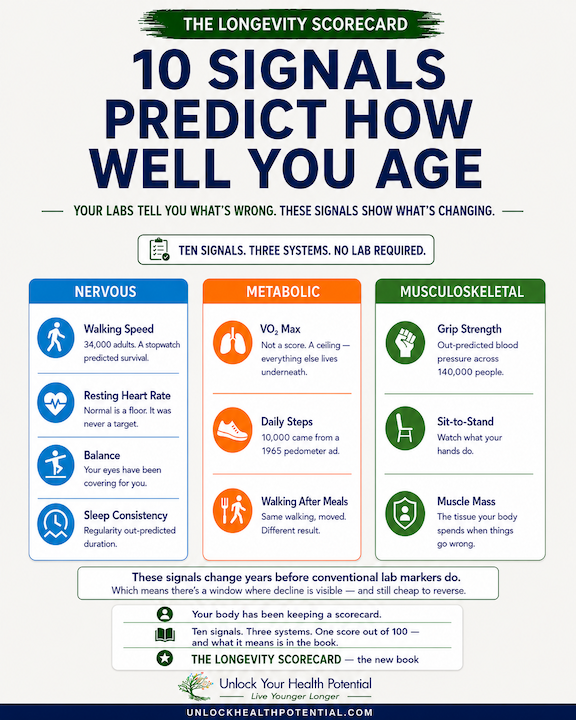
Ten signals. Three systems. Not one of them requires a laboratory.
And before you measure anything: read what you find as feedback, not as a grade. Wherever you land today is simply your starting line. Every one of these signals responds to being asked — which is the entire reason they are worth knowing.
Why Function Moves Before Pathology
Disease markers are lagging indicators. By the time a number goes out of range, the process producing it has usually been running for years.
Functional capacity is different. It degrades continuously and immediately, because your body is always adjusting what it maintains to match what you ask of it. Stop asking, and it quietly stops paying — not as damage, but as economics.
So the useful question is not what is wrong with me. It is what have I stopped being able to do, and when did that start.
That question has answers. They are cheap to collect, and almost nobody collects them.
Three Systems, Not Ten Measurements
The ten signals are not a checklist. They resolve into three interacting systems, and each system is examined from several angles — because any single measurement can mislead you in a specific and predictable way.
The Nervous system asks four questions: coordination, regulation, sensory integration, and rhythm. Can you still move well, stand down, stay oriented, and run to a schedule your body can rely on?
The Metabolic system asks three: capacity, exposure, and timing. How much energy can you produce, how often do you actually use it, and does movement arrive when your body can put it to work?
The Musculoskeletal system asks three: output, application, and substrate. Can you generate force, organize it into something useful, and is the tissue behind it growing or shrinking?
That structure is what turns a set of measurements into a reading. Someone can have excellent output and a substrate quietly draining underneath it. Someone else can have a strong ceiling and almost no daily movement. Those are different problems that produce similar-looking scores — and the difference is invisible in any single number, which is why the architecture matters more than the arithmetic.
The Ten Signals
Nervous System
Signal 01 — Walking Speed 34,000 adults over 65. A stopwatch predicted survival across every population studied. Your pace is not measuring your legs.
Signal 03 — Resting Heart Rate Ask a doctor what’s normal and you’ll hear 60 to 100. That range exists to catch arrhythmias — not to describe a heart that’s thriving. Normal is a floor.
Signal 06 — Balance Can you stand on one leg for ten seconds? In 2022, researchers found the answer predicted survival. Almost everyone believes theirs is fine — this is the signal where that belief is most often wrong.
Signal 10 — Sleep Consistency In 2024, researchers compared how long 60,000 adults slept against how regularly. Regularity was the stronger predictor of mortality. The number everyone tracks lost to the one nobody does.
Metabolic System
Signal 04 — VO₂ Max Cardiologists recommended measuring this routinely in 2016. Has anyone measured yours? It isn’t a score — it’s a ceiling, and everything else in your body operates underneath it.
Signal 07 — Daily Steps The 10,000-step target came from a 1965 pedometer advertisement. It was an excellent name. It was never a finding.
Signal 08 — Walking After Meals Researchers gave people the same total walking, arranged three different ways. One arrangement worked significantly better. Not more walking — the same walking, moved.
Musculoskeletal System
Signal 02 — Grip Strength Across nearly 140,000 adults in seventeen countries, it predicted mortality more strongly than blood pressure. Not because hands matter.
Signal 05 — The Sit-to-Stand Test Watch someone rise from a low armchair and you’ll see something they can’t see about themselves. At some point, their hands started helping.
Signal 09 — Muscle Mass It’s the tissue your body spends when something goes wrong. Which means you’re not building it for this year — you’re building it for the week you can’t get out of bed.
What the Series Gives You — and What the Book Adds
The ten articles are free, and they’re the right place to start. Each one covers what a signal measures, why it changes, what the research actually found, and what moves it. Read all ten and you’ll understand your body’s early warning system better than most people ever will — including which three systems it runs on and why a pattern matters more than any single reading.
That’s a genuinely useful place to stand. The book goes on from there.
Every signal becomes a full chapter. More of the research and what it found, the mechanisms underneath, what truly changes with age versus what we’ve simply stopped asking for, and considerably more on what to do about it than an article has room for.
Every benchmark, with the self-test to match. Validated thresholds for all ten signals, most adjusted for age and sex, alongside the at-home protocol for measuring each one properly — because how you test changes the result more than most people expect.
Your score out of 100. Each signal scores in three bands — Strong, Watch, or Priority — resolving into a single total you can retest in eight weeks to see which direction you’re moving.
A practice plan matched to your result. Every signal carries its own tiered protocol, because rebuilding from a low number and protecting a strong one are different jobs. Score all ten and those tiers resolve into a personalized action plan built from your own numbers.
And the part that makes all of it usable: how to read your own pattern. The ten signals don’t carry equal weight and don’t fail in random order. Some drift first and pull others down behind them. Some are consequences wearing the costume of causes — which is how people spend years working hard on the wrong thing.
Two people can reach the same total and need almost opposite advice. One has a system to rebuild. The other has a habit to change. Same score, and their next twelve months should look nothing alike.
Learning to tell those apart is the whole discipline. It’s what the book is for.
Where to Start
If you want the fastest read on yourself: start with Signal 05. You can complete the test while reading, using nothing but a chair.
If you want the single most surprising finding: Signal 02.
If you want the one thing you could change tomorrow: Signal 08 — the only signal here that measures a decision rather than a capacity.
If you’d rather go in order: begin at Signal 01 and work through. Each part hands off to the next, and the system architecture assembles as you go.
Whichever route you take, resist drawing conclusions from any single article. One signal is a data point. What tells you something is whether it stands alone or has company.
Get the Book
The Longevity Scorecard — the new book from Ronit Mor, ND and Russell Skinner, MD — goes deeper on every signal in this series: the benchmark and at-home self-test for each one, your total score out of 100, and how to read the pattern across your three systems, so you know which one to rebuild first.
Order The Longevity Scorecard →
Your body has been keeping a scorecard. Every day of your adult life, in a language nobody taught you to read.
It is not too late. It has never been too late.
Assess. Resolve. Maximize. Live Younger Longer.
FAQs
A framework of ten functional measurements — walking speed, grip strength, resting heart rate, VO₂ max, the sit-to-stand test, balance, daily steps, walking after meals, muscle mass, and sleep consistency — organized into three interacting body systems. Each is scored in three bands and combined into a total out of 100. The premise is that functional capacity changes years before conventional disease markers do.
For most signals, no. Several require nothing but a chair, a wall, a stopwatch, or a phone you already own. Grip strength needs an inexpensive hand dynamometer, and VO₂ max is most accurately measured in a lab — though validated at-home estimates exist for both.
Most people can measure all ten across a week, since a few require a several-day average rather than a single reading. Reassessment every eight to twelve weeks is enough to show whether things are moving.
No. These are functional measures reflecting population-level associations, not diagnostic tests. They describe patterns and trajectories, not conditions. Anything persistent or worrying deserves proper clinical evaluation.
The sit-to-stand test. It takes thirty seconds, needs only a chair, and maps more directly onto continued independent living than almost any other measure in the set.
This content is for educational purposes only and is not intended as medical advice.