
Longevity -> Measure It. Train It. Extend It.
SIGNAL 01 · Walking Speed · System: Nervous · What it measures: How efficiently your brain, nerves, heart, and muscles still cooperate to produce ordinary movement.
Signal 1 of 10 in The Longevity Scorecard.
Longevity science has never been better equipped. We can sequence a genome, image a beating heart, and measure inflammation down to fractions of a milligram per liter.
And one of the most reliable predictors of how well you will age still costs about four dollars and fits in a pocket.
It is a stopwatch.
In 2011, researchers pooled data on more than 34,000 adults over sixty-five and published the result in JAMA. Walking speed predicted survival across every population studied — consistently enough that pace alone could flag who was aging well and who was aging faster.
A stopwatch and a few yards of open floor. That was the entire apparatus.
Your Pace Is Not About Your Legs
Walking feels like nothing because you have done it several hundred million times. Watch a toddler attempt it and you get an honest look at the difficulty.
Every step is a controlled fall. You lift a foot, surrender your balance to gravity, and catch yourself with a limb that has to arrive in precisely the right place at precisely the right moment — while your eyes track the horizon, your inner ear reports on tilt, your heart raises output to meet demand, and your metabolism quietly funds the whole transaction.
Then you do it again, twice a second, thinking about your grocery list the entire time.
This is why pace carries so much information. It is not reporting on your legs. It is reporting on whether a dozen systems are still willing to cooperate at speed.
Weaken any contributor — cardiac output, muscle force, balance, neural timing — and the body rarely announces it. It simply negotiates a slightly slower pace, and never mentions the trade.
Which is also why medicine has started paying attention. Heart rate, blood pressure, temperature and respiration all describe a body at rest. None of them asks the body to do anything. Walking speed does — and researchers have argued for years that it belongs beside the other four. Some call it the sixth vital sign.
There is more to this than one study, and considerably more than we have room for here. The chapter covers what walking asks of the brain in particular, and why the relationship between pace and memory runs in both directions.
Why Pace Slows — and Why That Explanation Is Usually Wrong
Here is the assumption we would most like to dismantle.
Most people notice they walk a little slower than they used to, decide it is age, and stop thinking about it. It is one of the quietest surrenders in adult life. It is also largely mistaken.
Chronological age is a weak predictor of walking speed. The condition of the systems underneath it is a strong one — and those decline on their own schedule, for their own reasons. Strength that was never challenged. Balance that was never practiced. Aerobic capacity slowly conceded to convenience. A nervous system that stopped being asked to solve anything interesting.
None of them announce themselves. Together, they arrive looking exactly like aging.
They are not the same thing. One of them is inevitable. The other is a set of inputs — and inputs respond.
So Is There a Number?
Yes. And here we would rather be direct than reassuring.
Validated benchmarks exist. They are specific, they adjust for age and for sex, and below a certain pace the risk of frailty, hospitalization, and lost independence rises in a way that is difficult to argue with. Above another, the picture looks considerably different.
In our book, The Longevity Scorecard, walking speed is measured against those benchmarks and scored in three bands — Strong, Watch, or Priority. The test takes under a minute and needs a hallway and a stopwatch. Eight weeks later you take it again and find out which direction you are traveling.
The thresholds live in the book, and there is a reason for that beyond selling copies.
A gait speed read on its own tells you something real but narrow: where you stand on one measure, on one day. What it cannot tell you is whether that number is isolated or part of something — and that difference is the whole game. A slow pace sitting alone among nine healthy signals is a different situation entirely from a slow pace with two other Nervous signals drifting the same way.
The first is worth watching. The second is worth acting on, and it tells you exactly where to start.
And whatever you eventually measure, read it as feedback rather than a grade. Wherever you land today is simply your starting line. A lower number does not mean something is wrong with you — it means your body is pointing, quite clearly, at the place where a little consistent effort will pay off most.
Where This Signal Sits in the Pattern
Walking speed is one of ten functional predictors in our book. The ten are not a list. They resolve into three interacting systems: Nervous, Metabolic, and Musculoskeletal.
Walking speed sits in the Nervous cluster, alongside resting heart rate, balance, and sleep consistency.
That placement surprises people, because walking looks muscular. But force is rarely the limiting factor in ordinary walking. Control is.
And this is where the whole thing turns practical. One low signal means very little on its own — anyone can have a slow month. What carries information is a cluster: two or three signals inside the same system drifting together, at the same time, in the same direction.
That pattern tends to surface years before anything abnormal appears on a standard panel. Function changes first. Pathology arrives later.
So please draw no conclusions from this article. One signal is a data point. Ten across three systems is a map — and the map is the part that tells you where to begin.
What Actually Moves It
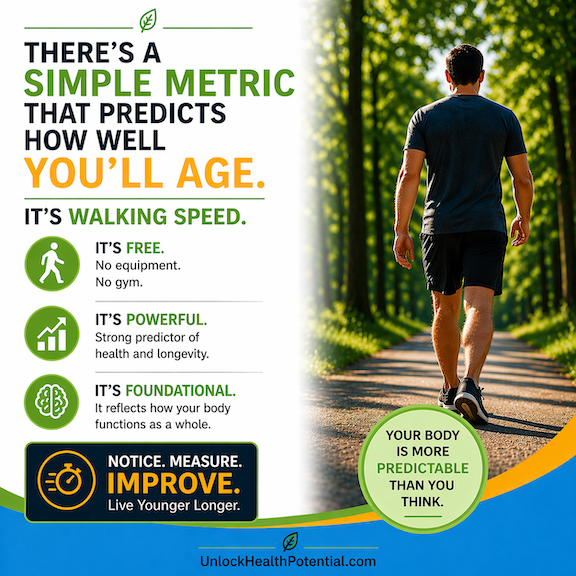
Walking speed responds to being asked. The levers are consistency, occasional pace, lower-body strength, and interrupting long sitting — none of which require a gym or a program.
The harder questions are how much of each, how often, and how you would know it was working.
Where This Leaves You
Walking speed may be the least impressive measurement in longevity science. No machine. No blood draw. No fasting.
It is also among the most honest, because it cannot be performed. You either have the capacity, or you are quietly working around its absence.
Your body has been publishing this figure every day of your adult life. Nobody ever taught us to read it — and that, rather than anything you have done wrong, is why it has gone unread.
So walk often. And once or twice a week, walk like you are late for something that matters.
Which is where an article reaches its limit. How much, and how often, depends on where you are starting from — so in the book each signal’s practice section is tiered against your score, because rebuilding from a low result and protecting a strong one are genuinely different jobs. Score all ten and those tiers resolve into a plan built from your own numbers.
Then keep going — because one signal is not a verdict.
In Part 2 we take up grip strength, a measure that has outperformed blood pressure as a predictor of mortality in some of the largest studies ever conducted, and which belongs to an entirely different system than this one. Whether your first two signals agree with each other turns out to matter more than either number alone.
Your body has been keeping a scorecard. It is time you read it.
Get the Book
Walking speed is Signal 01 of 10.
The Longevity Scorecard — the new book from Ronit Mor, ND and Russell Skinner, MD — gives you a full chapter on each of the ten signals, the research benchmark for every one, and the at-home self-test to measure it.
Then it turns your ten results into a score out of 100, three system totals, and a practice plan matched to what you actually scored — so you finish knowing which system to rebuild first, and exactly what to do about it.
Order The Longevity Scorecard →
Its companion volume, Ancient Biology, Modern Life, restores the ten inputs your body receives. This book measures the ten signals your body sends. Read them in either order.
New to the series? Start with the series overview →
It is not too late. It has never been too late.
FAQs
There are validated benchmarks, and they are more specific than most people expect — but they adjust for age and for sex, so any single universal number would mislead. Research consistently shows that people who maintain a brisk, purposeful pace experience better health outcomes and greater independence, while pace below an established threshold is associated with measurably higher risk of frailty and hospitalization. A useful everyday cue: walk fast enough that you can still hold a conversation but not sing comfortably. For an actual measurement, our book The Longevity Scorecard provides the benchmark bands and a one-minute self-test so you can place yourself accurately instead of guessing.
Not on the basis of a single measurement. Pace varies with fatigue, footwear, mood, joint pain, and the surface you are walking on. One low signal is a data point, not a diagnosis. What carries real information is a pattern — several signals within the same body system drifting together over time. That is precisely what the scorecard is built to reveal, and why we would rather you measure all ten than draw conclusions from one.
Yes. Walking speed is not fixed. It reflects the health of multiple systems — muscles, heart, lungs, brain, nervous system — and every one of those responds to training. Consistent walking, strength work, balance practice, and cardiovascular conditioning all improve walking speed over time, including in people who began late.
Because it is a whole-body performance test disguised as an ordinary activity. Every step requires your brain, heart, muscles, balance, coordination, and energy systems to work together. When those systems function efficiently, pace holds. When one or more begins to decline, pace slows — often years before more obvious symptoms appear.
Every eight to twelve weeks. Walking speed responds to training, but not overnight, and testing too frequently produces noise rather than trend. The number that matters is the direction of travel.
They are different things. Walking speed is not a replacement for exercise — it is a reflection of the fitness that exercise builds. Encouragingly, most of the habits that improve longevity broadly, such as walking regularly, strength training, sleeping well, and staying active, tend to improve walking speed as a side effect.
This content is for educational purposes only and is not intended as medical advice.
Scientific References
Studenski S, Perera S, Patel K, et al. Gait speed and survival in older adults. JAMA. 2011;305(1):50-58.
Middleton A, Fritz SL, Lusardi M. Walking speed: the functional vital sign. J Aging Phys Act. 2015;23(2):314-322.
Fritz S, Lusardi M. White paper: “Walking Speed: the Sixth Vital Sign.” J Geriatr Phys Ther. 2009;32(2):46-49.
Abellan van Kan G, Rolland Y, Andrieu S, et al. Gait speed at usual pace as a predictor of adverse outcomes in community-dwelling older people. J Nutr Health Aging. 2009;13(10):881-889.
Skillbäck T, Blennow K, Zetterberg H, et al. Slowing gait speed precedes cognitive decline by several years. Alzheimers Dement. 2022;18(9):1667-1676.
Erickson KI, Voss MW, Prakash RS, et al. Exercise training increases size of hippocampus and improves memory. Proc Natl Acad Sci U S A. 2011;108(7):3017-3022.
World Health Organization. WHO Guidelines on Physical Activity and Sedentary Behaviour. Geneva: WHO; 2020.