
The Hidden Biology of Everyday Life
INPUT 06 · Bare Feet · Question it answers: What is the world actually like? · What it restores: The high-resolution report on the ground your brain has been waiting for, and has largely stopped receiving.
Input 6 of 10 in Ancient Biology, Modern Life.
Consider what you’re standing on.
Not the floor — the instrument. Each of your feet holds twenty-six bones, thirty-three joints, and more than a hundred muscles, tendons, and ligaments, wrapped in a sole so densely wired that anatomists have spent careers mapping it.
We put this into a shoe every morning and treat it as a means of getting somewhere.
The trial worth knowing arrived recently. Researchers randomized 65 adults over the age of 65 — all screened as carrying a real risk of falling — either to a gradual, progressive schedule of minimal footwear, or to a sham program of seated exercises.
After a year, the footwear group had improved on a standard clinical balance test by about 2.6 points relative to the control group, which didn’t improve at all. Roughly a quarter reached the threshold considered a clinically meaningful gain.
Nothing about those people got stronger in any way a gym would recognize. What changed was how much their feet could feel.
Your Sole Is Not Skin. It’s an Antenna.
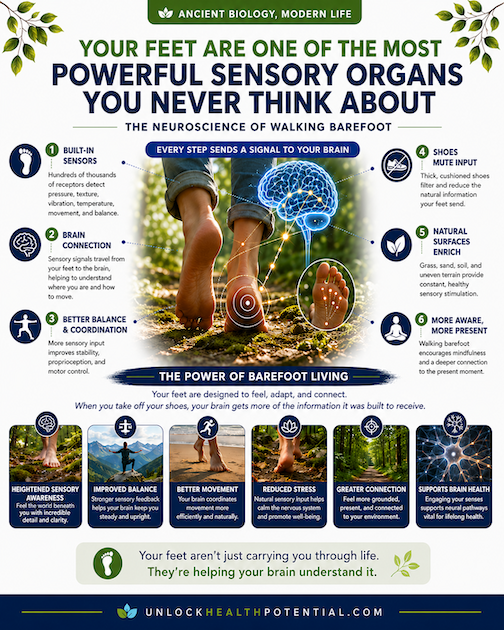
The sole of your foot is covered in glabrous skin — the same hairless, high-resolution tissue found on your palms and lips, which the body reserves for its most exquisite work.
Beneath it sit four families of mechanoreceptors, each built for a different question. Merkel cells register steady pressure and tell you where your weight sits. Meissner corpuscles catch slip and flutter, the instant a surface begins to give way. Ruffini endings read stretch across the skin as your arch loads and releases. Pacinian corpuscles detect vibration so faint it borders on the theoretical.
Together they generate a continuous stream of signal that travels up your legs, through the spinal cord, and into a brain that is waiting for it.
Neuroscientists call this proprioception: your sense of where your body is and what it’s doing, running quietly beneath conscious thought. It’s why you can cross a dark hallway without falling — and why one unexpected step off a curb makes your whole body react before you’ve registered anything at all.
A Cushioned Sole Is a Filter
Some claims about barefoot walking have outpaced the evidence. We’d rather stay where the science is solid, because the well-established story is remarkable enough.
Foam and rubber are engineered to absorb. That’s their purpose, and for concrete, gravel, and long days on hard floors it’s a genuine gift.
But absorption is indiscriminate. The same material that spares your joints also softens the fine-grained information your brain uses to calibrate balance. Dull the input, and the nervous system adjusts its output accordingly — which researchers have demonstrated directly by reducing plantar sensation and watching postural responses change with the muscles untouched.
Step onto grass and the filter lifts. Suddenly the ground has grain. Damp soil reads differently from dry. Sand shifts under the ball of the foot and your ankle answers before you’ve thought about it.
There’s more evidence than we have room for here, including a six-month study of what happens to the muscles of the foot itself. The chapter covers it, along with which claims in this area we think are overstated.
So How Much Do You Actually Need?
Here we have to be straight with you: there’s no simple dose, and inventing one would be worse than useless.
What matters is the progression — and the trial above is the clue. Those results came from a gradual, progressive schedule, not from taking your shoes off and hoping. Feet supported for decades can’t be handed decades of missed work in an afternoon. Tissue tolerance, surface order, and telling the difference between useful novelty and early injury are the whole game.
Those figures live in the book, and there’s a reason beyond selling copies.
Bare feet on their own is a data point — real, but narrow. Read against the other nine inputs it becomes a pattern. Read within its own question it becomes a direction: bare feet missing alone, among nine healthy inputs, is a different situation entirely from bare feet missing alongside scent and the living world, all three answering the same question badly at once.
And read whatever you find as feedback rather than a grade. Spending your life in shoes doesn’t mean something is wrong with you — it means one channel has been muffled, and the receptors on the other end of it are entirely intact.
Where This Input Sits in the Pattern
Ten inputs, and their value is structural rather than numerical. They answer four questions your biology asks continuously, beneath any awareness of yours: Is it safe here? Can I survive here? What is the world actually like? How big am I in this?
Bare feet belongs to the third, alongside scent and the living world. All three report on contact: what’s touching you, what’s in the air, what’s quietly teaching your immune system what belongs.
Which is worth noticing, because those three are also the ones we’ve insulated ourselves from most thoroughly. Sight and sound still reach us indoors. Contact does not. A person can spend an entire day surrounded by a rich environment while touching almost none of it.
What Actually Restores It
The levers are simple and cheap. Start on ground you know — grass, dry sand, packed soil — and scan it for glass and sharp stones first. Go slowly on purpose, because the point isn’t the walk but the noticing: temperature, give, the roll of weight from heel to toe. Rotate surfaces, since a different surface is a different stimulus. And stand on one foot near a wall or counter, which is proprioception training in its simplest form.
The harder questions are how to build tolerance without hurting yourself, which surfaces to introduce in which order, and how long any of it should take.
An important caution. If you live with diabetes, peripheral neuropathy, reduced sensation, poor circulation, or a foot wound, barefoot walking carries real risk of injuries you will not feel. Please talk with your physician about what’s appropriate for you. Protecting your feet comes first — always.
Where This Leaves You
Nothing here was lost. The receptors are still in your feet, wired to a brain still prepared to read them. This input wasn’t damaged — it was covered up, and it can be uncovered in an afternoon.
Most things worth restoring have to be rebuilt. This one only has to be asked for.
Which is where an article stops being useful. How fast to progress, and on what surfaces, depends on feet that have been doing very little for a long time — so in the book each input’s practice is worked against that, and against the other nine, because several of these arrive in the same act rather than as ten separate obligations.
Then keep going, because one input is never the whole picture.
In Part 7 we stay with contact and move to the air: the one sense that skips the queue on its way to your emotions, and a study involving mice with no cultural opinions whatsoever about lavender.
Your biology never stopped asking. It is time you answered.
New to this blog series? Start with the series overview →
Get the Book
Ancient Biology, Modern Life — the new book from Ronit Mor, ND and Russell Skinner, MD — gives you a full chapter on each of the ten inputs, the research behind every one, and simple steps for restoring it. Then it shows you how the ten fit together — which arrive in the same act, in what order, and which of your four questions has gone unanswered longest — so you finish with roughly fifteen minutes a day built around your own life.
This is Book Two in the Live Younger Longer series — short books you can finish in an afternoon, each focused on the small changes that make the biggest difference to how you age. Its companion volume, The Longevity Scorecard, measures the ten signals your body sends outward. This book restores the ten inputs your body receives. Read them in either order.
FAQs
Walking barefoot increases the sensory information traveling from your feet to your brain, which supports balance, coordination, spatial awareness, and proprioception. Because that input pulls attention toward the present moment, many people also find it steadying and mentally clarifying.
Remarkably. The sole is covered in glabrous skin — the same high-resolution tissue as your palms and lips — over four distinct families of mechanoreceptors that read pressure, slip, stretch, and vibration. It is among the most information-rich surfaces on the human body.
Research suggests clearer sensory feedback from the feet helps the brain make more accurate postural adjustments, and that reducing that feedback measurably alters postural responses. Improving the input is one practical way to support stability, particularly as we age — though how you build up to it matters more than most people expect.
No. If you have diabetes, neuropathy, reduced foot sensation, circulation problems, or an open wound, barefoot walking can lead to injuries you may not feel. Speak with your healthcare provider first.
This content is for educational purposes only and is not intended as medical advice.
Scientific References
Futrell EE, Chevan J. Minimal footwear and fall risk in older adults: a randomized controlled trial. Gerontology. 2026 (in press).
Meyer PF, Oddsson LIE, De Luca CJ. Reduced plantar sensitivity alters postural responses to lateral perturbations of balance. Exp Brain Res. 2004;157(4):526-536.
Curtis R, Willems C, Paoletti P, D’Août K. Daily activity in minimal footwear increases foot strength. Sci Rep. 2021;11:18648.
Kennedy PM, Inglis JT. Distribution and behaviour of glabrous cutaneous receptors in the human foot sole. J Physiol. 2002;538(Pt 3):995-1002.
Nurse MA, Nigg BM. The effect of changes in foot sensation on plantar pressure and muscle activity. Clin Biomech. 2001;16(9):719-727.
Proske U, Gandevia SC. The proprioceptive senses: their roles in signaling body shape, body position and movement. Physiol Rev. 2012;92(4):1651-1697.