

The Hidden Biology of Everyday Life
INPUT 07 · Scent · Question it answers: What is the world actually like? · What it restores: The fastest route the outside world has into your emotional brain — and the one modern life has most thoroughly closed.
Input 7 of 10 in Ancient Biology, Modern Life.
If lavender calms people only because of what it has meant in their lives — a grandmother’s linen cupboard, twenty years of spa marketing — then it should do nothing at all in an animal that has encountered none of that.
In 2018, researchers at Kagoshima University tested it. Mice exposed to linalool, a terpene alcohol in lavender, showed clear anxiety-reducing effects without sedation.
Then two steps that make it decisive.
They repeated it in anosmic mice, whose sense of smell had been eliminated. The effect vanished entirely — ruling out linalool being absorbed through the lungs and acting as a drug. The molecule had to be smelled.
Then they pre-treated mice with flumazenil, which blocks the benzodiazepine site on GABA-A receptors — the system anti-anxiety medications act on. The calming effect was abolished.
A real odor, a real behavioral change, running through the olfactory system and depending on a well-characterized receptor — in animals with no marketing exposure and no grandmother. Whatever else is true, that cannot be explained by learned association.
The Sense That Skips the Queue
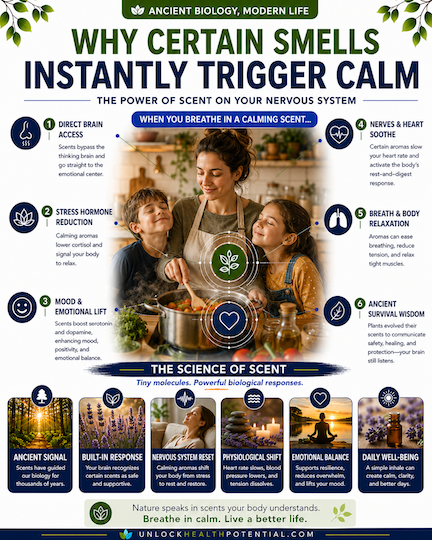
Here’s the structural fact that makes smell different from every other sense you have.
When light hits your retina or sound reaches your ear, the signal is relayed through the thalamus — a switching station that sorts and forwards before most of it reaches the regions that generate feeling. You see something; several steps later you feel about it.
Olfaction has unusually direct access: signals from the olfactory bulb reach the amygdala and neighboring structures without that obligatory relay.
The consequence is something you’ve experienced without knowing why: a smell can produce a full emotional response before you’ve identified it. You’re already feeling something — often with a place and a person attached — while still reaching for the word.
Does Aromatherapy Actually Work?
The mouse work settles one argument. The human evidence answers another.
A 2019 review pooled twenty-two randomized trials of lavender aromatherapy. Self-rated anxiety improved with a pooled effect size of −0.65, medium to large by conventional standards. Heart rate and salivary cortisol fell, with no adverse effects reported. This is not a null literature.
Where it’s weak: you cannot blind a participant to a smell. Everyone in a lavender trial knows what they’re receiving, so expectation does some of the work and nobody can say how much. Trial quality is uneven. And the specificity claims — this oil for focus, that one for grief — have far less support than the general finding.
So two things are true at once: certain odors have real pharmacological effects, and learned association is also powerful — which is why the same scent calms one person and unsettles another.
There’s a further line of research we don’t have room for — including a study in which overnight scent exposure did something measurable to memory in older adults.
So How Much Do You Actually Need?
Dose is the wrong question here, which is unusual for this series.
A scent isn’t something you accumulate minutes of. What decides whether it does anything for you is pairing — what your nervous system has learned it means — and unlike the pharmacology, that part is directable. A scent that means nothing today can come to mean calm, by the process that made some smell mean grandmother’s kitchen without anyone planning it.
The method has a shape: which scent, used when, for how long before you spend it. Get the sequence wrong — most people do, by reaching for it during stress before the association exists — and you condition it to the thing you were escaping. That sequence lives in the book.
Scent on its own is a data point — real, but narrow. Read against the other nine it becomes a pattern. Read within its own question it becomes a direction: scent missing alone is a different situation entirely from scent missing alongside bare feet and the living world, all three answering the same question badly at once.
And read whatever you find as feedback rather than a grade. Living in a scentless building doesn’t mean something is wrong with you — it means one channel has gone quiet, and it’s the easiest of the ten to reopen yourself.
Where This Input Sits in the Pattern
Ten inputs, and none is meant to be read alone. They answer four questions your biology asks about wherever it is: Is it safe here? Can I survive here? What is the world actually like? How big am I in this?
Scent belongs to the third, alongside bare feet and the living world — the three contact inputs, reporting on what is actually here rather than what can be seen from a distance.
Among those three, scent is the fast one. Bare feet report ground you already stand on; the living world works over years. Scent arrives before you’ve identified it, from something that hasn’t yet reached you.
What Actually Restores It
The levers are cheap and mostly a matter of noticing. Choose one scent and give it a job. Pair it while you’re already calm, not during stress. Add one slow breath — the scent is the cue, the breath is the physiology. And protect the associations you already own, which most people walk straight past.
The harder questions are which scent, for how long before you spend it, and in what order — because the sequence is where this either works or quietly conditions itself to the wrong thing.
Two things that need saying plainly. A persistent change in your sense of smell is a medical question, not an inconvenience. Reduced smell has been linked to meaningful health outcomes — including one study in which olfactory dysfunction predicted mortality in older adults over five years — and it’s a well-documented early feature of Parkinson’s and Alzheimer’s. Raise it with your physician rather than waiting.
And essential oils are concentrated plant chemistry. Don’t apply them undiluted to skin or ingest them without qualified guidance — the oral lavender preparation studied in trials is a standardized pharmaceutical, not a shop-shelf bottle. Some citrus oils are phototoxic on sun-exposed skin. Diffused oils can trigger symptoms in asthma and reactive airways, and several common oils, including tea tree and eucalyptus, are toxic to cats and dogs. If you’re pregnant, breastfeeding, or managing a respiratory condition, check with your physician first. Ventilate, use small amounts, stop if anything feels wrong.
Where This Leaves You
Most inputs in this series have to be gone and found. This one can be built on a kitchen counter — and the two or three scents you already find comforting are proof it works, because you built none of them on purpose.
Which is roughly where an article runs out. Doing deliberately what previously happened by accident is a matter of order and timing — so in the book each input’s practice is worked against that, and against the other nine, because several of these arrive in the same act rather than as ten separate obligations.
Then keep going, because one input is never the whole picture.
In Part 8 we finish the third question with the living world — the one organ that arrives unfinished on purpose, and two farming communities whose children turned out to have very different immune systems.
Your biology never stopped asking. It is time you answered.
New to this blog series? Start with the series overview →
Get the Book
Ancient Biology, Modern Life — the new book from Ronit Mor, ND and Russell Skinner, MD — gives you a full chapter on each of the ten inputs, the research behind every one, and simple steps for restoring it. Then it shows you how the ten fit together — which arrive in the same act, in what order, and which of your four questions has gone unanswered longest — so you finish with roughly fifteen minutes a day built around your own life.
This is Book Two in the Live Younger Longer series — short books you can finish in an afternoon, each focused on the small changes that make the biggest difference to how you age. Its companion volume, The Longevity Scorecard, measures the ten signals your body sends outward. This book restores the ten inputs your body receives. Read them in either order.
FAQs
Because of unusually direct wiring. Signals from the olfactory system reach emotion- and memory-related structures — including the amygdala and entorhinal area — without the same relay that other senses pass through. This is why a scent can produce a full emotional response before you have consciously identified what you are smelling.
Yes, within limits — and the evidence is better than skeptics often allow. A meta-analysis of twenty-two randomized trials found lavender aromatherapy reduced self-rated anxiety with a medium-to-large pooled effect, alongside reductions in heart rate and salivary cortisol, with no adverse effects reported. What remains uncertain is the magnitude in ordinary daily use, largely because blinding participants to a smell is close to impossible.
No, and there is a clean piece of evidence against that. Mice exposed to linalool showed clear anxiety-reducing effects. The effect disappeared in mice without a sense of smell, and was blocked by a compound that blocks the benzodiazepine site on GABA-A receptors. Mice have no cultural associations with lavender. That said, learned association is also real and powerful in humans, and explains why the same scent affects different people differently.
There is meaningful evidence, with an important distinction. Inhaled lavender has shown pooled anxiolytic effects across randomized trials, though those trials vary in quality. Separately, a standardized oral lavender oil preparation has been studied as a pharmaceutical in placebo-controlled trials, with meta-analyses supporting efficacy in subthreshold and generalized anxiety. These are different interventions, and evidence for one should not be presented as evidence for the other.
No. The effect sizes come largely from short-term anxiety in procedural settings — a dental appointment, a pre-operative wait — not from managing a diagnosed condition over time. Scent is a reasonable support alongside proper care. If anxiety, low mood, or sleep problems are persistent, please speak with a qualified professional.
It warrants medical attention rather than waiting. Reduced smell has been associated with meaningful health outcomes, including one study in which olfactory dysfunction predicted mortality in older adults over five years. Loss of smell is also a well-documented early feature of Parkinson’s and Alzheimer’s disease, sometimes appearing years before other symptoms. Post-viral loss is common and can improve with structured olfactory training.
This content is for educational purposes only and is not intended as medical advice.
Scientific References
Harada H, Kashiwadani H, Kanmura Y, Kuwaki T. Linalool odor-induced anxiolytic effects in mice. Front Behav Neurosci. 2018;12:241.
Kang HJ, Nam ES, Lee Y, Kim M. How strong is the evidence for the anxiolytic efficacy of lavender? Systematic review and meta-analysis of randomized controlled trials. Asian Nurs Res. 2019;13(5):295-305.
Woo CC, Miranda B, Sathishkumar M, et al. Overnight olfactory enrichment using an odorant diffuser improves memory and modifies the uncinate fasciculus in older adults. Front Neurosci. 2023;17:1200448.
Herz RS. Aromatherapy facts and fictions: a scientific analysis of olfactory effects on mood, physiology and behavior. Int J Neurosci. 2009;119(2):263-290.
Willander J, Larsson M. Smell your way back to childhood: autobiographical odor memory. Psychon Bull Rev. 2006;13(2):240-244.
Pinto JM, Wroblewski KE, Kern DW, Schumm LP, McClintock MK. Olfactory dysfunction predicts 5-year mortality in older adults. PLoS One. 2014;9(10):e107541.