The Hidden Biology of Everyday Life
INPUT 03 · Looking Into the Distance · Question it answers: Is it safe here? · What it restores: The sightline your eye was built to hold — and the one position from which you can see what is coming.
Input 3 of 10 in Ancient Biology, Modern Life.
Your eye has a resting position, and it is not this page.
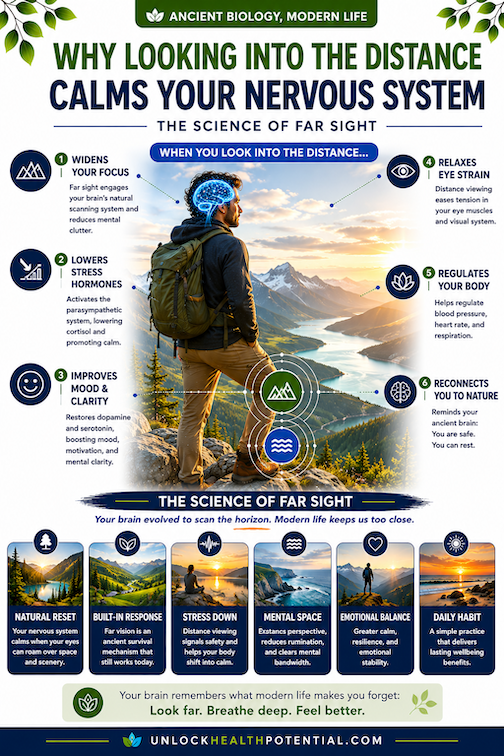
Inside each eye sits a ring of muscle wrapped around the lens. When it relaxes, the lens flattens and your eye focuses far away. When it contracts, your eye focuses close.
Read that again, because the direction surprises almost everyone. Distance is the relaxed state. Near focus is the effort.
The eye you were issued has a default, and the default is the horizon. Everything closer is a muscle holding a contraction.
Now consider the last ten hours of your life. A screen at arm’s length. A phone at twelve inches. A dashboard, a countertop. For most people that muscle contracts shortly after waking and doesn’t fully release until the lights go out.
The Trial That Changed the Question
For years the assumed culprit behind rising nearsightedness was near work itself — too much reading, too much close focus. Intuitive, and largely wrong.
In a randomized trial in China, researchers added a daily period of outdoor time to the school day and followed children for three years. The intervention group developed significantly less new myopia than schools that changed nothing.
Then the detail that reframes it. Observational work in Australia had already found that children who spent more time outdoors had substantially lower rates of myopia — regardless of how much near work they did.
The protective factor was not less reading. It was more outdoors.
Researchers are still working out why, with bright outdoor light the leading candidate. There’s more evidence than we have room for — a second trial using outdoor recess, and a large review of the whole picture. The chapter covers where the weight of it settles.
Three Miles, or Thirteen Feet
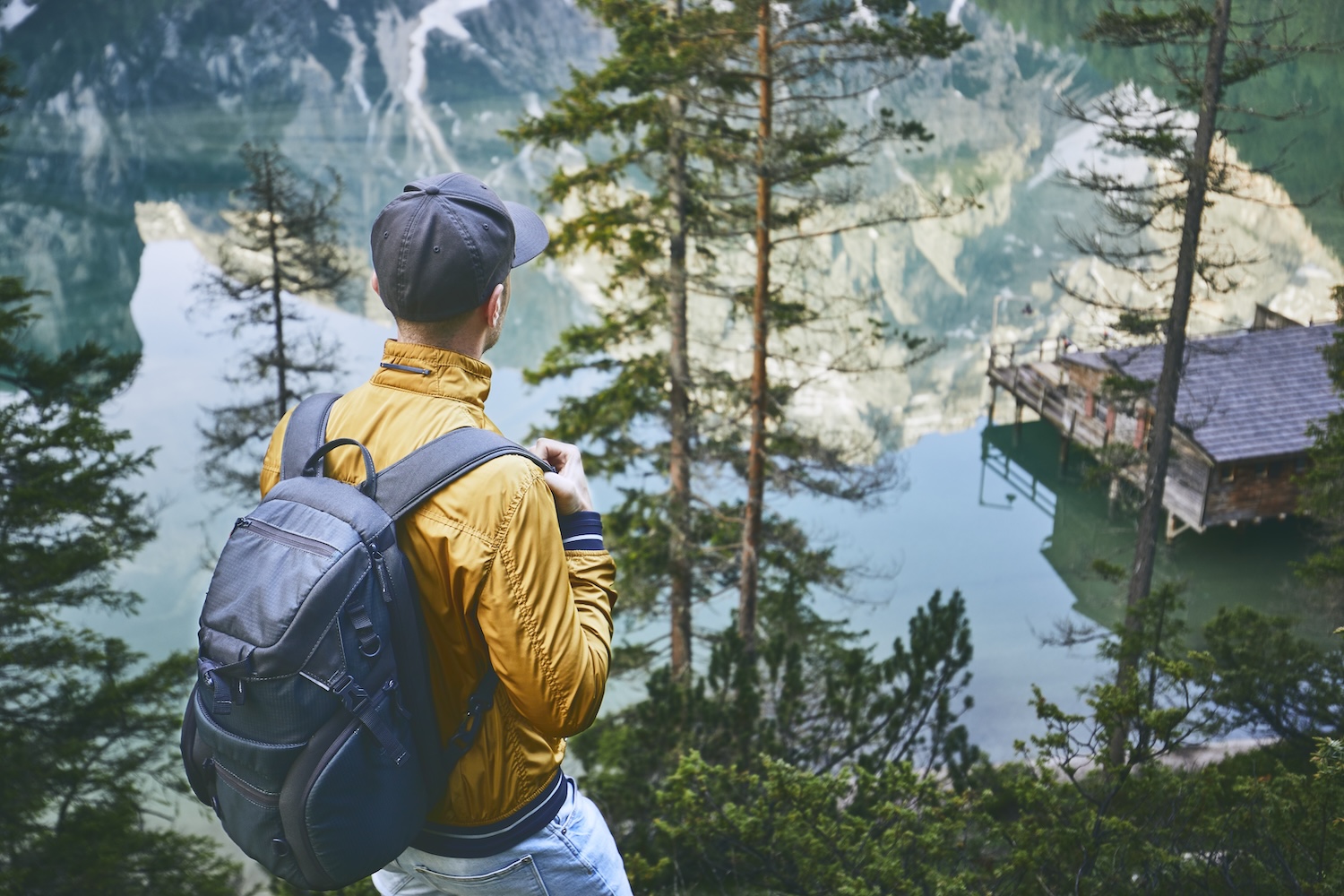
Stand on flat open ground at average adult height and the horizon sits roughly three miles away — a distance the eye visited constantly for most of human history, scanning a plain, watching weather build, tracking movement at the edge of the visible.
The modern equivalent, for a great many people, is a wall thirteen feet away.
There’s no villain in this story. Screens gave us work, connection, and medicine; buildings gave us shelter. None of it was designed to constrain our vision, and all of it succeeded at what it was for. But the muscle inside your eye is now holding a contraction it was never asked to hold this long.
And there’s a second, older story here, with softer evidence. We’ll mark the difference clearly.
In 1975, geographer Jay Appleton proposed that landscape preference follows a logic he called prospect and refuge: we’re drawn to places offering both a long view outward and cover at our backs. Once named it’s hard to unsee — the hilltop house, the window seat, the corner booth with your back to the wall that almost everyone prefers and almost nobody can explain.
How strong is the evidence? Mixed, and we wouldn’t claim more. A review found partial support: preference for open views is fairly consistently observed, while the refuge component has produced less reliable results.
Better established is the inverse. Psychologists have documented since the 1950s that heightened arousal narrows the cues a person attends to — under threat, the visual field of attention constricts toward the immediate. Whether it runs both ways is plausible and actively researched rather than proven.
So How Much Do You Actually Need?
You’ve probably met the answer without being told why it works.
The 20-20-20 rule — every twenty minutes of near work, look at something at least twenty feet away for twenty seconds — isn’t folk wisdom. Twenty feet is roughly where the focusing muscle can substantially release, and twenty seconds is long enough for it to do so. A muscle-recovery interval, and the cheapest intervention in this series.
Knowing it and executing it are famously different problems, and that gap is where the book lives — along with the worked figures for children, the strongest evidence-backed recommendation in the chapter.
Distance on its own is a data point — real, but narrow. Read against the other nine inputs it becomes a pattern. Read within its own question it becomes a direction: distance missing alone, among nine healthy inputs, is a different situation entirely from distance missing alongside morning light and birdsong, all three answering the same question badly at once.
And read whatever you find as feedback rather than a grade. Spending your days in a narrow band of focus doesn’t mean something is wrong with you — it means the room you work in was designed for something other than your eyes.
Where This Input Sits in the Pattern
Distance is one of ten. What makes the set useful isn’t the number but the shape — all ten answer only four questions, asked without consulting you: Is it safe here? Can I survive here? What is the world actually like? How big am I in this?
Distance belongs to the first, alongside morning light and birdsong — and its contrast with birdsong is the sharpest in the series.
Birdsong is a report on what you cannot see: something is singing beyond your sightline, therefore nothing is hunting there. Distance is the sightline itself — the ability to check for yourself, without anyone’s account of it.
One is intelligence, the other line of sight. A nervous system deprived of both is working from nothing.
What Actually Restores It
The levers are almost embarrassingly cheap. Interrupt near work with something far away, on a timer, because nobody remembers unprompted. Claim the longest sightline when you choose a desk. Look up — sky is free distance, and a city with no horizon still has one overhead. And for children, prioritize outdoor time, which doesn’t need to be sport and does need to be outside.
The harder questions are how to build the interval so it survives a working day without willpower, and how to find genuine depth in a city that appears to have none.
One clinical note. Persistent eye strain, headaches, blurred vision, or any noticeable change in how well you see at any distance deserves an eye examination rather than a habit change. The practices here support healthy eyes; they don’t correct refractive error and aren’t a treatment for any eye condition. If you’re experiencing symptoms, please see an optometrist or ophthalmologist.
Where This Leaves You
Of the ten inputs in this series, this is the only one you can act on without leaving your chair. No equipment, no travel. The farthest thing visible from where you’re sitting is enough to start, and twenty seconds is the entire ask.
Which is the point an article runs out. Whether a habit costing twenty seconds survives a Tuesday depends on how it is built — so in the book each input’s practice is worked against that, and against the other nine, because several of these arrive in the same act rather than as ten separate obligations.
Then keep going, because one input is never the whole picture.
In Part 4 we leave the safety question and take up water — why almost everyone stops at the edge of the sea, and what ninety minutes beside a river did to a brain region implicated in brooding.
Your biology never stopped asking. It is time you answered.
New to this blog series? Start with the series overview →
Get the Book
Ancient Biology, Modern Life — the new book from Ronit Mor, ND and Russell Skinner, MD — gives you a full chapter on each of the ten inputs, the research behind every one, and simple steps for restoring it. Then it shows you how the ten fit together — which arrive in the same act, in what order, and which of your four questions has gone unanswered longest — so you finish with roughly fifteen minutes a day built around your own life.
This is Book Two in the Live Younger Longer series — short books you can finish in an afternoon, each focused on the small changes that make the biggest difference to how you age. Its companion volume, The Longevity Scorecard, measures the ten signals your body sends outward. This book restores the ten inputs your body receives. Read them in either order.
FAQs
Yes, and the mechanism is straightforward. Focusing on near objects requires sustained contraction of the ciliary muscle inside the eye; focusing at distance allows it to relax. The widely recommended 20-20-20 rule exists specifically to give that muscle regular recovery intervals during prolonged near work.
A guideline for reducing digital eye strain: every 20 minutes of near work, look at something at least 20 feet away for at least 20 seconds. Twenty feet is approximately the distance at which the eye’s focusing muscle can substantially release, and twenty seconds allows time for it to do so.
The evidence here is unusually strong for this field. Randomized trials adding daily outdoor time to the school day found reduced incidence of new myopia compared with schools that made no change, and observational research found lower myopia rates among children who spend more time outdoors regardless of how much near work they do. Bright outdoor light is the leading proposed mechanism.
A hypothesis from geographer Jay Appleton proposing that people prefer environments offering both a long view outward and protective cover at their back — the reason a corner booth feels more settling than an exposed or enclosed position. Empirical support is partial: preference for open views is fairly consistently observed, while evidence for the refuge component is more mixed.
A window view is genuinely better than a wall, and research on hospital patients found meaningful differences associated with what a window looked onto. But glass substantially reduces light intensity, so if the protective outdoor effect is driven by bright light — currently the leading hypothesis — being outdoors is the stronger version.
A common preference, consistent with the prospect-refuge idea: a position offering visibility of the space while limiting what can approach unseen. The theory has partial rather than conclusive support, but the preference itself is widely reported, and there is no cost to arranging a room the way it suits you.
This content is for educational purposes only and is not intended as medical advice.
Scientific References
He M, Xiang F, Zeng Y, et al. Effect of time spent outdoors at school on the development of myopia among children in China: a randomized clinical trial. JAMA. 2015;314(11):1142-1148.
Rose KA, Morgan IG, Ip J, et al. Outdoor activity reduces the prevalence of myopia in children. Ophthalmology. 2008;115(8):1279-1285.
Wu PC, Tsai CL, Wu HL, Yang YH, Kuo HK. Outdoor activity during class recess reduces myopia onset and progression in school children. Ophthalmology. 2013;120(5):1080-1085.
Morgan IG, Ohno-Matsui K, Saw SM. Myopia. Lancet. 2012;379(9827):1739-1748.
Appleton J. The Experience of Landscape. London: John Wiley & Sons; 1975.
Dosen AS, Ostwald MJ. Evidence for prospect-refuge theory: a meta-analysis of the findings of environmental preference research. City, Territory and Architecture. 2016;3:4.
Ulrich RS. View through a window may influence recovery from surgery. Science. 1984;224(4647):420-421.
Sheppard AL, Wolffsohn JS. Digital eye strain: prevalence, measurement and amelioration. BMJ Open Ophthalmol. 2018;3(1):e000146.