
The Hidden Biology of Everyday Life
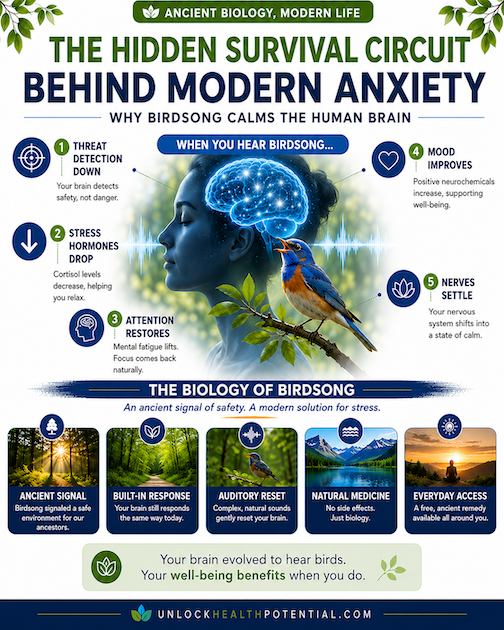
INPUT 02 · Birdsong · Question it answers: Is it safe here? · What it restores: A continuous, ambient report that nothing in the immediate area is hunting.
Input 2 of 10 in Ancient Biology, Modern Life.
None of it is for you.
The blackbird outside your window at five in the morning isn’t offering you anything. It’s making a territorial claim, or advertising for a mate, or telling a rival where the boundary lies. The dawn chorus is a negotiation among birds, in a language addressed entirely to other birds.
You are eavesdropping. You have always been eavesdropping.
In 2022, researchers at the Max Planck Institute for Human Development put that to the test with nearly three hundred participants. One group heard six minutes of birdsong. Another heard six minutes of traffic noise.
The birdsong condition produced measurable reductions in anxiety and in paranoid thinking. The traffic condition worsened depressive symptoms.
Six minutes. A recording, through headphones, indoors.
And the detail that makes it interesting: the benefit showed up in people living in dense cities, whose lives contain almost no birdsong at all. The signal didn’t need to be familiar. The circuit was already there, waiting.
The Oldest Alarm System We Never Built
Birds are superb sentinels, and not altruistic about it. They watch for predators because their own lives depend on it — and when a hawk crosses the treeline, the singing changes. Song gives way to alarm calls, or to silence.
Any animal sharing that landscape gets the information free. It’s why a deer lifts its head when the woods go quiet, and why a sudden hush raises the hair on your arms before you’ve noticed anything at all.
Something is singing. Which means nothing is hunting.
We should be careful here — evolutionary reasoning is easy to tell and hard to test, and this remains a well-reasoned hypothesis rather than a settled finding. But it makes a checkable prediction: if the circuit is real, it should still be running in people who’ve never spent a night in a forest.
There’s a second study we don’t have room for — one that abandoned the laboratory entirely and went looking for the same effect in ordinary days, out in the world. The chapter covers what it found.
Why This Particular Sound
Much of birdsong falls between roughly 1,000 and 8,000 Hz, overlapping the band where human hearing is most acute. We’re built to hear it clearly.
But frequency is only part of it. Consider the shape.
Birdsong is intermittent, gently varied, and structured without being repetitive. It arrives in short phrases with quiet between them. It never builds, never demands, never resolves into a message you have to decode. It has none of the properties that make a sound alerting: no sudden onset, no rising urgency.
Now compare the soundscape most of us inhabit. Traffic. HVAC drone. Notification tones — sounds engineered to capture attention, which is to say engineered to interrupt. A phone alert is designed to defeat the very filtering system that lets birdsong wash past unexamined.
A quiet room isn’t the same as a safe-sounding room. Silence tells the nervous system nothing, and absence of threat is not evidence of safety. A vigilance system with no incoming reassurance simply keeps scanning.
So How Much Do You Actually Need?
Less than you’d expect, and the research is unusually clear about it.
There are worked figures here — how long, how often, and whether recorded sound behaves like the real thing, which turns out to be a more interesting question than it sounds. There’s also a volume rule that matters more than most people realize.
Those figures live in the book, and there’s a reason for that beyond selling copies.
Birdsong on its own is a data point — real, but narrow. Read against the other nine inputs, it becomes a pattern. Read within its own question, it becomes a direction: birdsong missing alone, among nine healthy inputs, is a different situation entirely from birdsong missing alongside morning light and distance, all three answering the same question badly at once.
The first is worth fixing. The second tells you why your nervous system has been half-armed for a year.
And read whatever you find as feedback rather than a grade. Living somewhere without birdsong doesn’t mean something is wrong with you — it means your environment is quietly withholding something cheap to restore.
Where This Input Sits in the Pattern
There are ten of these inputs, and they don’t sit in a row. They sort into four questions your body keeps asking about wherever it is: Is it safe here? Can I survive here? What is the world actually like? How big am I in this?
Birdsong belongs to the first, alongside morning light and the long view into the distance. Three inputs, one question — and birdsong is the odd one among them.
Light and distance are both first-hand. Your own eyes, reading the world directly. Birdsong is second-hand: you aren’t sensing the environment at all. You’re reading another species’ continuously updated assessment of it.
It’s the only input in the ten that outsources the surveillance — which is why it’s so cheap, and why losing it is so easy to miss.
What Actually Restores It
The levers are simple. Open a window at dawn, when birds sing most and still air carries sound farthest. Take the walking route with trees in it. Use a recording when the real thing isn’t available, at a volume that sits in the background rather than replacing it. And audit what you’ve made unmuteable — every non-essential notification is a designed interruption to a system already running hot.
The harder questions are how long, how often, whether recordings genuinely substitute for the real thing, and when to use this at all — because deploying it after stress and supplying it as a background condition are two different interventions that people routinely confuse.
One honest note. Birdsong is a support, not a treatment. If anxiety is persistent, or interfering with your work, your sleep, or your relationships, it deserves proper evaluation and care — and there are effective options. Please talk with a qualified professional. Everything here can sit comfortably alongside that. None of it is a substitute for it.
Where This Leaves You
The most encouraging finding in this literature is the one about city dwellers. The people who benefited had almost no regular exposure to birdsong — they hadn’t trained for it, didn’t know the species, couldn’t have named what they were hearing.
The circuit worked anyway, on first contact. You aren’t building a capacity here. You’re feeding one that’s been idling.
That is about as far as an article carries you. How much, how often, and when to spend it depends on what your week looks like — so in the book each input’s practice is worked against that, and against the other nine, because several of these arrive in the same act rather than as ten separate obligations.
Then keep going, because one input is never the whole picture.
In Part 3 we take up distance — the third of the safety inputs, and the one most people have backwards, because inside your eye looking far away is the resting state and focusing up close is the work. Whether all three of your safety inputs are missing at once matters more than any one of them alone.
Your biology never stopped asking. It is time you answered.
New to this blog series? Start with the series overview →
Get the Book
Ancient Biology, Modern Life — the new book from Ronit Mor, ND and Russell Skinner, MD — gives you a full chapter on each of the ten inputs, the research behind every one, and simple steps for restoring it. Then it shows you how the ten fit together — which arrive in the same act, in what order, and which of your four questions has gone unanswered longest — so you finish with roughly fifteen minutes a day built around your own life.
This is Book Two in the Live Younger Longer series — short books you can finish in an afternoon, each focused on the small changes that make the biggest difference to how you age. Its companion volume, The Longevity Scorecard, measures the ten signals your body sends outward. This book restores the ten inputs your body receives. Read them in either order.
FAQs
It is not a treatment for an anxiety disorder, and we would not present it as one. But in controlled research, six minutes of birdsong produced measurable reductions in anxiety and paranoid thinking — likely because the brain reads it as a signal of environmental safety. Think of it as one useful input among many, not a solution on its own.
Both show benefit. Being outdoors is richer, because it engages sight, movement, air, and light at the same time. But the studies showing the clearest effects used recordings through headphones — which means this is genuinely available to you at a desk, in a city, in winter.
Longer than you might expect. Real-time mood research found that encounters with birdlife were associated with improved wellbeing that persisted for hours afterward, rather than fading as soon as the sound stopped.
Yes, and this is one of the most interesting findings in the literature. The benefit appeared in urban participants with little regular nature exposure. The circuitry does not appear to require practice.
No. Loud sound is a physiological stressor regardless of its content. Keep it at a natural background level — the volume at which you would hear birds through an open window, not the volume at which they replace everything else.
Then it deserves a closer look. Persistent anxiety often has identifiable contributors — sleep disruption, blood sugar instability, thyroid dysfunction, nutrient depletion, chronic inflammation, unresolved stress load. Please speak with a qualified professional rather than waiting it out.
This content is for educational purposes only and is not intended as medical advice.
Scientific References
Stobbe E, Sundermann J, Ascone L, Kühn S. Birdsongs alleviate anxiety and paranoia in healthy participants. Sci Rep. 2022;12:16414.
Hammoud R, Tognin S, Burgess L, et al. Smartphone-based ecological momentary assessment reveals mental health benefits of birdlife. Sci Rep. 2022;12:17589.
Ratcliffe E. Sound and soundscape in restorative natural environments: a narrative literature review. Front Psychol. 2021;12:570563.
Alvarsson JJ, Wiens S, Nilsson ME. Stress recovery during exposure to nature sound and environmental noise. Int J Environ Res Public Health. 2010;7(3):1036-1046.
Buxton RT, McKenna MF, Mennitt D, et al. Noise pollution is pervasive in U.S. protected areas. Science. 2017;356(6337):531-533.