

Longevity -> Measure It. Train It. Extend It.
SIGNAL 10 · Sleep Consistency · System: Nervous · What it measures: Not how long you sleep, but how reliably — whether your body can predict what tomorrow will ask of it.
Signal 10 of 10 in The Longevity Scorecard. This signal completes the set.
Almost everyone knows roughly how much sleep they get.
Very few people know when they get it — and it turns out that is the more revealing question.
Consider an ordinary week. In bed by eleven on weeknights, one o’clock on Saturday. Awake at six-thirty for work, nine on the weekend.
Nothing unusual there. Most people would call it a normal life with a decent sleep-in.
But you have just moved your body clock by around two and a half hours. That is the same displacement as flying from Los Angeles to Chicago. You do it on Friday night, and you fly home on Sunday.
Every week. For years.
Researchers call it social jetlag, and the name is not a metaphor. Your physiology handles it much the way it handles the real thing.
The Finding That Reorders the Priority
In 2024, researchers published an analysis of accelerometer data from around sixty thousand adults in the UK Biobank — actual measured sleep, not self-reported estimates, followed for years.
They compared two things: how long people slept, and how regularly.
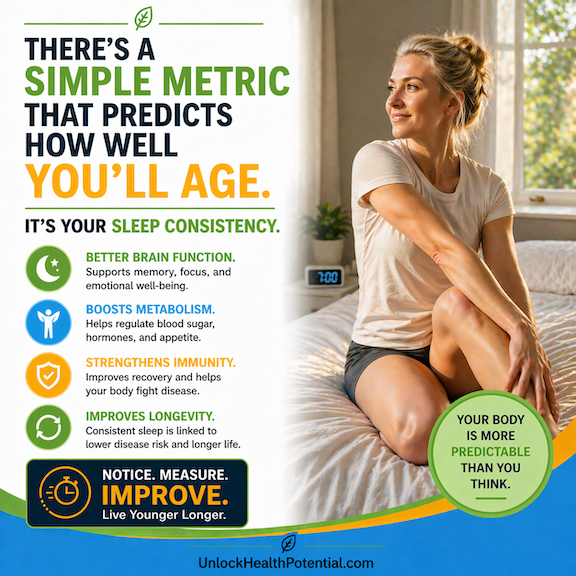
Sleep regularity predicted mortality more strongly than sleep duration did.
That is worth sitting with. Not as well as. More strongly than.
The number that everyone tracks was outperformed by the number almost nobody does.
Earlier work pointed the same way. An analysis from the Multi-Ethnic Study of Atherosclerosis found that people with highly variable sleep timing carried substantially higher cardiovascular risk than those with stable schedules — and critically, that association held after accounting for how much sleep people were getting.
You can get your eight hours and still be paying for it.
Your Body Is Running a Timetable
The reason is that your body does not merely respond to what is happening. It prepares for what is about to.
Your cortisol begins rising before you wake, so that you are ready to be conscious rather than merely conscious. Core body temperature starts falling before sleep, not after it. Insulin sensitivity, digestive activity, blood pressure, alertness, and repair processes all shift on a schedule — pre-positioned for what is expected next.
That entire arrangement rests on one assumption: that tomorrow will resemble today.
Here is what happens when the assumption fails.
A body that cannot predict cannot prepare. And a body that cannot prepare has to react instead — which is always more expensive.
Melatonin is still being cleared when the alarm goes. Cortisol arrives for a morning that started two hours ago. The repair processes that were queued for a particular window find the window has moved.
Nothing here is dramatic. No single instance of it matters.
But it is happening every day, across every tissue, and the cost is not the tiredness people notice. It is the accumulated inefficiency of a system permanently preparing for the wrong thing.
This is also why the familiar symptoms are so hard to attribute. Afternoon flatness. Waking unrefreshed after adequate hours. Being wired at midnight and hollow at ten in the morning. These get treated as separate complaints, and a fair number of them are one problem wearing several costumes.
The Wake Time Is the Anchor
If you change one thing, change this.
Most people trying to fix their sleep start with bedtime, which is the harder end and the less effective one. You cannot decide to fall asleep. You can only create conditions and wait.
But you can decide when to get up — and more importantly, when to meet light.
Morning light is the strongest signal your circadian system receives, and it sets the timing for everything downstream, including when you will feel sleepy that night. Anchor the wake time and get outside reasonably soon after, and bedtime tends to organize itself within a week or two.
Fix the front of the day and the back of it follows. It rarely works the other way round.
So Is There a Number?
Yes — and it is not the number you have been tracking.
The scorecard does not score how long you sleep. It scores how much your sleep timing varies from one night to the next.
Which you can work out this week without buying anything. For seven days, including the weekend, note roughly when you fall asleep and when you wake. The spread between your earliest and latest is your answer.
Most people are surprised. The weekdays look disciplined; it is Friday and Saturday that quietly undo the average — which is exactly why the number is more useful than the impression.
In our book, The Longevity Scorecard, sleep consistency is scored in three bands — Strong, Watch, or Priority — based on that variation. The book covers what to measure, how to handle a genuinely irregular life, and what to do when the variation is not something you chose.
The bands live in the book.
And if your spread is wider than you expected, that is not a discipline problem. For shift workers, new parents and carers it is not even a choice — it is a circumstance, and the information is still worth having, because it explains a great deal about how you feel.
Where This Signal Sits in the Pattern
Sleep consistency sits in the Nervous cluster, alongside walking speed, resting heart rate, and balance.
Which completes it — and with it, the scorecard.
Ten signals. Three systems. You have now seen all of them.
Nervous: walking speed, resting heart rate, balance, sleep consistency.
Metabolic: VO₂ max, daily steps, walking after meals.
Musculoskeletal: grip strength, sit-to-stand, muscle mass.
And look at what the Nervous system is actually being asked. Walking speed tests coordination under load. Resting heart rate tests whether the system can stand down. Balance tests sensory integration. Sleep consistency tests whether the whole apparatus is running to a timetable it can trust.
Coordination, regulation, integration, rhythm — four angles on a single question: is the control system still in control?
Which is the same design as the other two. Metabolic asked about capacity, exposure and timing. Musculoskeletal asked about output, application and substrate.
None of that is accidental.
What the Book Turns the Ten Numbers Into
Now the part this series has been building toward.
You have ten numbers, or you could have them by the weekend. The book turns them into a reading.
Because the ten do not carry equal weight. They do not fail in a random order. Some drift first and pull others down behind them. Some are consequences wearing the costume of causes — and treating a consequence is how people spend years working hard on the wrong thing.
The same total score can also describe two people whose situations have almost nothing in common. One needs to rebuild a system. The other needs to change a habit. Their scores are identical and their next twelve months should look nothing alike.
Telling those two apart is the entire discipline. It is what the benchmarks, the scoring, and the cluster interpretation exist to do, and it is what the book is for.
What Actually Moves It
Of all ten signals, this is among the fastest to respond. The circadian system is built to be entrained — that is its whole function — and it will take a consistent signal seriously within days. Wake time and morning light are the levers, and protecting the weekend is what most people underestimate.
The harder questions are how much variation actually costs you, and what to do when your schedule is not yours to set.
Where This Leaves You
Ten articles ago, we said your body had been keeping a scorecard.
It has. Every day of your adult life, in a language nobody taught you to read — in how fast you cross a parking lot, how firmly you hold a jar, what your pulse does at rest, how long you last on one leg, and whether Sunday night looks anything like Tuesday.
None of it was hidden. It simply went unread.
That is the honest summary of this series: the information was always available, most of it costs nothing to collect, and almost all of it moves years before anything shows up on a standard panel. Which means the window where things are still cheaply fixable opens long before anyone tells you there is a problem.
You are almost certainly inside that window right now. Most people are, for far longer than they think.
Which is where an article reaches its limit. How much, and how often, depends on where you are starting from — so in the book each signal’s practice section is tiered against your score, because rebuilding from a low result and protecting a strong one are genuinely different jobs. Score all ten and those tiers resolve into a plan built from your own numbers.
It is not too late. It has never been too late.
Your body has been keeping a scorecard.
It is time you read it.
Get the Book
Sleep consistency is Signal 10 of 10. You have now met the whole scorecard.
The Longevity Scorecard — the new book from Ronit Mor, ND and Russell Skinner, MD — gives you a full chapter on each of the ten signals, the research benchmark for every one, and the at-home self-test to measure it.
Then it turns your ten results into a score out of 100, three system totals, and how to read the pattern across them — which signals lead, which follow, and what a low cluster means that a low signal does not. Every signal also carries a practice plan matched to what you actually scored.
Order The Longevity Scorecard →
Its companion volume, Ancient Biology, Modern Life, restores the ten inputs your body receives. This book measures the ten signals your body sends. Read them in either order.
It is not too late. It has never been too late.https://unlockhealthpotential.com/landing-page-tlsc-book/
FAQs
For predicting mortality, a 2024 analysis of around sixty thousand UK Biobank participants using measured rather than self-reported sleep found regularity was the stronger predictor of the two. That does not make duration unimportant — chronic short sleep carries real consequences — but it does suggest regularity deserves considerably more attention than it currently receives. Both matter; only one is widely tracked.
Validated bands exist and are scored in our book The Longevity Scorecard. The practical starting point is to measure your own spread across seven days including a weekend, since most people substantially underestimate it. Weekday routines usually look disciplined; weekends are where the variation accumulates.
Wake time, in almost every case. You cannot decide to fall asleep, but you can decide when to get up and when to meet daylight — and morning light is the strongest input your circadian system receives. Anchoring the front of the day tends to organize the back of it within a week or two. The reverse rarely works.
Then this signal is measuring your roster rather than your discipline, and no amount of effort will change that. Shift work is a genuine circadian challenge and it is a structural problem, not a personal failing. What helps is consistency within your pattern where possible, deliberate light management around shifts, and protecting sleep opportunity rather than chasing an ideal schedule. Occupational health services and sleep specialists have specific strategies worth seeking out.
Please treat this as a separate matter rather than a consistency problem. Trying harder to sleep on a schedule can worsen insomnia by increasing effort and anxiety around sleep. The most effective treatment is cognitive behavioral therapy for insomnia (CBT-I), which is well evidenced and available through many health services and structured programs. Speak with your clinician rather than adding another rule to follow.
Partially for sleep debt, and unhelpfully for rhythm. A long weekend sleep-in repays some accumulated shortage while simultaneously moving your body clock — which is why Monday morning can feel like the worst of both. If you are genuinely short on sleep, an earlier bedtime is a better repair than a later wake time.
Then it is not a failing, and it should not be read as one. Some periods of life make sleep regularity impossible, and that is a circumstance rather than a choice. The information is still worth having, because it explains why you feel as you do and what will help when circumstances change. In the meantime, protecting the wake-time anchor and morning light exposure is usually the most achievable piece.
This content is for educational purposes only and is not intended as medical advice. Persistent insomnia, excessive daytime sleepiness, loud snoring, or pauses in breathing during sleep deserve proper clinical assessment.
Scientific References
Windred DP, Burns AC, Lane JM, et al. Sleep regularity is a stronger predictor of mortality risk than sleep duration: a prospective cohort study. Sleep. 2024;47(1):zsad253.
Huang T, Mariani S, Redline S. Sleep irregularity and risk of cardiovascular events: the Multi-Ethnic Study of Atherosclerosis. J Am Coll Cardiol. 2020;75(9):991-999.
Phillips AJK, Clerx WM, O’Brien CS, et al. Irregular sleep/wake patterns are associated with poorer academic performance and delayed circadian and sleep/wake timing. Sci Rep. 2017;7(1):3216.
Potter GDM, Skene DJ, Arendt J, et al. Circadian rhythm and sleep disruption: causes, metabolic consequences, and countermeasures. Endocr Rev. 2016;37(6):584-608.
Morris CJ, Aeschbach D, Scheer FAJL. Circadian system, sleep and endocrinology. Mol Cell Endocrinol. 2012;349(1):91-104.
Wittmann M, Dinich J, Merrow M, Roenneberg T. Social jetlag: misalignment of biological and social time. Chronobiol Int. 2006;23(1-2):497-509.