

We’ve blamed cholesterol for heart disease for 60 years. What if we’ve been chasing the wrong number?
For most of a lifetime, we’ve been handed the same tidy story:
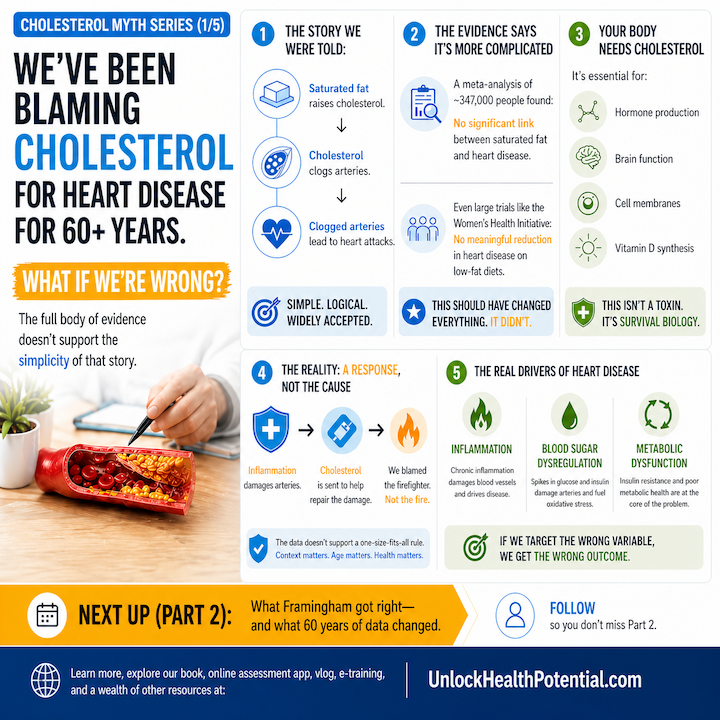
Saturated fat raises cholesterol. Cholesterol clogs arteries. Clogged arteries cause heart attacks.
It’s clear. It’s logical. It’s repeated in doctor’s offices, on food labels, and in advertising so often it feels less like a hypothesis and more like a law of nature.
But there’s one problem the tidy version never mentions: the full body of evidence doesn’t support the simplicity of that story.
And if we’ve spent six decades targeting the wrong culprit, then the uncomfortable question isn’t just “Were we wrong?”It’s “What have we been missing while we were busy chasing a number?”
That single shift — from lowering a marker to understanding the system beneath it — is where a smarter conversation about heart health begins.
The Origins of the Lipid Hypothesis
The lipid–heart hypothesis gave medicine something almost irresistible: simplicity.
It handed us a measurable target, a clear villain, and a straightforward intervention. Lower cholesterol, reduce risk, prevent disease. A clean line from cause to cure.
But human biology rarely moves in clean lines.
Consider what happened over the very same decades that low-fat messaging dominated the culture. As a nation dutifully swapped butter for margarine and eggs for cereal, we watched a parallel epidemic quietly take off:
- Obesity
- Type 2 diabetes
- Insulin resistance
- Metabolic dysfunction
If lowering fat and cholesterol were the answer, these curves should have bent downward. Instead, they climbed. Which raises a question that should have been asked far sooner:
Did we mistake a marker for a cause?
What the Research Actually Shows
Here’s where the story gets uncomfortable for the conventional narrative — because when researchers finally examined the diet–heart link at scale, the expected relationship kept failing to appear.
A meta-analysis pooling nearly 347,000 individuals found no significant association between saturated fat intake and cardiovascular disease (Siri-Tarino et al., 2010). Not a weak one. No significant association at all.
The Women’s Health Initiative — one of the largest dietary trials ever conducted — followed tens of thousands of women who reduced their fat intake and found it did not significantly lower their risk of heart disease or stroke (Howard et al., 2006).
The Nurses’ Health Study told the same story: simply cutting total fat didn’t produce the cardiovascular payoff the hypothesis promised (Hu et al., 2001).
Let’s be precise about what this does and doesn’t mean. It does not mean diet is irrelevant — diet may be the single most powerful lever you have. What it means is narrower and more important:
The story is more complex than “fat is bad.”
And when the foundational claim of a 60-year public health strategy turns out to be that fragile, it’s worth asking what else we accepted without looking closely.
Cholesterol: Essential, Not Optional
Somewhere along the way, cholesterol got cast as a contaminant — something to be feared, minimized, and driven as low as possible.
But cholesterol isn’t a toxin. It’s a biological necessity.
Every single cell in your body relies on it for structure and stability. Strip cholesterol away and cellular integrity itself begins to break down. Far from being a threat, it’s one of the molecules that makes you possible.
Cholesterol is essential for:
- Cell membrane stability — the structural backbone of every cell
- Hormone production — including your sex hormones and stress hormones
- Brain structure and function — your brain is one of the most cholesterol-rich tissues you have
- Vitamin D synthesis — the raw material starts as cholesterol
- Fat digestion — via the bile acids your body builds from it
This is why your body manufactures the majority of its own cholesterol rather than relying on your plate: it’s too important to leave to chance.
So the real question sharpens considerably:
If cholesterol is essential to survival, why are we treating it as the primary enemy?
How High Is “High Cholesterol”?
Here’s a detail that rarely makes the conversation: the definition of “high” keeps moving.
Not long ago, total cholesterol had to climb above 280 mg/dL to raise eyebrows. Then the threshold drifted:
- 250 mg/dL
- 220 mg/dL
- 200 mg/dL
- And now, in some cases, even 130–160 mg/dL is framed as “optimal”
Each downward step is significant, because each one instantly reclassifies millions of previously healthy people as candidates for medication — without a single thing changing in their bodies.
This doesn’t automatically mean the guidelines are wrong. But it does force an honest question:
Are we redefining risk — or quietly redefining normal?
From Framingham to HUNT 2: A Critical Shift
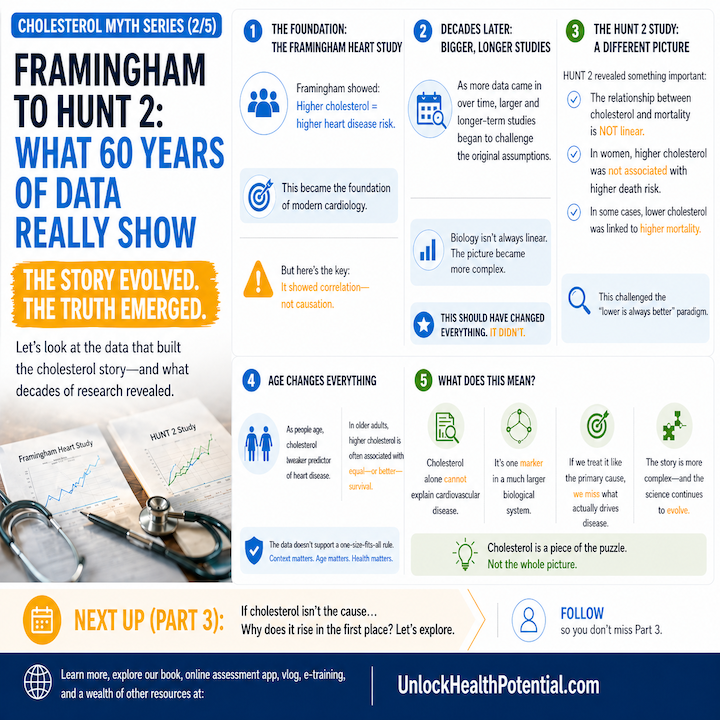
Much of modern cholesterol theory traces back to the Framingham Heart Study, which identified an association between cholesterol levels and heart disease risk. It was landmark work, and it earned its place in history.
But an association is not a cause. And the moment you treat one as the other, you can spend decades solving the wrong problem with great precision.
As longer-term data accumulated and broader populations were studied, the neat picture began to fracture. The HUNT 2 study — one of the largest population-based health studies ever conducted — surfaced findings that are genuinely hard to reconcile with the simple story:
- The relationship between cholesterol and mortality is not linear
- In many populations — women in particular — higher cholesterol was not associated with increased mortality
- In some cases, lower cholesterol tracked with higher mortality
And one finding deserves to be sat with:
- The predictive value of cholesterol declines with age
- In older adults, higher cholesterol is often associated with equal or better survival
Step back and take in the full arc — from Framingham to HUNT 2 and well beyond — and a conclusion becomes difficult to avoid:
Cholesterol alone does not adequately explain cardiovascular disease.
A Critical Reframe: Cholesterol as a Response
So if cholesterol isn’t the primary driver, what is it doing there at the scene of the crime?
Emerging science offers a very different model — one that flips the usual assumption on its head:
Cholesterol may be part of your body’s response to damage, not the root cause of it.
Picture the sequence:
- Inflammation injures the delicate lining of your blood vessels
- Your body dispatches lipoproteins — including LDL — to help patch and repair that damage
- Over time, that ongoing repair process can contribute to plaque
Seen this way, cholesterol looks less like an arsonist and more like a first responder — showing up precisely because something upstream is on fire. Blaming the responder for the blaze is how you end up treating the wrong thing for sixty years.
This reframe isn’t fringe. It aligns with decades of research pointing to inflammation — not cholesterol in isolation — as the central engine of atherosclerosis. Which naturally leads to the next question most people are never asked to consider: why would cholesterol be climbing in the first place?
Why Cholesterol Levels Rise
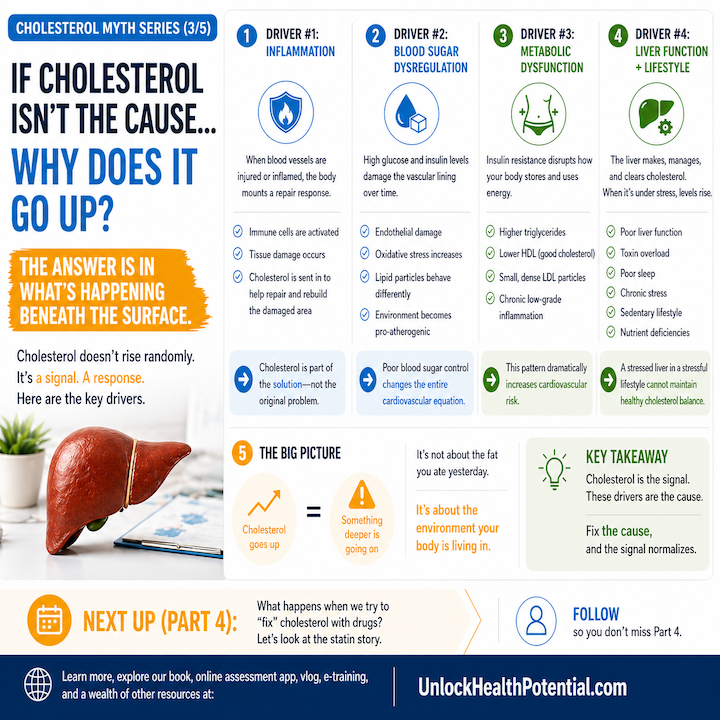
Elevated cholesterol is almost always blamed on diet, full stop. The reality is layered and far more interesting — and far more actionable.
Inflammation. The underlying trigger of vascular damage, and the fire the “first responder” is showing up to fight.
Blood sugar dysregulation. Chronically high glucose and insulin damage arteries and alter how your lipids behave. This is why blood sugar imbalance belongs at the center of any serious heart-health conversation.
Liver function. Your liver is the master regulator of cholesterol production and clearance — when it’s stressed, your numbers shift.
Metabolic dysfunction. Insulin resistance is one of the most under-appreciated drivers of cardiovascular risk on the entire list.
Lifestyle factors. Sleep, stress, hydration, and movement quietly shape your metabolic health every single day.
Notice the pattern: not one of these is fixed by simply forcing a number down. They’re addressed by understanding the system that produced the number.
Cholesterol and Longevity: A More Nuanced Reality
Some of the most overlooked data in this entire debate comes from longevity research — and it complicates the “lower is always better” reflex considerably.
Across multiple studies, a few findings keep resurfacing:
- Many heart attack patients arrive at the hospital with normal cholesterol levels
- In older populations, higher cholesterol is often associated with longer lifespan
- Very low cholesterol has been linked to increased mortality in certain groups
None of this means higher is always better — biology is rarely that obliging. But it does dismantle the idea that a single number moving in a single direction is the same as getting healthier. What it establishes is subtler and more honest:
The relationship between cholesterol and health is not simple — and it is not universal.
The Limits of a Single Biomarker
LDL cholesterol is useful. Let’s not overcorrect into pretending it tells us nothing.
But it’s one instrument in a much larger orchestra — and no orchestra is judged by a single note.
Your true cardiovascular risk is shaped by a web of interacting factors:
- Inflammation
- Insulin resistance
- Triglycerides
- HDL levels
- Lifestyle patterns
When you fixate on one marker, you don’t just miss the others — you can be reassured by a “good” number while the real drivers quietly advance. Because in the end, this is the principle everything else rests on:
Health is determined by systems, not single numbers.
Rethinking the “War” on Cholesterol
For decades, the strategy has been blunt and singular: lower cholesterol — usually with medication.
Statins are now among the most widely prescribed drugs on the planet. And as the thresholds have drifted lower, eligibility has expanded, sweeping millions more people into treatment with each revision.
On its face, the logic is airtight: lower cholesterol, reduce risk, improve outcomes.
But the data tells a more nuanced — and more important — story than the slogan.
Do Lower Numbers Always Translate to Better Outcomes?
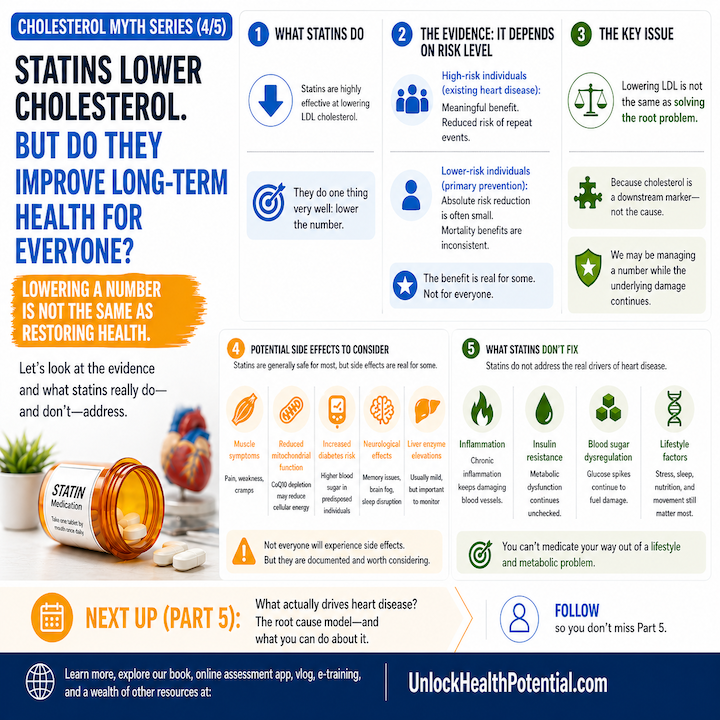
Let’s be fair: statins are genuinely effective at lowering LDL cholesterol. That’s not in dispute, and pretending otherwise would be its own kind of myth.
The more revealing question is the one the slogan skips:
Do they consistently improve meaningful, long-term outcomes — especially in lower-risk people?
Independent analyses have repeatedly found that:
- Benefits in primary prevention (people without established heart disease) are often modest
- The absolute risk reduction tends to be small, even when the relative numbers sound impressive
- Improvements in overall mortality are inconsistent
The takeaway isn’t “statins don’t work.” It’s more precise and more useful:
Lowering a number does not automatically translate into better health.
Treating Risk Factors vs. Root Causes
As the thresholds dropped and the treatment pool expanded, a deeper question got lost in the momentum:
Are we treating risk factors — or are we addressing root causes?
Because lowering a biomarker, however efficiently, does nothing to resolve the forces underneath it:
- Inflammation
- Insulin resistance
- Metabolic dysfunction
You can drive the number down and leave every actual driver of disease fully intact. That’s not a cure. That’s a quieter dashboard light on a car that still needs the engine looked at.
Understanding the Trade-Offs
Statins are not free of consequences, and a mature conversation has to include the other side of the ledger.
Many people tolerate them well — that’s real and worth stating plainly. But the documented side effects are also real, and they matter when you’re prescribing to millions:
- Muscle damage (myotoxicity)
- Nerve-related symptoms
- Liver dysfunction
- Endocrine disruption
- Cardiotoxicity
- Increased risk of diabetes
These effects aren’t universal. But they’re well-documented — and at population scale, “not universal” still translates to a very large number of people. Which is exactly why the risk-versus-benefit math has to be run honestly, individual by individual, rather than assumed.
A More Balanced Perspective
To be clear: this is not a case against conventional medicine. It’s a case for context.
Statins can be valuable tools — particularly for higher-risk individuals with established cardiovascular disease, where the evidence is strongest. That deserves to be said as plainly as everything else here.
But they are not a universal solution, and they don’t replace the work of addressing the deeper drivers of health:
- Inflammation
- Blood sugar regulation
- Metabolic function
- Lifestyle patterns
Because there’s a truth no prescription can get around:
You cannot medicate your way out of a lifestyle-driven condition.
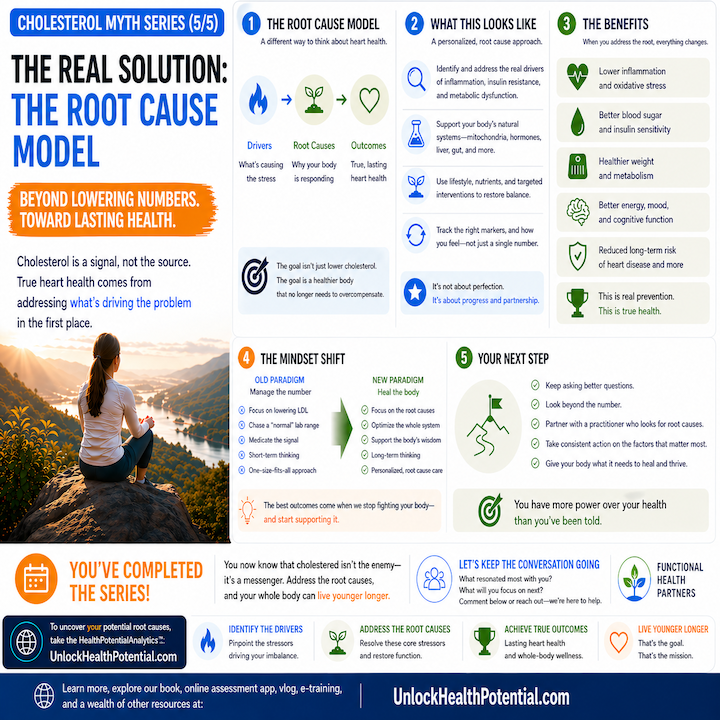
This is the same distinction that separates functional and conventional approaches more broadly — one manages the number, the other asks why the number moved.
Moving Beyond a Single-Target Approach
When cholesterol becomes the whole conversation, we don’t just narrow the discussion — we risk missing the actual disease.
True cardiovascular health was never defined by one number. It emerges from a network of interconnected systems: how you handle blood sugar, how much inflammation you carry, how well your metabolism runs, how you sleep and move and recover.
Shift from a narrow, number-driven model to a root-cause, systems-based one, and something powerful happens: the target stops being a lab value and becomes you — the whole, interconnected system your health actually lives in.
The Bottom Line
But real health was never about a single biomarker. It’s about understanding the system your body operates within — and addressing the root causes that actually drive disease.
We’ve spent decades chasing a number.
If this shifted how you see your own numbers, don’t keep it to yourself. Share it with someone who’s been told to live in fear of their cholesterol.
And if you’re ready to go deeper — to understand your body beyond a surface-level lab result — that’s exactly the work we do. Because the goal was never just to live longer.
It’s to live younger, longer.
Your Next Step: From Fear of a Number to a Real Map
Understanding why the cholesterol story is incomplete is powerful. Knowing what to do with that understanding is where it becomes transformative. Here’s the path we’d walk with you:
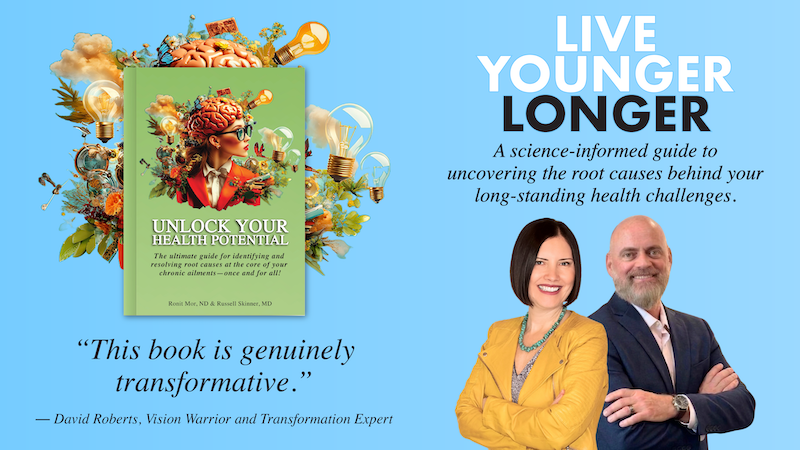
1. Build the understanding. Start with the book, Unlock Your Health Potential, co-authored with Russell Skinner, MD. It turns the systems-based, root-cause thinking behind this article into a practical framework you can actually follow — written for your kitchen table, not decoded like a textbook. Optional, but the readers who start here tend to go the furthest.
2. Pinpoint your personal root causes. Take the proprietary HealthPotentialAnalytics™ assessment. This isn’t a free online quiz — it’s a premium assessment tool built over years to map potential root-cause patterns driving your results, from inflammation and blood sugar to metabolic function. It’s the difference between guessing and starting with a real map.
3. Go deeper on the drivers. Watch our free 24-video Root-Cause Series, which walks through the major root causes described in the book and mapped in your assessment — including the ones most relevant to heart health. And if this piece resonated, its companion myth-buster — The Cortisol Myth — makes the same case for your stress hormone.
4. Prepare for your practitioner. Return to the book for practical strategies and next steps you can bring into an informed conversation with your health professional.
5. Change the trajectory. When you’re ready to translate insight into a lifestyle, join Master Your Health in 8 Weeks™— our structured, expert-led health mastery program built by a naturopath and an integrative, board-certified MD. Not a quick fix. A real, science-informed path to a proactive approach to your health.
Your cholesterol number was never the whole story. Your body is. Let’s read it properly.
FAQs
Cholesterol is associated with cardiovascular risk, but current research suggests the relationship is more complex than simply “high cholesterol causes heart disease.” Factors such as inflammation, insulin resistance, metabolic dysfunction, blood sugar regulation, and lifestyle patterns also play major roles in cardiovascular health.
Not necessarily. Studies have found that the relationship between cholesterol and health is not always linear. In some populations—particularly older adults and women—higher cholesterol levels have not consistently been associated with increased mortality. Cholesterol levels should always be interpreted within the context of overall health and risk factors.
Cholesterol is essential for life. It helps build cell membranes, produce hormones, synthesize vitamin D, support brain function, and aid in fat digestion. In fact, the body manufactures most of its own cholesterol because it is required for normal biological function.
Research increasingly points to inflammation, insulin resistance, metabolic dysfunction, elevated blood sugar, smoking, poor sleep, chronic stress, lack of physical activity, and other lifestyle factors as important contributors to cardiovascular disease. Cholesterol is only one piece of a much larger picture.
Yes. Supporting cardiovascular health often involves addressing root causes such as chronic inflammation, blood sugar instability, excess body fat, poor sleep, stress, physical inactivity, and nutrient deficiencies. A systems-based approach can help improve overall metabolic and cardiovascular health rather than focusing on a single biomarker.
This article is for educational purposes only and is not a substitute for professional medical advice, diagnosis, or treatment. Do not start or stop any medication, including statins, without consulting your physician. Individual results vary.
References & Further Reading
Björnsson E. Hepatotoxicity associated with statins. Liver International. 2017;37(2):173–178. https://pubmed.ncbi.nlm.nih.gov/27716967/
Chaulin A. Cardiotoxicity as a Possible Side Effect of Statins. Reviews in Cardiovascular Medicine. 2023;24(1):22. https://pmc.ncbi.nlm.nih.gov/articles/PMC11270446/
Hansson GK. Inflammation, atherosclerosis, and coronary artery disease. New England Journal of Medicine. 2005;352(16):1685–1695. https://pubmed.ncbi.nlm.nih.gov/15745999/
Howard BV, Van Horn L, Hsia J, et al. Low-fat dietary pattern and risk of cardiovascular disease: the Women’s Health Initiative Randomized Controlled Dietary Modification Trial. JAMA. 2006;295(6):655–666. https://pubmed.ncbi.nlm.nih.gov/16467234/
Hu FB, Stampfer MJ, Manson JE, et al. Dietary fat intake and the risk of coronary heart disease in women. New England Journal of Medicine. 2001;345(11):790–797. https://pubmed.ncbi.nlm.nih.gov/11301006/
Jacobs D, Blackburn H, Higgins M, et al. Report of the Conference on Low Blood Cholesterol: Mortality Associations.Circulation. 1992;86(3):1046–1060. https://pubmed.ncbi.nlm.nih.gov/1737601/
Kannel WB, Castelli WP, Gordon T, McNamara PM. Serum cholesterol, lipoproteins, and the risk of coronary heart disease: the Framingham Study. Annals of Internal Medicine. 1971;74(1):1–12. https://pubmed.ncbi.nlm.nih.gov/5107701/
Libby P. Inflammation in atherosclerosis. Circulation. 2002;105(9):1135–1143. https://pubmed.ncbi.nlm.nih.gov/12119242/
Marcoff L, Thompson PD. The role of coenzyme Q10 in statin-associated myopathy. Journal of the American College of Cardiology. 2007;49(23):2231–2237. https://pubmed.ncbi.nlm.nih.gov/17643597/
Ravnskov U, Diamond DM, Hama R, et al. Lack of an association or an inverse association between low-density-lipoprotein cholesterol and mortality in the elderly: a systematic review. BMJ Open. 2016;6:e010401. https://pubmed.ncbi.nlm.nih.gov/27292972/
Rojas-Fernandez CH, Cameron JC. Is statin-associated cognitive impairment clinically relevant? Annals of Pharmacotherapy. 2012;46(4):549–557. https://pubmed.ncbi.nlm.nih.gov/22274654/
Sachdeva A, Cannon CP, Deedwania PC, et al. Lipid levels in patients hospitalized with coronary artery disease: an analysis of 136,905 hospitalizations in Get With The Guidelines. American Heart Journal. 2009;157(1):111–117. https://pubmed.ncbi.nlm.nih.gov/19081406/
Sattar N, Preiss D, Murray HM, et al. Statins and risk of incident diabetes: a collaborative meta-analysis of randomised statin trials. The Lancet. 2010;375(9716):735–742. https://pubmed.ncbi.nlm.nih.gov/20167359/
Siri-Tarino PW, Sun Q, Hu FB, Krauss RM. Meta-analysis of prospective cohort studies evaluating the association of saturated fat with cardiovascular disease. American Journal of Clinical Nutrition. 2010;91(3):535–546. https://pubmed.ncbi.nlm.nih.gov/20071648/
Taylor F, Huffman MD, Macedo AF, et al. Statins for the primary prevention of cardiovascular disease. Cochrane Database of Systematic Reviews. 2013;(1):CD004816. https://pubmed.ncbi.nlm.nih.gov/23440795/
Thompson PD, Panza G, Zaleski A, Taylor B. Statin-associated side effects. Journal of the American College of Cardiology. 2016;67(20):2395–2410. https://pubmed.ncbi.nlm.nih.gov/27712900/
Turner RM, Pirmohamed M. Statin-related myotoxicity: a comprehensive review of the pharmacokinetic, pharmacogenomic, and muscle components. Journal of Clinical Medicine. 2019;9(1):22. https://pmc.ncbi.nlm.nih.gov/articles/PMC7019839/