

Hormonal Imbalance Isn’t Just Part of Life
Hormonal symptoms are so common today that many people have started accepting them as inevitable.
Mood swings.
Fatigue.
Sleep disruption.
Weight gain.
Irregular cycles.
Low libido.
PMS.
Brain fog.
Anxiety.
Poor stress tolerance.
For many women especially, these symptoms are often dismissed as “just hormones.” And while hormones are certainly involved, that explanation barely scratches the surface.
Because hormones rarely become imbalanced in isolation. More often, hormonal imbalance is the downstream consequence of deeper dysfunction occurring throughout the body’s interconnected systems. Hormones respond continuously to stress, blood sugar, inflammation, nutrient status, gut health, sleep quality, toxin exposure, liver function, and nervous system regulation.
In other words: Hormonal imbalance is often not the root problem itself. It is the body responding to deeper dysfunction.
This is where the contrast between conventional medicine and functional medicine becomes especially important.
Two Approaches. Two Very Different Outcomes.
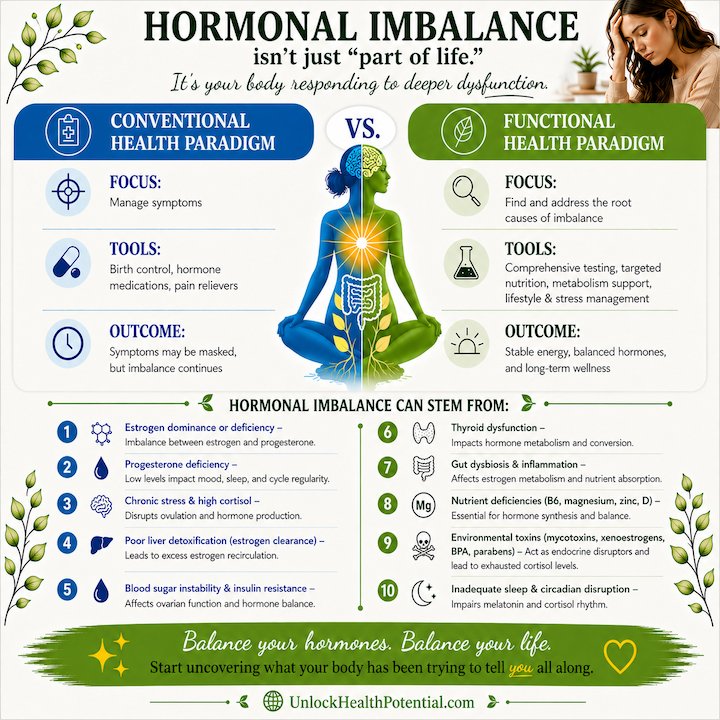
The Conventional Health Paradigm
Conventional medicine is incredibly valuable in acute care, disease diagnosis, emergency intervention, and serious pathology management. It has transformed healthcare in many extraordinary ways.
But when it comes to hormonal imbalance, the conventional approach often centers primarily around symptom control.
The focus frequently becomes:
- Regulating cycles
- Reducing discomfort
- Improving lab markers
- Suppressing symptoms
Common tools may include:
- Birth control pills
- Hormone medications
- Pain relievers
- Antidepressants
- Symptom-focused pharmaceutical management
These interventions can absolutely help in certain situations and may be appropriate for some individuals. But many people eventually discover something frustrating: the symptoms often return once the intervention stops.
That’s because symptom suppression does not necessarily address the deeper biological environment that created the imbalance in the first place.
The central question often becomes: “How do we manage the hormone?”
Functional medicine asks something different: “Why is the hormonal system struggling to maintain balance?” That question changes the entire conversation.
The Functional Health Paradigm
Functional medicine views hormones as responsive messengers rather than isolated problems.
Hormones constantly adapt to signals coming from the rest of the body. They respond to stress physiology, blood sugar regulation, inflammation, nutrient availability, sleep patterns, detoxification pathways, gut health, and environmental inputs.
This means hormonal symptoms often represent deeper system-wide dysregulation rather than a simple “hormone deficiency” or “hormone excess.”
The body functions as an interconnected ecosystem. When one system becomes overwhelmed, hormonal signaling changes in response. This is why so many people experience hormonal symptoms alongside fatigue, digestive issues, weight resistance, anxiety, poor sleep, inflammation, and metabolic dysfunction.
The goal of functional medicine is not simply balancing hormones temporarily. The goal is restoring the systems that allow hormones to regulate naturally.
Why Root Causes Matter
Hormones do not operate independently. They are deeply interconnected with the nervous system, immune system, metabolism, gut microbiome, liver function, and circadian rhythm.
When these systems become chronically stressed or dysregulated, hormonal signaling often becomes disrupted as well. This may show up as:
- Estrogen dominance
- Progesterone deficiency
- Thyroid dysfunction
- Cortisol dysregulation
- Insulin resistance
- Reproductive hormone instability
And unless the deeper drivers are addressed, the body often continues repeating the same patterns no matter how many short-term symptom-management strategies are added on top.
10 Major Root Causes of Hormonal Imbalance
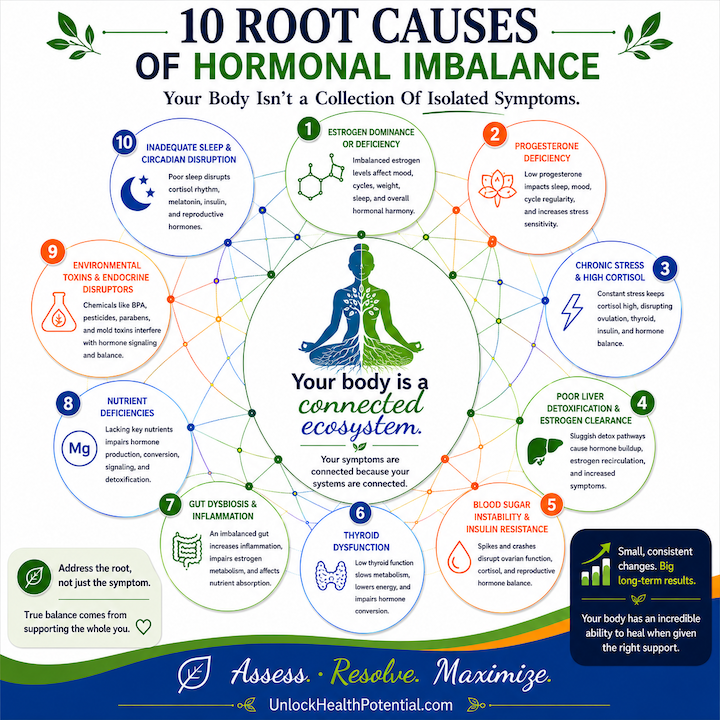
1. Estrogen Dominance or Deficiency
Healthy hormonal balance depends not only on hormone production, but also on proper ratios between hormones. When estrogen becomes excessively high relative to progesterone, or excessively low overall, symptoms may include:
- Mood swings
- Fatigue
- Irregular cycles
- Heavy periods
- Sleep disruption
- Weight gain
Hormonal balance is about harmony, not just isolated hormone levels.
2. Progesterone Deficiency
Progesterone plays a major role in calming the nervous system, supporting sleep, balancing estrogen, and regulating menstrual cycles.
Chronic stress is one of the biggest contributors to progesterone depletion because the body prioritizes cortisol production during prolonged stress states.
This is one reason stress and hormonal symptoms are so tightly connected.
3. Chronic Stress & High Cortisol
The body does not distinguish very well between emotional stress, work pressure, poor sleep, overtraining, chronic mental overload, on an imminent attack by a lion. All activate the same stress-response system.
When cortisol remains elevated for prolonged periods, it can disrupt:
- Ovulation
- Thyroid function
- Insulin sensitivity
- Reproductive hormone balance
- Sleep regulation
The body shifts from optimization to survival. And hormonal balance often suffers in the process.
4. Poor Liver Detoxification & Estrogen Clearance
The liver plays a critical role in hormone metabolism and detoxification. If detoxification pathways become sluggish or overwhelmed, hormones, particularly estrogen, may not be processed and cleared efficiently.
This can contribute to:
- Estrogen recirculation
- PMS
- Bloating
- Headaches
- Mood changes
- Inflammatory symptoms
Hormonal balance depends not only on production, but also on clearance.
5. Blood Sugar Instability & Insulin Resistance
Blood sugar and hormones are deeply intertwined. Frequent glucose spikes and insulin resistance can disrupt ovarian function, cortisol regulation, fat storage, and reproductive hormone balance.
This is particularly important in conditions like PCOS, where insulin resistance often plays a major underlying role. Stable blood sugar is one of the most foundational aspects of hormonal health.
6. Thyroid Dysfunction
The thyroid influences metabolism, energy production, body temperature, and hormone conversion throughout the body. Even subtle thyroid dysfunction can contribute to:
- Fatigue
- Weight gain
- Hair loss
- Poor recovery
- Brain fog
- Menstrual irregularities
The thyroid does not function in isolation from the rest of the hormonal system.
7. Gut Dysbiosis & Inflammation
The gut microbiome plays a major role in estrogen metabolism, nutrient absorption, immune regulation, and inflammatory balance.
An unhealthy gut environment can contribute to increased inflammation, impaired estrogen clearance, nutrient deficiencies, and hormone disruption. This is why digestive symptoms and hormonal symptoms often appear together.
8. Nutrient Deficiencies
Hormones depend on nutrients for production, conversion, signaling, and detoxification. Deficiencies in key nutrients can impair hormone synthesis and nervous system regulation, including:
- Magnesium
- Vitamin D
- Vitamin B6
- Zinc
- Omega-3 fatty acids
The body cannot create balance without the raw materials required for proper function.

9. Environmental Toxins & Endocrine Disruptors
Modern environments expose us to many compounds capable of interfering with hormonal signaling. These may include:
- BPA
- Pesticides
- Parabens
- Plastics
- Mold toxins
- Xenoestrogens
- Other endocrine-disrupting chemicals
These compounds can mimic, block, or interfere with natural hormone activity. Over time, chronic exposure may contribute to estrogen imbalance, cortisol dysregulation, thyroid dysfunction, and reproductive issues.
10. Inadequate Sleep & Circadian Disruption
Sleep is one of the body’s most powerful hormonal regulators. Poor sleep disrupts:
- Cortisol rhythms
- Melatonin production
- Insulin sensitivity
- Reproductive hormone balance
This is why sleep disruption often amplifies cravings, mood instability, fatigue, inflammation, and cycle irregularities. The endocrine system depends heavily on circadian rhythm stability.
How to Start Promoting Hormonal Balance Naturally
Healing hormonal imbalance does not require perfection. The goal is creating an environment where the body feels safer, more supported, and more capable of regulating itself naturally.
Here’s where to begin:
1. Stabilize Blood Sugar
Build meals around:
- Protein
- Healthy fats
- Fiber
- Consistent energy intake
Stable blood sugar supports cortisol regulation, insulin sensitivity, mood stability, and reproductive hormone balance.
2. Prioritize Sleep Consistency
Focus on:
- Consistent sleep timing
- Morning sunlight exposure
- Reducing nighttime stimulation
- Creating a calming evening routine
Hormones rely heavily on circadian rhythm regulation. When sleep is irregular, hormonal signals often become irregular too.
3. Reduce Chronic Stress Load
Incorporate simple nervous system support practices such as:
- Walking
- Breathwork
- Time outdoors
- Slower evenings
- Intentional recovery
The body cannot maintain hormonal balance while remaining in chronic survival physiology.
4. Support Gut & Liver Health
Focus on:
- Whole foods
- Fiber
- Hydration
- Adequate protein
- Reducing ultra-processed foods
Hormonal balance depends heavily on detoxification, gut-mediated hormone metabolism, and healthy elimination.
5. Reduce Toxic Burden Where Possible
You do not need to become fearful or obsessive. But small changes matter.
Consider:
- Reducing plastic exposure
- Improving indoor air quality
- Filtering water
- Choosing cleaner personal-care products when possible
Endocrine disruptors can significantly affect hormonal signaling over time, and reducing exposure where practical can support the body’s natural regulatory systems.
Final Thought
Hormonal symptoms are not random. And they are not simply something you should “learn to live with.” Your hormones are constantly responding to the internal environment of your body.
When symptoms appear, they often reflect deeper dysfunction beneath the surface. The goal is not simply masking symptoms temporarily. The goal is restoring the systems that allow hormones to regulate naturally.
Because your body is not failing you. It is communicating with you.
Okay — So What Do I Actually Do With All This?
General knowledge is useful — but knowing which of the 24 major root causes are driving your symptoms is the real game-changer. That’s what the HealthPotentialAnalytics™ assessment is built to do. This isn’t a throwaway online quiz — it’s a sophisticated algorithm refined over years of expert work that acts like a detective for your body, connecting the dots across systems to reveal exactly where your trouble is hiding. You get what you pay for, and serious results come from serious tools.

FAQs
Hormonal imbalance can show up in many different ways, including fatigue, mood swings, poor sleep, irregular cycles, PMS, weight gain, low libido, brain fog, anxiety, and reduced stress tolerance. While these symptoms do not automatically mean you have a hormonal issue, they are often important signals that your body may be struggling to maintain balance.mation just a normal part of aging?
Hormones naturally change with age, but age is rarely the whole story. Factors such as chronic stress, blood sugar instability, poor sleep, gut dysfunction, nutrient deficiencies, inflammation, toxin exposure, and thyroid imbalances can all influence hormone regulation. In many cases, hormones are responding to deeper imbalances elsewhere in the body.ow if I have chronic inflammation?
Start with the foundations: stabilize blood sugar, prioritize sleep, manage stress, support gut health, and focus on nutrient-dense foods. Hormones are highly responsive to the overall environment of the body. Small, consistent improvements in these areas often create meaningful changes over time.hat is the most important thing I can do to lower inflammation naturally?
Because hormones are often messengers rather than the root problem themselves. If the underlying drivers—such as stress, inflammation, poor sleep, gut dysfunction, insulin resistance, or toxin exposure—remain unresolved, hormonal symptoms may continue to return. Lasting improvement often comes from supporting the systems that influence hormone balance rather than focusing on hormones alone.y do anti-inflammatory medications help, but my symptoms keep coming back?
Absolutely. Hormones help regulate nearly every major system in the body, including metabolism, brain function, stress resilience, appetite, sleep quality, and emotional well-being. This is why hormonal imbalances often affect far more than reproductive health alone. Your hormones are connected to the rest of your physiology—and your symptoms are connected because your systems are connected.
This content is for educational purposes only and is not intended as a substitute for professional medical advice, diagnosis, or treatment. Individual results vary.
References & Further Reading
Chrousos GP. Stress and Disorders of the Stress System. Nature Reviews Endocrinology. 2009;5(7):374–381.
https://www.nature.com/articles/nrendo.2009.106
Diamanti-Kandarakis E, Bourguignon JP, Giudice LC, et al. Endocrine-Disrupting Chemicals: An Endocrine Society Scientific Statement. Endocrine Reviews. 2009;30(4):293–342.
https://academic.oup.com/edrv/article/30/4/293/2354958
Cani PD, Amar J, Iglesias MA, et al. Metabolic Endotoxemia Initiates Obesity and Insulin Resistance.Diabetes. 2007;56(7):1761–1772.
https://diabetesjournals.org/diabetes/article/56/7/1761/12878/Metabolic-Endotoxemia-Initiates-Obesity-and
Spiegel K, Leproult R, Van Cauter E. Impact of Sleep Debt on Metabolic and Endocrine Function. The Lancet. 1999;354(9188):1435–1439.
https://pubmed.ncbi.nlm.nih.gov/10543671/
Biondi B, Cooper DS. The Clinical Significance of Subclinical Thyroid Dysfunction. Endocrine Reviews.2008;29(1):76–131.
https://academic.oup.com/edrv/article/29/1/76/2354954
Vujkovic-Cvijin I, Sklar J, Jiang L, et al. Host Variables Confound Gut Microbiota Studies of Human Disease. Nature. 2020;587(7834):448–454.
https://www.nature.com/articles/s41586-020-2881-9