

Poor Sleep Is Rarely Just About Sleep Itself
Most people think of sleep problems as a nighttime issue.
You can’t fall asleep.
You wake up repeatedly.
Your mind races at night.
You feel exhausted in the morning.
You rely on caffeine during the day and struggle to wind down at night.
And because sleep problems have become so common, many people simply accept them as a normal part of modern life.
But poor sleep is rarely just about sleep itself.
More often, insomnia and sleep disruption are the body’s way of signaling that deeper systems have fallen out of balance. Because healthy sleep depends on far more than simply “being tired.”
Sleep is deeply connected to:
- Nervous system regulation
- Cortisol rhythms
- Blood sugar stability
- Neurotransmitter production
- Inflammation
- Gut health
- Hormones
- Breathing patterns
- Environmental inputs
This is why sleep problems frequently appear alongside:
- Anxiety
- Fatigue
- Brain fog
- Inflammation
- Hormonal imbalance
- Metabolic dysfunction
The body functions as an interconnected ecosystem. When multiple systems become dysregulated simultaneously, sleep often becomes one of the first things to suffer.
And this is where the contrast between conventional medicine and functional medicine becomes especially important. Because while both paradigms recognize insomnia and sleep issues, they often approach them in profoundly different ways—with very different long-term outcomes.
Two Approaches. Two Very Different Outcomes.
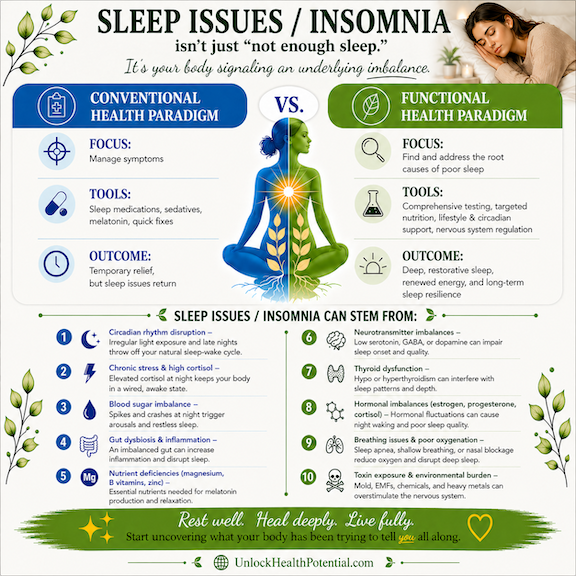
The Conventional Health Paradigm
Conventional medicine is highly effective in diagnosing serious sleep disorders, sleep apnea, neurological conditions, and acute pathology. But when it comes to chronic insomnia and persistent sleep disruption, the conventional approach often centers primarily around symptom management.
The focus frequently becomes:
- Helping the person fall asleep
- Reducing nighttime awakenings
- Improving short-term sleep duration
- Managing symptoms
Common interventions may include:
- Sleep medications
- Sedatives
- Melatonin supplements
- Symptom-focused strategies
These tools may absolutely provide temporary relief and can be appropriate in certain situations. But many individuals eventually notice something frustrating: The sleep problems often return.
Because sleep disruption is frequently a downstream consequence of deeper physiological imbalance—not simply a lack of sleep itself.
The central question often becomes: “How do we help someone sleep?”
Functional medicine asks something different: “Why is the body struggling to enter restorative sleep in the first place?”
That question changes everything.
The Functional Health Paradigm
Functional medicine views sleep through a systems-biology lens. Instead of seeing insomnia as an isolated nighttime problem, it recognizes sleep as one of the body’s most important regulatory processes. Healthy sleep depends heavily on:
- Nervous system safety
- Circadian rhythm alignment
- Stable cortisol rhythms
- Balanced blood sugar
- Low inflammation
- Healthy neurotransmitter production
- Proper oxygenation
- Hormonal regulation
- Metabolic stability
When these systems become dysregulated, sleep often becomes fragmented, shallow, inconsistent, or difficult.
The goal is not simply sedation. The goal is restoring the internal environment that allows deep restorative sleep to occur naturally. Because sleep is not passive. It is one of the body’s most critical healing processes.
Why Root Causes Matter
Poor sleep is often a signal—not the root problem itself. Difficulty falling asleep, staying asleep, or waking restored may reflect:
- Cortisol dysregulation
- Blood sugar instability
- Inflammation
- Neurotransmitter imbalance
- Hormonal dysfunction
- Poor oxygenation
- Gut dysfunction
- Toxin exposure
- Nervous system overload
And unless those deeper drivers are addressed, many people remain trapped in repetitive cycles of exhaustion, caffeine dependence, poor recovery, anxiety, and worsening sleep quality. Even while trying everything they can to “sleep better.”
The body may not be refusing sleep. It may simply not feel physiologically safe enough to fully restore.
10 Major Root Causes of Sleep Issues
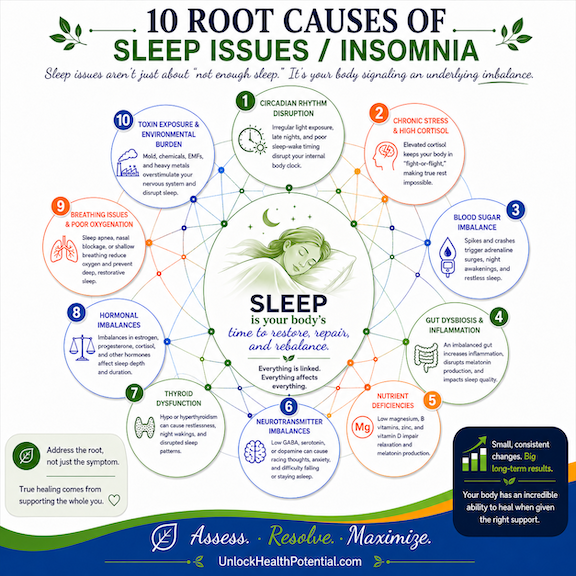
1. Circadian Rhythm Disruption
The body operates on an internal biological clock strongly influenced by:
- Light exposure
- Meal timing
- Activity patterns
- Sleep consistency
Late-night stimulation, irregular schedules, excessive artificial light, and disrupted circadian signaling can impair melatonin production and sleep timing.
The body depends on rhythm to regulate sleep effectively.
2. Chronic Stress & High Cortisol
The nervous system cannot fully relax while remaining in survival mode. When cortisol remains elevated late into the evening, the body may stay:
- Alert
- Restless
- Hypervigilant
- Unable to fully power down
Many individuals with insomnia feel “tired but wired.”
The body may be exhausted, but the nervous system still perceives threat.
3. Blood Sugar Imbalance
Blood sugar instability can significantly disrupt sleep quality. Rapid glucose drops during the night may trigger:
- Adrenaline release
- Nighttime awakenings
- Restlessness
- Sweating
- Racing thoughts
Many individuals unknowingly experience metabolic stress while sleeping.
Stable sleep often requires stable energy regulation.
4. Gut Dysbiosis & Inflammation
The gut strongly influences:
- Inflammation
- Neurotransmitter production
- Melatonin synthesis
- Nervous system signaling
An unhealthy gut environment may contribute to poor sleep quality, nighttime restlessness, inflammation, and disrupted circadian rhythms.
The gut and brain communicate continuously.
5. Nutrient Deficiencies
The nervous system depends heavily on nutrients for sleep regulation. Deficiencies in magnesium, B vitamins, zinc, and vitamin D may impair:
- Melatonin production
- Neurotransmitter balance
- Muscle relaxation
- Nervous system calmness
The body cannot fully relax without adequate biochemical support.
6. Neurotransmitter Imbalances
Healthy sleep depends heavily on balanced neurotransmitters such as GABA, serotonin, and dopamine. These signaling molecules help regulate relaxation, mood, circadian rhythm, and sleep onset.
Imbalances may contribute to:
- Racing thoughts
- Restlessness
- Nighttime anxiety
- Shallow sleep
7. Thyroid Dysfunction
The thyroid strongly influences:
- Metabolism
- Body temperature
- Nervous system activation
- Energy production
Both hypo- and hyperthyroidism may contribute to insomnia, nighttime awakenings, anxiety, restlessness, and poor recovery.
Even subtle thyroid imbalance may affect sleep quality significantly.
8. Hormonal Imbalances
Hormones strongly influence circadian rhythm and nervous system regulation. Fluctuations involving cortisol, estrogen, progesterone, and reproductive hormones may contribute to:
- Night waking
- Hot flashes
- Anxiety
- Poor sleep depth
Hormonal shifts frequently affect sleep resilience.
9. Breathing Issues & Poor Oxygenation
Healthy sleep depends on proper oxygen delivery throughout the night. Sleep apnea, nasal congestion, shallow breathing, or poor airway function may impair:
- Oxygenation
- Nervous system calmness
- Sleep restoration
Many individuals wake exhausted because the body never fully entered restorative sleep states.
10. Toxin Exposure & Environmental Burden
Environmental stressors such as mold, chemicals, EMFs, poor indoor air quality, and toxin burden may overstimulate the nervous system and increase inflammatory stress.
For some individuals, hidden environmental burden becomes a major contributor to chronic sleep disruption.
How to Start Supporting Better Sleep Naturally

The goal is not perfection. The goal is creating an environment where the nervous system feels safer, calmer, and more capable of entering restorative sleep naturally. Here’s where to begin:
1. Support Circadian Rhythm
Focus on:
- Consistent sleep timing
- Morning sunlight exposure
- Reducing bright light at night
- Limiting late-night stimulation
The body relies heavily on rhythm and light signaling.
2. Stabilize Blood Sugar
Build meals around:
- Protein
- Healthy fats
- Fiber
- Balanced meal timing
Stable blood sugar helps reduce nighttime adrenaline surges and awakenings.
3. Reduce Evening Nervous System Overload
Incorporate calming practices such as:
- Walking
- Breathwork
- Stretching
- Reduced screen exposure
- Quiet evenings
The nervous system cannot fully relax while overstimulated.
4. Support Nutrient Density
Prioritize foods rich in:
- Magnesium
- Minerals
- Omega-3s
- Protein
- Whole-food nutrients
Sleep is a biochemical process requiring nutritional support.
5. Improve the Sleep Environment
Support recovery through:
- Cooler room temperatures
- Better air quality
- Reduced noise
- Darkness
- Improved breathing conditions
The body sleeps best in an environment that feels physiologically safe.
Final Thought
Sleep problems are rarely just about sleep itself. More often, insomnia and poor sleep quality reflect deeper imbalance occurring throughout the body.
The goal is not simply forcing sedation temporarily. The goal is restoring the systems that allow deep restorative sleep to happen naturally.
Because sleep is not a luxury. It is one of the body’s most important healing mechanisms. And when sleep improves, nearly every other system in the body often improves alongside it.
Okay — So What Do I Actually Do With All This?
General knowledge is useful — but knowing which of the 24 major root causes are driving your symptoms is the real game-changer. That’s what the HealthPotentialAnalytics™ assessment is built to do. This isn’t a throwaway online quiz — it’s a sophisticated algorithm refined over years of expert work that acts like a detective for your body, connecting the dots across systems to reveal exactly where your trouble is hiding. You get what you pay for, and serious results come from serious tools.

FAQs
This is often a sign that your stress-response system may be out of sync. Chronic stress, elevated evening cortisol, blood sugar instability, excessive stimulation, and circadian rhythm disruption can all make the body feel exhausted while simultaneously making it difficult to relax enough to sleep. The issue is often not a lack of tiredness—it’s a lack of physiological readiness for restorative sleep.
Nighttime awakenings can be influenced by many factors, including blood sugar fluctuations, elevated cortisol, hormonal imbalances, poor sleep habits, inflammation, breathing issues, or nervous system hypervigilance. Waking up at the same time every night is often a clue that the body is responding to a deeper imbalance rather than simply having trouble sleeping.
Start with consistency. Going to bed and waking up at the same time each day, getting morning sunlight exposure, reducing nighttime stimulation, and supporting stable blood sugar can dramatically improve sleep quality over time. Small, repeatable habits often create more lasting results than quick fixes.
Because sleep and restoration are not always the same thing. Some medications may help induce sleep, but they do not necessarily address the underlying factors affecting sleep quality, such as stress physiology, blood sugar instability, inflammation, hormone imbalance, poor oxygenation, or nervous system dysregulation. The goal is not just sleeping longer—it’s sleeping more restoratively.
Absolutely. Sleep influences nearly every major system in the body, including metabolism, immune function, hormone regulation, blood sugar control, brain function, stress resilience, and recovery. This is why poor sleep often appears alongside fatigue, brain fog, anxiety, inflammation, hormonal symptoms, and weight-loss resistance. Your sleep is connected to the health of your entire system because your systems are connected.
This content is for educational purposes only and is not intended as a substitute for professional medical advice, diagnosis, or treatment. Individual results vary.
References & Further Reading
Spiegel K, Leproult R, Van Cauter E. Impact of Sleep Debt on Metabolic and Endocrine Function. The Lancet. 1999;354(9188):1435–1439.
https://pubmed.ncbi.nlm.nih.gov/10543671/
Xie L, Kang H, Xu Q, et al. Sleep Drives Metabolite Clearance from the Adult Brain. Science.2013;342(6156):373–377.
https://www.science.org/doi/10.1126/science.1241224
McEwen BS. Protective and Damaging Effects of Stress Mediators. New England Journal of Medicine.1998;338(3):171–179.
https://www.nejm.org/doi/full/10.1056/NEJM199801153380307
Cryan JF, O’Riordan KJ, Cowan CSM, et al. The Microbiota-Gut-Brain Axis. Physiological Reviews.2019;99(4):1877–2013.
https://journals.physiology.org/doi/full/10.1152/physrev.00018.2018
Walker MP. Sleep, Memory and Emotion. Progress in Brain Research. 2010;185:49–68.
https://pubmed.ncbi.nlm.nih.gov/21075232/
Tasali E, Leproult R, Ehrmann DA, et al. Slow-Wave Sleep and the Risk of Type 2 Diabetes in Humans.Proceedings of the National Academy of Sciences. 2008;105(3):1044–1049.
https://www.pnas.org/doi/10.1073/pnas.0706446105
Cappuccio FP, D’Elia L, Strazzullo P, et al. Sleep Duration and All-Cause Mortality: A Systematic Review and Meta-Analysis. Sleep. 2010;33(5):585–592.
https://academic.oup.com/sleep/article/33/5/585/2454551