

Blood Sugar Imbalance Isn’t Just About Sugar
If you ask most people what causes blood sugar problems, the answer usually comes quickly and confidently: Too much sugar. Too many carbs. Not enough exercise. Poor discipline.
And because the explanation sounds simple, the proposed solution often sounds simple too: eat less, move more, avoid sugar, and take medication if necessary.
But if blood sugar imbalance were truly that straightforward, millions of people would not still be struggling with:
- Energy crashes
- Brain fog
- Cravings
- Weight resistance
- Poor sleep
- Metabolic dysfunction
…despite trying incredibly hard to “do everything right.”
That disconnect matters because it points to something deeper.
Blood sugar imbalance is rarely just about sugar itself. More often, it reflects a broader breakdown in how the body regulates energy, responds to stress, processes nutrients, manages inflammation, and maintains metabolic stability over time.
In other words: Blood sugar imbalance is not simply a dietary issue. It’s a systems-level issue.
And this is where the contrast between conventional medicine and functional medicine becomes especially important.
Two Approaches. Two Very Different Outcomes.

The Conventional Health Paradigm
Conventional medicine is extraordinarily effective in many areas of healthcare. It saves lives every day through emergency medicine, surgery, acute disease management, and pharmaceutical intervention.
When it comes to blood sugar imbalance, the conventional approach typically focuses on:
- Lowering glucose levels
- Improving laboratory markers
- Reducing short-term risk
- Preventing serious complications
The tools often include:
- Insulin or glucose-lowering medications
- Standard dietary advice
- Generalized lifestyle recommendations
And to be clear, these interventions can absolutely be necessary and helpful.
But the framework itself often centers around one primary question: “How do we control the number?” While this may improve glucose readings temporarily, it often leaves a much more important question unanswered: “Why is the body struggling to regulate blood sugar in the first place?”
That question changes everything.
The Functional Health Paradigm
Functional medicine approaches blood sugar imbalance from an entirely different perspective. Instead of focusing solely on controlling glucose, it seeks to understand the biological environment that created the imbalance.
Rather than asking: “What medication lowers the number?” Functional medicine asks: “What systems are no longer functioning optimally?”
Because blood sugar is not an isolated system. It is heavily influenced by:
- Hormonal signaling
- Nervous system regulation
- Sleep quality
- Mitochondrial function
- Gut health
- Inflammation
- Nutrient status
- Liver function
- Physical activity
The body functions as an interconnected network. When one area becomes dysregulated, the effects ripple throughout the rest of the system. This is why two people can eat the exact same meal and have completely different blood sugar responses. It’s also why symptom management alone so often fails to create lasting change.
Functional medicine recognizes that sustainable health outcomes require identifying and addressing the root causes driving dysfunction beneath the surface.
The goal is not merely symptom suppression. The goal is restoration.
Why Root Causes Matter
Your body is not random. It is adaptive, intelligent, and constantly responding to its environment in an attempt to maintain balance.
When blood sugar becomes unstable, the body is not “failing.” It is compensating. That compensation may look like:
- Elevated insulin
- Fat storage
- Fatigue
- Cravings
- Inflammation
- Energy crashes
These are not isolated problems. They are biological responses to deeper internal stressors. And unless those deeper drivers are identified and addressed, the body continues repeating the same patterns.
This is one reason so many people feel trapped in cycles of dieting, restricting, crashing, regaining, and starting over. They are trying to force change at the surface while the underlying physiology remains unchanged.
10 Hidden Root Causes Most People Never Address
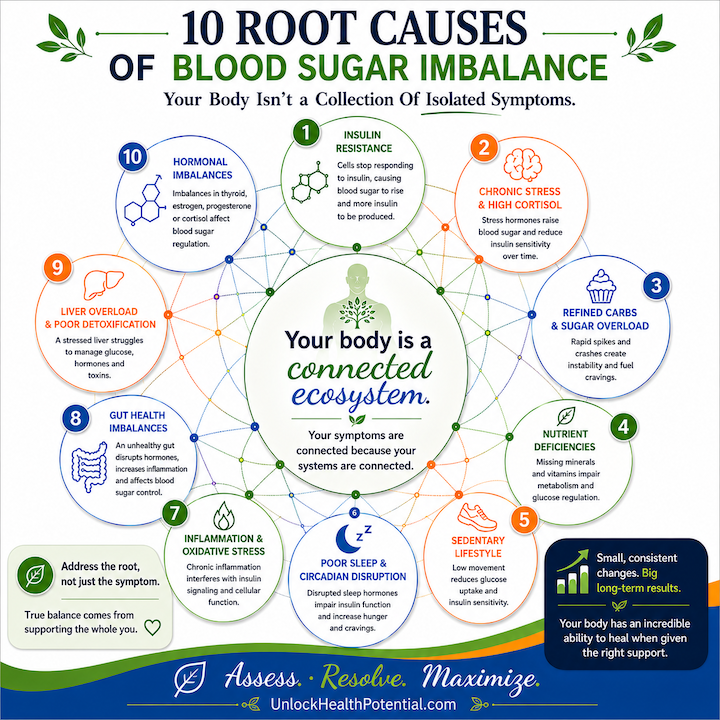
1. Insulin Resistance – A Breakdown in Cellular Communication
Insulin is often described as a “blood sugar hormone,” but its role is much deeper than many people realize. Insulin acts as a messenger. It tells your cells: “Energy is available. Let it in.”
When cells stop responding effectively:
- Glucose remains elevated in the bloodstream
- Insulin levels rise
- Fat storage increases
- Energy regulation becomes less efficient
Over time, this creates a vicious cycle: More insulin → more resistance → more dysfunction.
This is not simply a matter of willpower. It is a breakdown in metabolic communication.
2. Chronic Stress & High Cortisol – Survival Physiology in a Modern World
Your body does not distinguish very well between:
- Emotional stress
- Work stress
- Sleep deprivation
- Overtraining
- Physical danger
All activate the same physiological response → cortisol release.
Cortisol’s job is to increase available energy in the bloodstream during times of stress.
Short term, this is protective. Long term, chronic cortisol elevation contributes to:
- Higher blood sugar
- Reduced insulin sensitivity
- Increased fat storage
- Energy instability
- Cravings and appetite dysregulation
Many people attempting to “fix” blood sugar are unknowingly fighting against an unregulated stress response.
3. Refined Carbs & Sugar Overload – Rapid Input, Unstable Output
It’s not just what you eat. It’s how quickly your body processes it. Highly refined carbohydrates:
- Digest rapidly
- Spike glucose quickly
- Trigger large insulin surges
The result is a repeating cycle: Spike → crash → craving → repeat.
Over time, this pattern reinforces instability throughout the metabolic system and makes sustained energy much harder to maintain.
4. Nutrient Deficiencies – Missing Building Blocks
Your metabolism is biochemical. It depends on adequate levels of nutrients such as magnesium, chromium, and B vitamins. Without these nutrients, the body struggles to:
- Produce energy efficiently
- Regulate glucose properly
- Maintain hormonal balance
Many people are simultaneously overfed and undernourished, consuming enough calories while lacking the nutrients needed for optimal cellular function.
5. Sedentary Lifestyle – Reduced Metabolic Demand
Muscle tissue acts as one of the body’s largest glucose reservoirs. Without regular movement:
- Glucose uptake declines
- Insulin sensitivity worsens
- Metabolic flexibility decreases
Even simple daily movement—especially walking and resistance training—can dramatically improve blood sugar regulation.

6. Poor Sleep & Circadian Disruption – The Overlooked Metabolic Regulator
Sleep is one of the most underestimated influences on metabolic health. During deep sleep:
- Hormones reset
- Insulin sensitivity improves
- Cortisol normalizes
- Cellular repair accelerates
When sleep becomes fragmented, irregular, or insufficient, blood sugar regulation suffers quickly. Even a few nights of poor sleep can:
- Increase cravings
- Elevate cortisol
- Reduce glucose tolerance
- Increase fatigue and brain fog
This is why sleep quality often becomes a foundational piece of metabolic healing.
7. Inflammation & Oxidative Stress – Silent Interference
Inflammation disrupts insulin signaling at the cellular level. Chronic low-grade inflammation can interfere with:
- Insulin receptor sensitivity
- Glucose transport
- Energy production
This creates a state where the body struggles to regulate energy efficiently. Inflammation is often driven by:
- Diet
- Stress
- Gut dysfunction
- Environmental exposure
- Poor recovery
Functional medicine recognizes inflammation as a major driver—not just a side effect—of metabolic dysfunction.
8. Gut Health Imbalances – The Metabolic Control Center Most People Overlook
Your gut does more than digest food. It helps regulate:
- Glucose metabolism
- Hormone signaling
- Immune function
- Inflammatory pathways
When the gut microbiome becomes imbalanced:
- Inflammation increases
- Nutrient absorption suffers
- Metabolic regulation becomes impaired
Many people struggling with blood sugar issues also experience bloating, digestive symptoms, or food sensitivities that are part of the same physiological picture.
9. Liver Overload & Poor Detoxification – The Metabolic Hub Under Stress
The liver plays a central role in:
- Glucose storage and release
- Hormone metabolism
- Detoxification
- Fat metabolism
When the liver becomes overburdened:
- Blood sugar regulation becomes less stable
- Hormonal clearance slows
- Energy production declines
A stressed liver cannot efficiently regulate glucose or process excess metabolic waste.
10. Hormonal Imbalances – The System Behind the System
Blood sugar does not operate independently. It is influenced by thyroid hormones, estrogen, progesterone, and cortisol. When these systems become dysregulated:
- Insulin sensitivity changes
- Appetite and cravings shift
- Energy production slows
Hormonal imbalance often becomes both a cause and consequence of metabolic dysfunction.
A More Empowering Perspective
One of the most damaging beliefs in modern health culture is the idea that metabolic dysfunction is simply the result of laziness or lack of discipline. That narrative creates shame. And shame rarely creates sustainable health.
Functional medicine offers a much more empowering perspective. It recognizes that symptoms are not character flaws. They are physiological signals.
Your cravings are not random. Your fatigue is not random. Your energy crashes are not random. Your body is responding to internal conditions that deserve investigation—not judgment.
How to Start Stabilizing Your Blood Sugar (Without Overwhelm)
Reading about root causes is powerful. But applying them is where real change happens. The goal is not perfection. The goal is progress, consistency, and alignment with your biology.
Here’s how to begin:
1. Stabilize Your Meals
Start by building meals around:
- Protein
- Fiber
- Healthy fats
This helps reduce rapid glucose spikes and creates more stable energy throughout the day.
Why this matters: Stable blood sugar reduces cravings, fatigue, and hormonal stress on the body.
2. Improve Sleep Consistency
Focus on:
- A consistent sleep schedule
- Morning sunlight exposure
- Reducing nighttime stimulation
Why this matters: Circadian rhythm strongly influences cortisol, insulin sensitivity, and metabolic regulation.
3. Support Your Nervous System
Incorporate daily stress regulation practices such as:
- Walking
- Breathwork
- Time outdoors
- Intentional downtime
Why this matters: Chronic stress physiology directly impacts blood sugar regulation.
4. Move Your Body Regularly
You do not need extreme workouts. Consistent movement matters more than intensity.
Why this matters: Walking after meals and strength training are powerful tools for improving insulin sensitivity.
5. Look Beyond the Surface
Instead of asking: “How do I suppress this symptom?” Ask: “What is my body trying to communicate?”
Why this matters: That shift alone changes the entire healing process.
Final Thought
The goal is not just lower blood sugar. The goal is a body that regulates energy naturally. That is the difference between managing symptoms and restoring function.
Balanced blood sugar is not about perfection. It’s about understanding your biology. And when you begin working with your body instead of against it, everything starts to change.
Okay — So What Do I Actually Do With All This?
General knowledge is useful — but knowing which of the 24 major root causes are driving your symptoms is the real game-changer. That’s what the HealthPotentialAnalytics™ assessment is built to do. This isn’t a throwaway online quiz — it’s a sophisticated algorithm refined over years of expert work that acts like a detective for your body, connecting the dots across systems to reveal exactly where your trouble is hiding. You get what you pay for, and serious results come from serious tools.

FAQs
No. Blood sugar imbalance often develops years before diabetes is diagnosed. Symptoms such as fatigue, cravings, brain fog, weight gain, poor sleep, and energy crashes can all be early signs that your body is struggling to regulate glucose effectively. Addressing these imbalances early may help support long-term metabolic health and reduce future risk.
Absolutely. When you’re stressed, your body releases cortisol and adrenaline, which increase blood sugar as part of your natural survival response. Occasional stress is normal, but chronic stress can contribute to insulin resistance, cravings, energy instability, and weight gain. Blood sugar is influenced by much more than food alone.
Start by building meals around protein, fiber, and healthy fats. This simple shift can help reduce blood sugar spikes, improve energy stability, decrease cravings, and support hormone balance. Small, consistent habits often create more lasting results than extreme diets or short-term fixes.
Weight loss resistance is often a symptom of deeper metabolic dysfunction, not simply a calorie problem. Factors such as insulin resistance, chronic stress, poor sleep, inflammation, hormonal imbalances, and gut dysfunction can all make fat loss more difficult. The goal is not just eating less—it’s restoring the systems that allow your body to regulate energy efficiently.
If you’re experiencing recurring symptoms such as fatigue, cravings, brain fog, poor sleep, stubborn weight gain, or energy crashes despite making healthy choices, it may be worth looking beyond blood sugar itself. Blood sugar imbalance is often a signal that other systems—including hormones, stress physiology, gut health, inflammation, or nutrient status—need attention. Your symptoms are connected because your systems are connected.
This content is for educational purposes only and is not intended as a substitute for professional medical advice, diagnosis, or treatment. Individual results vary.
References & Further Reading
DeFronzo RA. From the Triumvirate to the Ominous Octet: A New Paradigm for the Treatment of Type 2 Diabetes Mellitus. Diabetes. 2009;58(4):773–795.
https://diabetesjournals.org/diabetes/article/58/4/773/13238/From-the-Triumvirate-to-the-Ominous-Octet-A
Hackett RA, Steptoe A. Type 2 Diabetes Mellitus and Psychological Stress — A Modifiable Risk Factor. Nature Reviews Endocrinology. 2017;13:547–560.
https://www.nature.com/articles/nrendo.2017.64
Ludwig DS. The Glycemic Index: Physiological Mechanisms Relating to Obesity, Diabetes, and Cardiovascular Disease. JAMA. 2002;287(18):2414–2423.
https://jamanetwork.com/journals/jama/fullarticle/194675
Barbagallo M, Dominguez LJ. Magnesium and Type 2 Diabetes. World Journal of Diabetes. 2015;6(10):1152–1157.
https://www.ncbi.nlm.nih.gov/pmc/articles/PMC4549665/
Spiegel K, Leproult R, Van Cauter E. Impact of Sleep Debt on Metabolic and Endocrine Function. The Lancet. 1999;354(9188):1435–1439.
https://pubmed.ncbi.nlm.nih.gov/10543671/
Hotamisligil GS. Inflammation and Metabolic Disorders. Nature. 2006;444(7121):860–867.
https://www.nature.com/articles/nature05485
Cani PD, Amar J, Iglesias MA, et al. Metabolic Endotoxemia Initiates Obesity and Insulin Resistance. Diabetes. 2007;56(7):1761–1772.
https://diabetesjournals.org/diabetes/article/56/7/1761/12878/Metabolic-Endotoxemia-Initiates-Obesity-and
Samuel VT, Shulman GI. Mechanisms for Insulin Resistance: Common Threads and Missing Links. Cell. 2012;148(5):852–871.
https://www.cell.com/cell/fulltext/S0092-8674(12)00185-4
Booth FW, Roberts CK, Laye MJ. Lack of Exercise Is a Major Cause of Chronic Diseases.
Comprehensive Physiology. 2012;2(2):1143–1211.
https://www.ncbi.nlm.nih.gov/pmc/articles/PMC4241367/
Brenta G. Why Can Insulin Resistance Be a Natural Consequence of Thyroid Dysfunction?
Journal of Thyroid Research. 2011.
https://www.ncbi.nlm.nih.gov/pmc/articles/PMC3139205/
Wright KP Jr, Drake AL, Frey DJ, et al. Influence of Sleep Deprivation and Circadian Misalignment on Cortisol, Inflammatory Markers, and Cytokine Balance.
Brain, Behavior, and Immunity. 2015;47:24–34.
https://pubmed.ncbi.nlm.nih.gov/25640604/
Ceriello A, Esposito K, Piconi L, et al. Oscillating Glucose Is More Deleterious to Endothelial Function and Oxidative Stress Than Mean Glucose in Normal and Type 2 Diabetic Patients.
Diabetes. 2008;57(5):1349–1354.
https://diabetesjournals.org/diabetes/article/57/5/1349/13752/Oscillating-Glucose-Is-More-Deleterious-to