

Anxiety is often described as an emotional problem, a personality trait, or simply “the way someone is wired.”
People struggling with anxiety are frequently told they are:
- Overthinking
- Too sensitive
- Naturally anxious
- Simply under too much stress
And while stress absolutely plays a role, anxiety is often far more physiological than most people realize. Because anxiety is not always just happening in the mind. Very often, it is happening throughout the body.
The racing thoughts, hypervigilance, panic sensations, tension, restlessness, emotional overwhelm, sleep disruption, and constant feeling that “something is wrong” may actually reflect a body whose survival systems have become chronically dysregulated.
This is where the contrast between conventional medicine and functional medicine becomes especially important. Because while both paradigms recognize anxiety symptoms, they often approach them in profoundly different ways—with very different long-term outcomes.
Two Approaches. Two Very Different Outcomes.
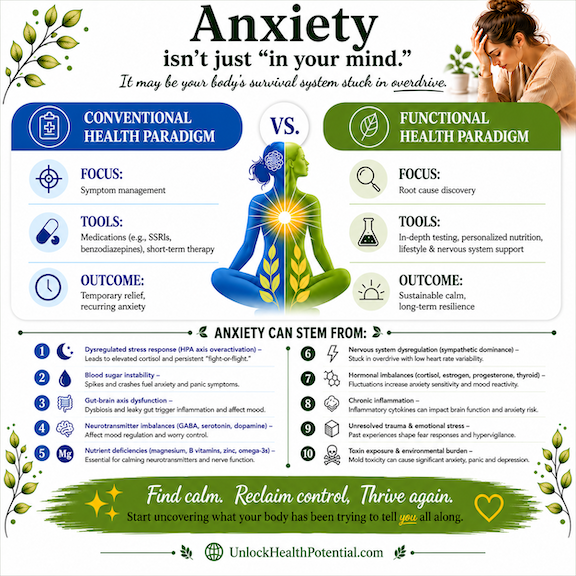
The Conventional Health Paradigm
Conventional medicine is incredibly valuable in acute psychiatric care, crisis intervention, trauma management, and severe mental health conditions. For many individuals, medication and therapy can be life-changing and absolutely necessary.
But when it comes to chronic anxiety, the conventional approach often centers primarily around symptom management.
The focus frequently becomes:
- Reducing anxious thoughts
- Improving emotional control
- Managing panic symptoms
- Stabilizing mood
Common interventions may include:
- SSRIs
- Benzodiazepines
- Anti-anxiety medications
- Short-term therapy
- Symptom-management strategies
These interventions can absolutely provide relief and may be appropriate in certain situations.
But many people eventually discover something frustrating: The anxiety often returns when the underlying physiological stressors remain unresolved. That’s because anxiety frequently reflects deeper dysfunction occurring beneath the surface—not simply “irrational thinking.”
The central question often becomes: “How do we suppress the symptom?”
Functional medicine asks something different: “Why is the nervous system stuck in a state of threat and overactivation?”
That question changes everything.
The Functional Health Paradigm
Functional medicine views anxiety through a systems-biology lens. Instead of seeing anxiety solely as a psychological issue, it recognizes that the brain and nervous system are deeply influenced by:
- Blood sugar regulation
- Inflammation
- Neurotransmitter production
- Gut health
- Hormonal balance
- Nutrient status
- Sleep quality
- Toxin exposure
- Immune activity
- Nervous system regulation
In other words: Anxiety is often not just emotional. It is physiological.
The body functions as an interconnected ecosystem. When multiple systems become dysregulated simultaneously, the nervous system may become increasingly reactive, hypervigilant, and stuck in survival mode.
The goal of functional medicine is not simply temporary calming. The goal is restoring the internal environment that allows the nervous system to feel safe again.
Why Root Causes Matter
Anxiety is not always a sign that something is “wrong” with your personality. Very often, it reflects a body attempting to adapt to chronic internal stress. When these stressors persist long enough, the body may begin interpreting ordinary experiences as threats. The nervous system becomes hypersensitive.
And unless the deeper drivers are addressed, many people remain trapped in repetitive cycles of:
- Hypervigilance
- Exhaustion
- Panic
- Poor recovery
- Emotional overwhelm
Even when they desperately want to feel calm.
10 Major Root Causes of Anxiety
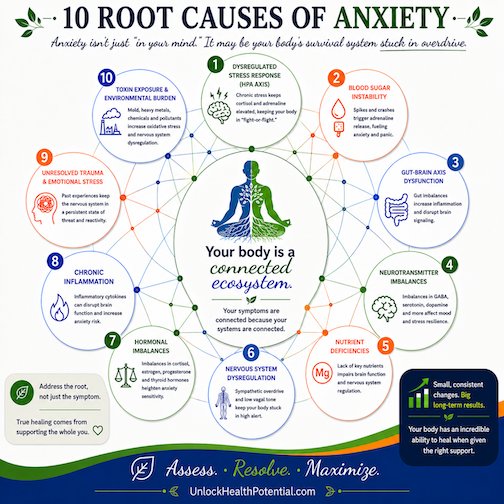
1. Dysregulated Stress Response (HPA Axis Overactivation)
The HPA axis regulates the body’s stress-response system. When stress becomes chronic, cortisol and adrenaline may remain elevated for prolonged periods, creating a constant physiological “fight-or-flight” state. This can contribute to:
- Racing thoughts
- Panic sensations
- Sleep disruption
- Hypervigilance
- Emotional reactivity
The body begins behaving as though danger is always present.
2. Blood Sugar Instability
The brain depends heavily on stable glucose availability. Frequent blood sugar spikes and crashes can trigger:
- Adrenaline release
- Shakiness
- Irritability
- Panic sensations
- Heightened anxiety
Many individuals experience anxiety symptoms that are at least partially metabolic in nature.
The nervous system does not feel safe when energy availability becomes unstable.
3. Gut-Brain Axis Dysfunction
The gut and brain communicate constantly through the gut-brain axis. An unhealthy gut environment may contribute to:
- Inflammation
- Neurotransmitter disruption
- Immune activation
- Altered stress signaling
This is one reason anxiety frequently appears alongside bloating, digestive symptoms, food sensitivities, and chronic inflammation.
The gut strongly influences mood regulation.
4. Neurotransmitter Imbalances
Neurotransmitters regulate calmness, focus, motivation, emotional balance, and nervous system stability. Imbalances involving GABA, serotonin, dopamine, and other signaling molecules may contribute to:
- Excessive worry
- Panic
- Low resilience
- Emotional instability
Anxiety is often biochemical—not simply cognitive.
5. Nutrient Deficiencies
The nervous system depends heavily on nutrients for proper regulation. Deficiencies in magnesium, B vitamins, zinc, omega-3 fatty acids, and vitamin D may impair:
- Neurotransmitter production
- Stress resilience
- Nervous system regulation
- Emotional stability
The brain cannot function optimally without adequate nutritional support.
6. Nervous System Dysregulation
Many people with anxiety have nervous systems that remain chronically activated even in the absence of immediate danger. This may involve:
- Sympathetic dominance
- Poor vagal tone
- Low heart rate variability
- Impaired recovery capacity
The body loses flexibility between activation and calm.
The nervous system becomes stuck in overdrive.
7. Hormonal Imbalances
Hormones strongly influence mood and nervous system regulation. Imbalances involving cortisol, estrogen, progesterone, and thyroid hormones can significantly affect:
- Anxiety sensitivity
- Emotional resilience
- Stress tolerance
- Mood stability
Hormonal fluctuations often amplify anxiety symptoms.
8. Chronic Inflammation
Inflammation affects the brain far more than most people realize. Inflammatory cytokines can alter:
- Neurotransmitter signaling
- Stress-response pathways
- Mitochondrial function
- Emotional regulation
This is one reason chronic inflammation is increasingly associated with anxiety and mood disorders.
9. Unresolved Trauma & Emotional Stress
The nervous system stores experiences. Past emotional trauma, chronic stress exposure, or prolonged hypervigilance may keep the body operating in a persistent threat-response state long after the original danger has passed.
This creates:
- Nervous system hypersensitivity
- Emotional reactivity
- Poor stress recovery
- Chronic anxiety patterns
Anxiety is often deeply connected to nervous system memory.
10. Toxin Exposure & Environmental Burden
Environmental toxins are one of the most overlooked contributors to anxiety. Exposure to mold, heavy metals, pesticides, chemicals, and poor indoor air quality can increase oxidative stress, inflammation, and nervous system dysregulation.
For some individuals, toxic burden becomes a major hidden driver of chronic anxiety symptoms.
How to Start Supporting the Nervous System Naturally
The goal is not perfection. The goal is creating an environment where the nervous system feels safer, more stable, and more resilient. Here’s where to begin:
1. Stabilize Blood Sugar
Build meals around:
- Protein
- Healthy fats
- Fiber
- Consistent meal timing
Stable blood sugar helps reduce adrenaline spikes and nervous system instability.
2. Prioritize Sleep & Recovery
Focus on:
- Consistent sleep timing
- Morning sunlight exposure
- Reduced nighttime stimulation
- Calmer evening routines
The nervous system cannot regulate properly without restoration.
3. Reduce Chronic Nervous System Overload
Incorporate recovery practices such as:
- Walking
- Breathwork
- Time outdoors
- Quiet moments
- Reduced overstimulation
The body needs opportunities to shift out of survival mode.
4. Support Nutrient Density
Prioritize foods rich in:
- Magnesium
- Omega-3s
- B vitamins
- Minerals
- Protein
The nervous system is metabolically demanding and highly nutrient-dependent.
5. Support Gut Health
Focus on:
- Whole foods
- Fiber
- Hydration
- Reducing inflammatory dietary patterns
The gut and brain are deeply interconnected. Improving digestive health often improves emotional resilience too.
Final Thought
Anxiety is not always “just in your mind.” Very often, it is the body signaling that deeper systems have become overwhelmed, dysregulated, or stuck in chronic survival mode.
The goal is not simply suppressing symptoms temporarily. The goal is restoring the systems that allow the nervous system to feel safe again.
Because your body is not trying to betray you. It is trying to protect you.
Okay — So What Do I Actually Do With All This?
General knowledge is useful — but knowing which of the 24 major root causes are driving your symptoms is the real game-changer. That’s what the HealthPotentialAnalytics™ assessment is built to do. This isn’t a throwaway online quiz — it’s a sophisticated algorithm refined over years of expert work that acts like a detective for your body, connecting the dots across systems to reveal exactly where your trouble is hiding. You get what you pay for, and serious results come from serious tools.

FAQs
Anxiety can absolutely have physiological contributors. Blood sugar instability, chronic stress, gut dysfunction, inflammation, hormonal imbalances, nutrient deficiencies, poor sleep, and nervous system dysregulation can all influence how safe or threatened the body feels. Anxiety is often more than a mindset—it can be a whole-body experience.
Because anxiety is not always driven by external circumstances. Sometimes the nervous system is responding to internal stressors such as elevated cortisol, unstable blood sugar, inflammation, poor sleep, or chronic nervous system activation. The body can perceive threat even when your conscious mind does not.
Start by supporting the nervous system. Prioritize sleep, stabilize blood sugar, reduce chronic stress, spend time outdoors, move your body regularly, and nourish yourself with nutrient-dense foods. Anxiety often improves when the body begins feeling safer, more stable, and better supported.
Because anxiety is not always driven solely by thoughts. If factors such as blood sugar instability, inflammation, gut dysfunction, hormonal imbalance, nutrient deficiencies, poor sleep, or chronic stress remain unresolved, the nervous system may continue signaling threat. Lasting improvement often requires supporting both the mind and the physiology beneath it.
Absolutely. The nervous system constantly communicates with the gut, immune system, endocrine system, and metabolic system. This is why anxiety frequently appears alongside digestive symptoms, fatigue, hormonal imbalances, brain fog, inflammation, and sleep disruption. Your symptoms are connected because your systems are connected.
This content is for educational purposes only and is not intended as a substitute for professional medical advice, diagnosis, or treatment. Individual results vary.
References & Further Reading
Chrousos GP. Stress and Disorders of the Stress System. Nature Reviews Endocrinology. 2009;5(7):374–381.
https://www.nature.com/articles/nrendo.2009.106
Cryan JF, O’Riordan KJ, Cowan CSM, et al. The Microbiota-Gut-Brain Axis. Physiological Reviews.2019;99(4):1877–2013.
https://journals.physiology.org/doi/full/10.1152/physrev.00018.2018
McEwen BS. Protective and Damaging Effects of Stress Mediators. New England Journal of Medicine.1998;338(3):171–179.
https://www.nejm.org/doi/full/10.1056/NEJM199801153380307
Miller AH, Maletic V, Raison CL. Inflammation and Its Discontents: The Role of Cytokines in the Pathophysiology of Major Depression. Biological Psychiatry. 2009;65(9):732–741.
https://www.sciencedirect.com/science/article/pii/S0006322309000407
Jacka FN, Mykletun A, Berk M, et al. The Association Between Habitual Diet Quality and the Common Mental Disorders in Community-Dwelling Adults. Psychosomatic Medicine. 2011;73(6):483–490.
https://journals.lww.com/psychosomaticmedicine/Abstract/2011/07000/The_Association_Between_Habitual_Diet_Quality.7.aspx
Bremner JD. Traumatic Stress: Effects on the Brain. Dialogues in Clinical Neuroscience. 2006;8(4):445–461.
https://www.ncbi.nlm.nih.gov/pmc/articles/PMC3181836/
Dinan TG, Cryan JF. Gut Instincts: Microbiota as a Key Regulator of Brain Development, Ageing and Neurodegeneration. The Journal of Physiology. 2017;595(2):489–503.
https://physoc.onlinelibrary.wiley.com/doi/full/10.1113/JP273106