
Your Body Keeps Trying To Tell You Something. This Blog Series Is About Learning To Hear It.
You know that thing where you’ve been inside all day, you’re irritable and foggy and slightly sick of everyone, and you step outside to take the trash out — and something in you just… loosens?
You’re out there maybe ninety seconds. Nothing has been solved. The emails are still there.
But you come back in a little more like yourself.
Most of us notice that, think huh, nice, and never think about it again.
We’ve spent a lot of time thinking about it. And it turns out there’s a whole body of research explaining what just happened to you on the way to the trash can — and, more usefully, why it keeps not happening on the days you never go outside at all.
That’s what this series is about. Ten of those moments. What’s actually going on underneath them, and how to get more of them without rearranging your life.
First: No, This Isn’t A “Go Touch Grass” Article
Let’s get that out of the way, because we’d be skeptical too.
This is not going to tell you that nature is healing and you should feel more grateful. It’s not going to suggest you move to the woods, buy anything, or start a morning routine with eleven steps in it.
We’re a naturopathic doctor and a medical doctor, and between us we’ve spent a long time with people who are exhausted, foggy, anxious, or just off — and whose lab work comes back completely normal. That’s a specific and maddening experience, and it’s more common than anyone admits.
When that happens, everyone goes looking in the same places. Sleep, blood sugar, thyroid, inflammation, stress. All worth checking. All sometimes the answer.
But there’s a category almost nobody checks, because no blood panel has a line for it: the environment your body is sitting in while it tries to do its job.
Not “nature” in the abstract. Specific, physical inputs — light, sound, texture, air, distance, other people — that your body has expected to receive for its entire evolutionary history and has recently, quietly, stopped getting.
Everything in this series has research behind it. Some of it is strong: randomized trials, large cohorts, findings that have held up. Some of it is early and interesting and we’ll say so. When a study is small, or a mechanism is guessed at rather than demonstrated, you’ll hear that from us — including the times the flimsier version would make a much better headline.
That’s the deal. Ten articles, free, no hype.
What Your Body Is Doing All Day While You’re Busy
Here’s the part that reorganized how we think about this.
Underneath everything you’re consciously doing — the meeting, the commute, the argument you’re replaying — your body is running a quiet background check on where you are. Not in words. In physiology: what to prioritize, what to postpone, how much to keep in reserve, whether now is a good time for repair or a good time for vigilance.
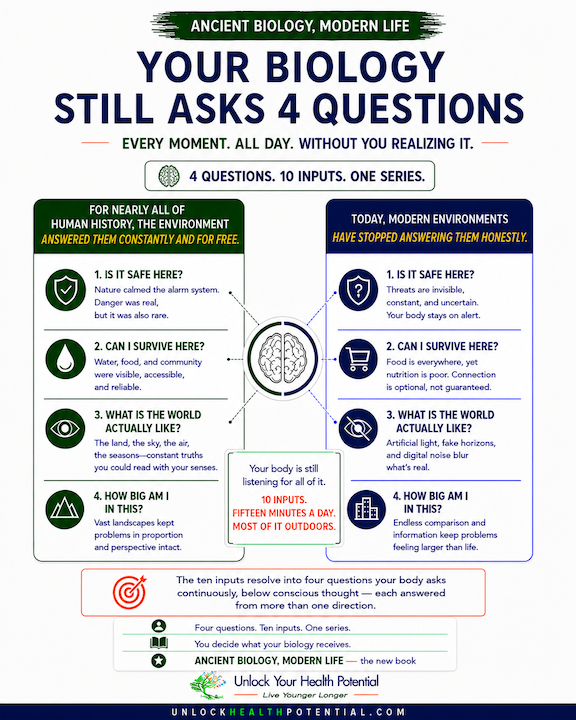
And that background check comes down to four questions.
Is it safe here? Should the alarm system stay armed, or can it stand down so your body can get on with the unglamorous maintenance work it would rather be doing?
Can I survive here? Is what I need actually nearby — water, food, people who’d notice if I disappeared?
What is the world actually like? What’s touching me, what’s in the air, what’s really out there — as opposed to what a screen is telling me is out there?
How big am I in this? Am I the largest thing in my own field of view right now, or is there something here bigger than my problems?
Your body asks all four, constantly, and adjusts you accordingly — below thought, without ever consulting you.
For nearly all of human history, the world answered them for you, for free, without you doing anything about it. You woke up when it got light. Birds went quiet when something was wrong. You could see a long way. You ate with people. The ground had texture.
Nobody scheduled any of that. It was just what being alive was like.
So What Happened?
The interesting thing is that modern life didn’t stop answering these questions.
It just started answering them badly.
Your alarm system asks is it safe here? and gets back: a phone that buzzes at unpredictable intervals, forty unread messages, a news cycle engineered to feel urgent, and no resolution to any of it. Threat that never arrives and never leaves. So the alarm stays half-armed, all day, for years.
It asks can I survive here? and gets: a fridge that’s full, a calendar that’s full, and a table you eat at alone with one hand on a keyboard.
It asks what is the world actually like? and gets: a flat screen, a flat floor, filtered air, a wall thirteen feet away, and a room that smells of nothing at all.
It asks how big am I in this? and gets: everyone else’s life, at a scale that makes your Tuesday look small and your problems look enormous.
Here’s what makes this so easy to miss. None of that feels like deprivation. It feels like a normal week. Nothing was taken away — it was replaced with something more convenient, one reasonable decision at a time, over about three generations.
And there’s no test for it. You can’t order a panel for “hasn’t seen the horizon in four months.” So it doesn’t come up, and people spend years working hard on the wrong thing.
The Ten Inputs
We call these inputs — the specific, physical things your environment used to hand your body without being asked. These ten have the best evidence behind them, and the biggest gap between what your biology expects and what a modern week actually supplies.
They sort into the four questions. Each article is free and stands on its own.
Is It Safe Here?
Part 1 — Morning Light There’s a third type of cell in your eye that has nothing to do with seeing. It wasn’t discovered until 2002, it’s wired straight to your body’s master clock, and we know it works because some people who are completely blind still keep perfect time. What you do in the first hour after waking quietly sets up the next sixteen. Start here if you’re tired despite sleeping enough.
Part 2 — Birdsong The blackbird outside your window at 5 a.m. is not singing for you — it’s making a territorial claim. But your nervous system has been eavesdropping on that conversation for a very long time, and it reads the gist perfectly: something is singing, therefore nothing is hunting. Six minutes of it did something measurable in a study of nearly three hundred people, including city dwellers who never hear birds.
Part 3 — Looking Into the Distance Most people have this exactly backwards. Inside your eye, looking far away is the relaxed state and focusing up close is the muscular work — which means a normal screen day is hours of held contraction in a muscle you’ve never thought about. It’s also why you always want the corner booth with your back to the wall.
Can I Survive Here?
Part 4 — Water Watch people arrive at the edge of the sea: they stop. Almost everyone stops, conversation dies out, and they stand there looking at a surface doing the same thing over and over. There’s a real reason for that, a genuinely lovely fact about what you’re made of, and one number about time in nature that’s far more achievable than you’d guess.
Part 5 — The Shared Table You’re hungry, you’re holding food, and you wait — carrying it somewhere else to divide it with people who didn’t help get it. Almost nothing else alive does this. And in a study of more than thirty-seven thousand adults, one finding turns the obvious assumption on its head: living with other people didn’t protect the ones who still ate alone.
What Is The World Actually Like?
Part 6 — Bare Feet The sole of your foot is covered in the same high-resolution tissue as your palms and lips, over four separate families of sensors reading pressure, slip, stretch, and vibration. A cushioned shoe is, functionally, a filter on all of it. In a recent trial, older adults at real risk of falling were randomized to a lifestyle change most people wouldn’t call medicine — and their balance improved while the control group’s didn’t.
Part 7 — Scent You can detect the smell of rain on dry ground at a few parts per trillion. Smell is also the only sense that skips the usual queue on the way to your emotions, which is why a scent hits you before you’ve worked out what it is. Also settled here: the long-running argument about whether aromatherapy is real, using a study involving mice with no cultural opinions about lavender.
Part 8 — The Living World Almost every organ you own arrived finished. One shipped deliberately incomplete — brilliant hardware, almost no content, and a curriculum that had to come from outside. Two farming communities with nearly identical genetics and very different barns tell you what happens when the curriculum changes.
How Big Am I In This?
Part 9 — Natural Geometry A fern repeats its own shape at every scale. So does a coastline, a cloud, a river delta — and so, it turns out, do your lungs, your blood vessels, and the branching of your neurons. Which raises a slightly vertiginous question about what you’re actually looking at when you look at a forest.
Part 10 — Awe The goosebumps you get at the end of a great song are your body trying to raise fur it stopped growing a very long time ago. In one experiment, sixty seconds of looking up at tall trees changed how people treated a stranger immediately afterward. And there’s a finding here that answers the objection everyone raises, which is that they don’t have time for any of this.
“This Sounds Like A Lot Of Homework”
It isn’t, and this is the part we’d most like you to believe.
Several of these arrive together, whether you plan it or not. Step outside early and you get morning light and the dawn chorus in the same act — they’ve always been delivered as a pair. Walk barefoot on grass and you’re feeding two completely different body systems at once with one decision. Sit somewhere with a long view and you’re doing something for your eyes and something for your nervous system simultaneously.
Which means this is not ten new obligations. It’s a much smaller number of small changes, most of them to time you were already going to spend somewhere anyway.
It also isn’t all-or-nothing. Nobody needs all ten. Most people have one question that’s gone badly unanswered for years and three that are broadly fine — and the whole trick is working out which one is yours before you spend six months energetically fixing something that wasn’t the problem.
That’s why the ten are worth reading together rather than one at a time. Any single input is a data point: real, but narrow. Read against the other nine it becomes a pattern — is this the only thing missing, or one of several? Read within its own question it becomes a direction. One input missing among nine healthy ones is a different situation entirely from three missing at once, all answering the same question badly.
The first is worth fixing. The second tells you where your week has actually gone wrong.
What The Articles Give You, And What The Book Adds
Every article here is free, and we’d genuinely rather you read them than buy anything. Each one covers what the input is, what the research found, why it went missing, and where to start.
Ancient Biology, Modern Life — the book — exists for the part an article can’t do.
The full chapter on each. More of the research and what it actually found, the mechanisms underneath, and considerably more on what to do about it than a blog post has room for.
The protocol. Every one of these has a version that works and several that quietly waste your time — wrong moment, wrong dose, wrong order. Get it wrong and you’ll conclude the input doesn’t work, when what didn’t work was the way you used it.
How they stack. Which of these collapse into each other, and in what order, so that ten inputs become roughly fifteen minutes a day instead of a second job.
How to read your own pattern. Which of the four questions has gone longest unanswered in your life — because two people missing the same number of inputs can need almost nothing in common.
And whatever you find when you go looking, read it as feedback rather than a grade. Wherever you’re starting today is simply your starting line. Discovering that four of these have been missing for years doesn’t mean something is wrong with you — it means your environment has been quietly withholding things that are, for the most part, cheap to give back.
Where To Start
If you’re exhausted and your sleep is fine: Part 1. Circadian misalignment is one of the most common and most missed causes of unexplained fatigue, and it’s cheap to fix.
If your brain won’t stop running: Part 2 or Part 4. Both work through attention rather than willpower, which matters, because willpower is usually the thing that’s run out.
If you want something you can do in the next sixty seconds: Part 7. Nothing else here acts faster.
If you have kids: Part 3. The strongest evidence-backed recommendation in the whole series is in that article, and it’s about children.
If you’d rather just read it in order: start at Part 1 and work through. Each one hands off to the next, and the shape of the thing assembles as you go.
Get the Book
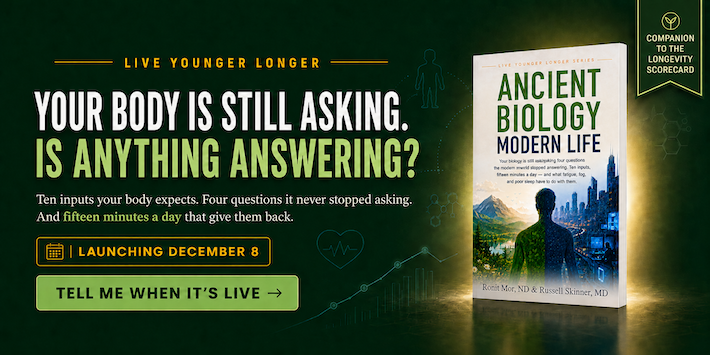
Ancient Biology, Modern Life — the new book from Ronit Mor, ND and Russell Skinner, MD — gives you a full chapter on each of the ten inputs, the research behind every one, and simple steps for restoring it. Then it shows you how the ten fit together — which arrive in the same act, in what order, and which of your four questions has gone unanswered longest — so you finish with roughly fifteen minutes a day built around your own life.
This is Book Two in the Live Younger Longer series — short books you can finish in an afternoon, each focused on the small changes that make the biggest difference to how you age. Its companion volume, The Longevity Scorecard, measures the ten signals your body sends outward. This book restores the ten inputs your body receives. Read them in either order.
FAQs
A framework of ten environmental inputs — birdsong, water, natural geometry, bare feet, awe, morning light, shared meals, distance, scent, and the living world — organized around four questions your biology asks continuously below conscious thought. The premise is that these answered those questions for free throughout human history, and modern environments stopped supplying them honestly.
No. Nobody is suggesting you leave your life. Every practice takes minutes and works in a city; several work indoors. The claim is narrower and more testable than “get back to nature”: ten specific channels between your environment and your biology, and what happens when you reopen them.
Every article is built on peer-reviewed research with full citations. Where the evidence is strong we say so. Where a finding is preliminary or a mechanism contested, we say that too — including when the more impressive version would make a better headline.
Less than most people expect, because several arrive together rather than separately. The book sets out the daily practice in full. The short answer is that it is measured in minutes, most of it during time you were going to spend somewhere anyway.
No. These are inputs that support a body already working hard on your behalf. They are not treatments for disease, and several articles carry cautions about who should speak with a physician first. Anything persistent or worrying deserves proper clinical evaluation.
This content is for educational purposes only and is not intended as medical advice. Individual articles contain specific safety guidance — please read them before beginning any new practice.