

Find clarity. Find causes. Find your way forward
You sleep. You try to eat well. You keep showing up — for work, for the people who count on you, for the endless invisible list of things that only get done because you do them. And still, you wake up tired. By mid-afternoon you’re dragging your body through the day like it’s not quite yours anymore. By evening you’re too depleted to enjoy the life you’re working so hard to hold together.
If you’ve ever typed “why am I always tired despite doing everything right” into a search bar late at night, read this first: you’re not being dramatic. You’re paying attention to your body — and it’s trying to tell you something. Chronic exhaustion is almost never solved by “go to bed earlier” or “drink more water.”
Fatigue is one of the top reasons people see a primary care provider, and left unexplained, it quietly wears down your focus, your work, and your sense of self. A truly thorough evaluation looks at your history, symptoms, medications, sleep, heart and lungs, nervous system — even your skin. Not one rushed lab panel.
And here’s the part that changes everything: your exhaustion is information. It’s a signal with a source. When you can see the pattern underneath it, you stop guessing and start moving toward answers.
This is your map.
What Your Exhaustion Is Actually Telling You
Let’s name what you’ve probably been told, out loud or between the lines — that you’re tired because you’re lazy, weak, or not trying hard enough. None of it is true.
Persistent exhaustion is your body flagging that something in your energy system is under strain. And that system is bigger than most people realize: sleep quality, oxygen delivery, blood sugar, thyroid, hormone rhythms, nervous-system load, nutrient levels, immune activity, medications, stress, and recovery. MedlinePlus alone lists dozens of possible causes, from anemia and thyroid problems to autoimmune conditions, diabetes, depression, and heart failure.
This is why so many people leave an appointment feeling unseen after hearing “Your labs are normal.” Normal screening can be reassuring and still not explain why you’re tired all the time. A standard panel often won’t capture your afternoon crashes, your post-meal slump, your hormonal shifts, your fragmented sleep, or the way you crash for days after pushing too hard. Normal isn’t the same as answered.
A quick safety note. Most fatigue builds slowly, but some signs need prompt attention. If your fatigue is sudden, severe, or worsening fast — or comes with chest pain, shortness of breath, fainting, confusion, black or bloody stools, new neurological symptoms, unexplained weight loss, high fever, or any thoughts of harming yourself — seek care right away.
For everyone else, here are the eight patterns standard checkups most often miss.
8 Root-Cause Patterns That Can Keep You Running on Empty
1. You’re Sleeping — but It Isn’t Restoring You
You can spend a full eight hours in bed and still not get the sleep your body uses to repair, balance hormones, and rebuild energy. Time in bed and restorative sleep are not the same thing — and the NIH’s National Heart, Lung, and Blood Institute notes that the deficit spills into your work, your driving, and your relationships.
One commonly missed culprit is sleep apnea — breathing that repeatedly stops and restarts overnight, dropping your sleep quality and oxygen without fully waking you. The FDA links obstructive sleep apnea to morning exhaustion, with clues like daytime sleepiness, waking with a dry throat or headache, frequent night waking, and trouble concentrating — and notes these can be quieter in some people, which is part of why it goes undiagnosed for years.
Pattern clues: You wake unrefreshed, lean on caffeine to function, get morning headaches, snore, wake gasping, get up often at night, or nod off while sitting still.
Next step: For 7–10 days, track your bedtime, wake time, night wakings, alcohol and caffeine timing, screens, and morning energy. For deeper support, explore our guide on the root causes of sleep issues and insomnia.
2. A Quiet Nutrient Gap Is Capping Your Energy
Your body can’t make energy without the raw materials to build it — so fatigue often shows up long before you’d ever call yourself “sick.”
Iron is one of the biggest. You’re more vulnerable if you menstruate, have been pregnant, donate blood often, have digestive conditions that affect absorption, or don’t eat much iron-rich food. The Office on Women’s Health notes that iron-deficiency anemia is more common in women than men and can bring fatigue, weakness, dizziness, feeling cold, breathlessness with activity, and cravings for ice or non-food items.
Vitamin B12 matters just as much. The NIH’s Office of Dietary Supplements notes a deficiency can cause fatigue, neurological changes, and a type of anemia in which red blood cells grow abnormally large. Here’s the catch worth underlining: those nerve symptoms can appear without anemia — so a quick “you’re not anemic” result may not tell the whole story.
Pattern clues: Fatigue paired with headaches, dizziness, breathlessness on stairs, restless legs, hair shedding, tingling or numbness, brain fog, or low mood.
Next step: Ask your clinician whether to test iron studies, ferritin (a marker of stored iron), B12, folate, and vitamin D for your situation. A functional health evaluation often looks past a single “in-range” value to the fuller picture.
3. Your Thyroid Is Running Slower Than Your Life Demands
Your thyroid is the dial that sets how fast your body burns energy. When it’s turned down, your internal battery never quite reaches a charge. The NIDDK lists the signs of an underactive thyroid: fatigue, weight gain, feeling cold, achy joints, dry skin, thinning hair, heavier or irregular periods, and low mood. It can develop so gradually you may not notice for months or years — you simply adjust to a lower-energy version of yourself.
That slow creep is exactly why thyroid fatigue gets mistaken for stress, a hormonal transition, anemia, or depression — and how people end up told it’s “just aging.”
Pattern clues: You’re cold when no one else is, gained weight without a clear reason, feel puffy, foggy, achy, or flat, or notice heavier cycles or thinning hair.
Next step: Ask whether a thyroid evaluation fits — possibly TSH, free T4, free T3, and thyroid antibodies, a fuller picture than the single value many panels stop at.
4. Blood Sugar Swings Are Putting You on a Rollercoaster
If your energy spikes and plummets across the day, how you process blood sugar may be part of the story. This does not mean you have diabetes. It can simply mean your body struggles to keep energy steady between meals or after a starch-heavy plate. The NIDDK notes that type 2 diabetes can develop slowly over years, mild enough that many people don’t notice it — which is why steady, unexplained fatigue is worth attention early.
Pattern clues: You crash after meals, feel shaky or irritable when a meal runs late, crave sugar or caffeine in the afternoon, or feel wiped after high-carb meals.
Next step: Notice your energy 30, 60, and 120 minutes after eating, and pair carbohydrates with protein, fat, and fiber. Ask whether fasting glucose, A1C (your average blood sugar over roughly three months), or fasting insulin are worth checking. For more, see our post on the root causes of blood sugar imbalance.
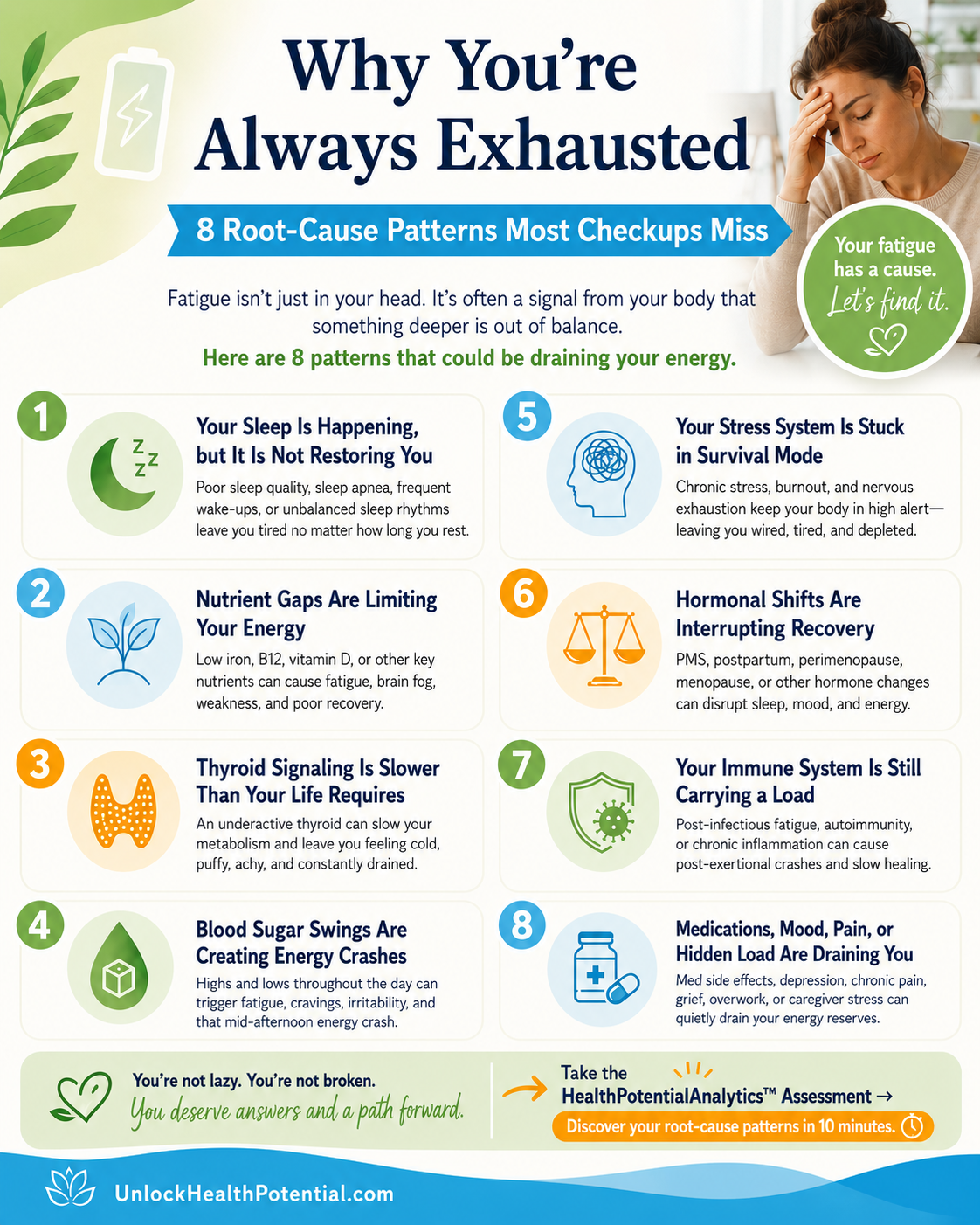
5. Your Stress System Is Stuck in Survival Mode
You might call it burnout, nervous exhaustion, or “adrenal fatigue.” The labels vary, but the experience rhymes: wired and tired — overstimulated yet depleted, unable to rest even when you finally stop.
Here’s the honest distinction, because you deserve the real answer. “Adrenal fatigue” is not a recognized diagnosis — the Endocrine Society states there’s no scientific proof behind it, and warns that an unproven label can delay finding the real cause. At the same time, adrenal insufficiency — where the glands genuinely underproduce key hormones — is a real condition deserving evaluation, with signs like fatigue, muscle weakness, low appetite, weight loss, lightheadedness, and low blood pressure. Underneath it all sits your HPA axis (the hypothalamic-pituitary-adrenal axis), the line between brain and adrenal glands that regulates cortisol, your main stress hormone. When life keeps that line lit, your whole system struggles to power down.
Pattern clues: You’re exhausted but restless, need caffeine to push through, feel worse after conflict, sleep poorly, crave salty or sweet foods, or feel stuck on “high alert.”
Next step: Don’t self-treat with adrenal hormones or aggressive supplements — that’s exactly where unproven labels do real harm. Look instead at the fixable inputs: sleep, nourishment, recovery, nervous-system regulation, stress load, and the medical causes that can mimic burnout. Our post on burnout and adrenal dysfunction goes deeper.
6. Hormonal Shifts Are Interrupting Your Recovery
Hormones shape sleep, temperature, mood, metabolism, and energy — for everyone. Thyroid hormones, cortisol, insulin, estrogen, progesterone, and testosterone all play a part, and when any one of them shifts, your energy shifts too.
The biggest shifts come during clear transitions: the menstrual cycle, pregnancy and postpartum, perimenopause and menopause, PCOS, endometriosis, or low testosterone. If any of these apply to you, the fatigue isn’t “all in your head” — it’s your body responding to genuine change. The Office on Women’s Health notes that many people struggle to sleep through perimenopause and menopause, as lower progesterone makes sleep harder to hold and lower estrogen can trigger hot flashes and night sweats that fracture it. Daytime tiredness follows.
Pattern clues: Your exhaustion tracks with your cycle, ovulation, the postpartum period, or a menopausal transition — or travels with mood swings, cravings, headaches, heavier bleeding, or night sweats.
Next step: Track symptoms against your cycle or hormonal stage so a pattern can surface. For more guidance, read our post on the root causes of hormonal imbalance.
7. Your Immune System Is Still Carrying a Load
Sometimes fatigue begins after an infection or a long stretch of immune stress, and your energy never climbs back to baseline. Other times it worsens after exertion — a workout, a hard conversation, a poor night’s sleep. You can look completely “fine” while your body works overtime beneath the surface.
One pattern worth knowing is post-exertional malaise (PEM) — when symptoms flare after effort that used to feel manageable. The crash is sneaky: it may surface hours later or the next day and take days to lift, which is exactly why the connection is so easy to miss.
Pattern clues: You crash after exercise, errands, social events, or demanding mental work, and rest doesn’t fully restore you. You may also notice brain fog, dizziness, body aches, swollen glands, or a flu-like feeling.
Next step: Resist pushing through repeated crashes — that pattern is itself a clue. Track what you did, how you felt afterward, and whether symptoms flared later. Then bring it to a clinician who understands complex fatigue, and consider discussing post-infectious fatigue, immune dysregulation, autoimmune conditions, and ME/CFS (myalgic encephalomyelitis/chronic fatigue syndrome).
8. Medications, Mood, Pain, or Hidden Load Are Draining Your Reserves
Sometimes the answer isn’t one dramatic diagnosis. It’s the quiet accumulation of many smaller drains — each forgivable alone, exhausting in total.
Medications can be part of it: MedlinePlus lists antihistamines, blood pressure medicines, sleeping pills, steroids, and diuretics among those that can cause fatigue. A change you barely registered weeks ago can still be pulling at your energy now. Mood can play a role too — without your fatigue being “all in your head.” The NIMH describes depression as a real illness that affects how you feel, think, sleep, eat, and move.
And then there’s everything else a real life asks of a real body: pain, grief, caregiving, overwork, trauma, loneliness, under-eating, and the sheer weight of constant decisions. These aren’t character flaws. They’re genuine loads — and any one of them can quietly empty your tank.
Pattern clues: Your fatigue started after a medication change, a major stressor, a loss, an injury, a caregiving season, a pain flare, or a long stretch of carrying more than your share.
Next step: Review medications and supplements with your clinician or pharmacist. Then take an honest, blame-free inventory of the load you’re carrying. Easing it — and getting real support — can be a meaningful part of getting your energy back.
What Standard Care Can Miss
Conventional medicine is essential. It rules out the urgent and the clearly treatable, and you should never skip that step. But many visits are built around short appointments and standard screening — not pattern recognition across your whole life. There often isn’t time in fifteen minutes to connect the dots you’ve been collecting for months: the timing of your fatigue, your post-meal crashes, your cycle pattern, your delayed crashes after exertion, your unrefreshing sleep, your “low-normal” nutrients, your invisible workload.
Here’s the reframe that changes the entire search. Instead of asking “What single thing is wrong with me?” ask “What patterns are draining my energy faster than I can restore it?” That one shift turns a dead end into a map you can follow — and it’s the heart of a root-cause approach to health.
How HealthPotentialAnalytics™ Connects the Dots
At Unlock Health Potential, we built a proprietary online assessment to help you move from scattered symptoms to a clear pattern. To be clear about what it is — and isn’t: it’s not a diagnosis, and not a replacement for medical care. It’s a structured way to view your energy through multiple lenses at once: sleep, stress, hormones, nutrition, lifestyle, recovery, immune load, and daily function.
That matters because fatigue is so often multi-factorial. You might have disrupted sleep and low iron. Blood sugar swings and a hormonal transition. Thyroid changes and chronic stress. Examine one piece at a time and the pattern stays hidden. HealthPotentialAnalytics™ helps you organize what your body has been trying to tell you — so you can walk into your next conversation informed.
Ready to Discover Your Root-Cause Patterns?
You don’t have to keep pushing through the exhaustion or guessing your way forward. Lasting energy rarely comes from one quick fix — it comes from understanding your own root causes and addressing them with the right tools and expert guidance. Here’s the path we’d recommend:
1. Build your foundation (optional, but recommended). Start with our book, Unlock Your Health Potential, to understand how your body’s energy systems connect — and why “normal labs” so often miss the real story.
2. Pinpoint your patterns. Take the HealthPotentialAnalytics™ assessment — our proprietary tool, refined over years of clinical work — to see which root-cause patterns are draining your energy. This is the step that turns scattered symptoms into a clear map.
3. Go deeper, free. Root cause by root cause. Work through our free 24-video series, which unpacks each of the 24 major root causes mapped in your assessment. And because gut health quietly underpins so many of these patterns — from nutrient absorption to blood sugar stability — download our free Gut Intelligence ebook to understand one of the most overlooked drivers of low energy.
4. Prepare for your practitioner. Return to the book for practical strategies and next steps you can bring into an informed conversation with your health professional.
5. Rebuild your energy for good. When you’re ready to turn insight into lasting change, our Master Your Health in 8 Weeks health mastery program guides you through a structured, expert-led plan to revamp the lifestyle inputs behind your fatigue.
Want to go deeper on a specific pattern first? Keep reading on sleep issues and insomnia, burnout and adrenal dysfunction, and hormonal imbalance.
Your fatigue is not a verdict. It’s a message. And with the right pattern map in hand, that message becomes your first real step back toward energy, clarity, and confidence.

FAQs
Spending enough time in bed isn’t the same as getting restorative sleep. Hidden disruptors like sleep apnea, low iron or B12, thyroid changes, blood sugar swings, or chronic stress can leave you exhausted despite a full night’s rest. Tracking your patterns helps reveal the cause.
Low iron and low vitamin B12 are two of the most common nutrient-related causes of fatigue. Notably, B12-related nerve symptoms can appear even without anemia, so a basic “you’re not anemic” result may not tell the whole story. Vitamin D and folate can also play a role.
Yes. Normal screening labs can be reassuring but don’t always explain ongoing fatigue. Standard panels may miss “low-normal” nutrients, post-meal energy crashes, hormonal shifts, unrefreshing sleep, or post-exertional crashes. Normal isn’t always the same as answered, and your symptoms still deserve a closer look.
“Adrenal fatigue” is not a recognized medical diagnosis, and the Endocrine Society notes there’s no scientific proof behind it. However, true adrenal insufficiency is a real, diagnosable condition. Persistent burnout-like fatigue is worth evaluating to find the actual underlying cause rather than self-treating.
See a clinician if fatigue is persistent or affecting daily life. Seek prompt care for sudden, severe, or worsening fatigue, or fatigue with chest pain, shortness of breath, fainting, confusion, unexplained weight loss, or new neurological symptoms. These can signal something needing urgent attention.
This article is for education and is not a substitute for medical care. Individual results vary. If you’re experiencing any of the urgent warning signs described above, seek medical attention promptly.
Scientific References
Latimer, K. M., Gunther, A., & Kopec, M. Fatigue in Adults: Evaluation and Management. American Family Physician. 2023.
URL: https://www.aafp.org/afp/2023/0700/fatigue-adults
MedlinePlus. Fatigue. U.S. National Library of Medicine. Updated 2025.
URL: https://medlineplus.gov/ency/article/003088.htm
National Heart, Lung, and Blood Institute. How Sleep Affects Your Health. NIH.
URL: https://www.nhlbi.nih.gov/health/sleep-deprivation/health-effects
U.S. Food & Drug Administration. Always Tired? You May Have Sleep Apnea. FDA Consumer Updates. 2024.
URL: https://www.fda.gov/consumers/consumer-updates/always-tired-you-may-have-sleep-apnea
Office on Women’s Health. Iron-Deficiency Anemia. U.S. Department of Health and Human Services. Updated 2025.
URL: https://womenshealth.gov/a-z-topics/iron-deficiency-anemia
National Institutes of Health, Office of Dietary Supplements. Vitamin B12: Fact Sheet for Health Professionals. Updated 2025.
URL: https://ods.od.nih.gov/factsheets/VitaminB12-HealthProfessional/
National Institute of Diabetes and Digestive and Kidney Diseases. Hypothyroidism, also called Underactive Thyroid. NIH.
URL: https://www.niddk.nih.gov/health-information/endocrine-diseases/hypothyroidism
National Institute of Diabetes and Digestive and Kidney Diseases. Symptoms & Causes of Diabetes. NIH.
URL: https://www.niddk.nih.gov/health-information/diabetes/overview/symptoms-causes
Endocrine Society. Adrenal Fatigue. Hormone Health Network / Endocrine Society. 2022.
URL: https://www.endocrine.org/patient-engagement/endocrine-library/adrenal-fatigue
Cadegiani, F. A., & Kater, C. E. Adrenal fatigue does not exist: a systematic review. BMC Endocrine Disorders. 2016;16:48.
URL: https://pmc.ncbi.nlm.nih.gov/articles/PMC4997656/
Endocrine Society. Adrenal Insufficiency. Hormone Health Network / Endocrine Society. 2022.
URL: https://www.endocrine.org/patient-engagement/endocrine-library/adrenal-insufficiency
Cleveland Clinic. Hypothalamic-Pituitary-Adrenal Axis: What It Is. Medically reviewed, 2024.
URL: https://my.clevelandclinic.org/health/body/hypothalamic-pituitary-adrenal-hpa-axis
Herman, J. P., McKlveen, J. M., Ghosal, S., et al. Regulation of the Hypothalamic-Pituitary-Adrenocortical Stress Response. Comprehensive Physiology. 2016.
URL: https://pmc.ncbi.nlm.nih.gov/articles/PMC4867107/
Office on Women’s Health. Menopause Symptoms and Relief. U.S. Department of Health and Human Services. Updated 2025.
URL: https://womenshealth.gov/menopause/menopause-symptoms-and-relief
Centers for Disease Control and Prevention. Clinical Overview of ME/CFS. CDC. 2024.
URL: https://www.cdc.gov/me-cfs/hcp/clinical-overview/index.html
Centers for Disease Control and Prevention. Strategies to Prevent Worsening of Symptoms: ME/CFS. CDC. 2024.
URL: https://www.cdc.gov/me-cfs/hcp/clinical-care/treating-the-most-disruptive-symptoms-first-and-preventing-worsening-of-symptoms.html
Centers for Disease Control and Prevention. Symptoms of ME/CFS. CDC. 2024.
URL: https://www.cdc.gov/me-cfs/signs-symptoms/index.html
National Institute of Mental Health. Depression. NIH.
URL: https://www.nimh.nih.gov/health/topics/depression
National Institute of Mental Health. Depression. NIH Publications.
URL: https://www.nimh.nih.gov/health/publications/depression