
The Hidden Biology of Everyday Life
INPUT 05 · The Shared Table · Question it answers: Can I survive here? · What it restores: Daily, renewed evidence that you are not alone against the odds.
Input 5 of 10 in Ancient Biology, Modern Life.
Here’s something you do that almost nothing else alive does.
You’re hungry. You’re holding food. And you wait.
You carry it somewhere else. You put it down on a flat surface. You divide it, hand most of it to other people, and then — often — wait longer still, until everyone’s been served, before eating any of it yourself.
Watch a hungry animal find food. It eats, immediately, where it stands.
A Japanese cohort followed more than thirty-seven thousand older adults and found eating alone associated with higher risk of developing depression over the following three years.
That much you might have guessed. Here’s the part that isn’t guessable.
A later analysis of the same cohort, looking at mortality rather than mood, found that men who ate alone while living with others carried higher risk than men who both ate and lived alone.
Proximity didn’t protect. Which suggests what registers isn’t another person in the building.
What a Meal Was Actually For
Strip away the cuisine and the etiquette, and a shared meal is a transaction of real consequence.
To hand someone food is to give away calories you could have eaten. It’s costly, visible, and difficult to fake — which makes it one of the most reliable signals available that a group intends to keep each other alive.
For nearly all of human history this wasn’t sentiment. It was infrastructure. Hunting failed unpredictably; gathering fluctuated with season and luck. The people who ate consistently weren’t the best hunters — they were the ones embedded in a group that pooled and redistributed.
A shared meal was ongoing evidence, renewed daily, that you weren’t alone against the odds. Your nervous system, which spends every waking moment assessing exactly this question, had every reason to treat it as significant.
There’s a second line of research we don’t have room for — on who thrives rather than who struggles, and on what happens to children specifically. The chapter takes both.
Why the Body Notices
There’s a physiological argument alongside the social one, and it’s more mundane than it sounds.
Digestion is parasympathetic work. It proceeds well when the body has decided nothing urgent is happening — blood toward the gut, secretions on schedule, motility uninterrupted. That’s the state called rest and digest, and the name isn’t decorative. The digesting depends on the resting.
Now consider how most solitary meals happen. Standing at a counter. In a car. At a desk, one hand on a keyboard, the meal registering mainly as an interruption.
A shared meal is structurally different. Slower, because conversation takes time. Seated, because you’re facing someone. It has a beginning and an end rather than dissolving into the day.
The mechanism here is more clearly reasoned than measured, and we’d rather say so. But the conditions a shared meal creates are, quite precisely, the conditions digestion prefers.
A necessary caution. Almost every study here is observational. People who eat with others differ in health, income, mobility, and circumstance — and causation could run either direction, or both. Eating together may build wellbeing; feeling well may make eating together easier.
So How Much Do You Actually Need?
There’s no established threshold, and we won’t manufacture one.
Nearly all of this research measures frequency rather than testing doses against outcomes. Nobody has run the trial that would give you a number, and it isn’t obvious such a trial could be run well.
What the evidence does point at is that consistency beats volume: one protected meal that reliably happens outperforms four aspirational ones that keep getting moved. Which meal, and how to hold it, lives in the book.
The shared table on its own is a data point — real, but narrow. Read against the other nine it becomes a pattern. Read within its own question it becomes a direction: a table missing alone is a different situation from a table missing alongside water, both answering the same question badly at once.
And read whatever you find as feedback rather than a grade. Eating most meals alone doesn’t mean something is wrong with you — for many people it’s a consequence of a schedule nobody chose. Wherever you’re starting is simply your starting line.
Where This Input Sits in the Pattern
Ten inputs, and the interesting part isn’t the count — it’s that they answer only four questions, the ones your biology puts to a place over and over: Is it safe here? Can I survive here? What is the world actually like? How big am I in this?
The shared table belongs to the second, sharing that question with only one other input: the pull of open water. Water is the landscape saying this place can sustain you. A table is other people saying and we will.
But this input differs from the other nine in one respect. Every other one can be restored alone — light, water, birdsong, bare ground, all available today without asking anyone.
This one requires another person to be standing there, which makes it the hardest to arrange and the easiest to postpone indefinitely.
What Actually Restores It
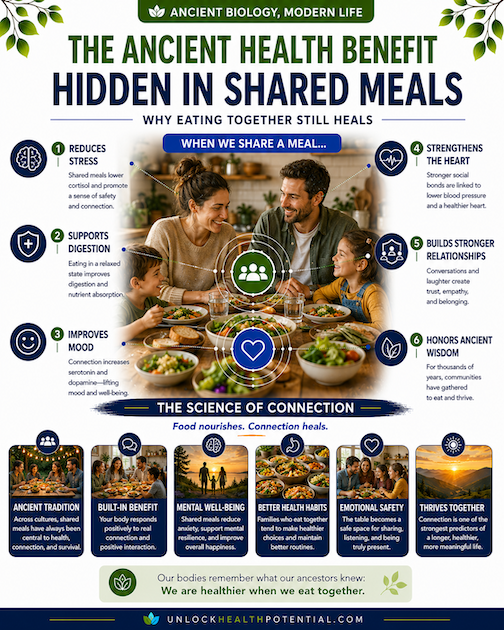
The levers are unglamorous and they work. Protect one meal and treat it as fixed — a specific meal on a specific day, held as firmly as a work commitment. Put the phones in another room rather than face-down on the table, because research on the mere presence of a device found reduced conversation quality even when nobody picked it up. Serve from shared dishes, portioned at the table rather than plated in the kitchen. And if you live with people and still eat separately, start exactly there.
The harder questions are which meal to protect, how to structure it so it does the work rather than merely occurring, and how to build this at all if you live alone.
One honest note. Shared meals aren’t universally easy. For someone recovering from disordered eating, managing a complicated relationship with food, or navigating a difficult family, a table can be a hard place rather than a restorative one. If that’s your situation, please work with a qualified professional on what a good meal looks like for you. Pushing through discomfort is not the goal.
Where This Leaves You
You don’t need to rebuild the family dinner. You need one meal, on one day, that actually happens — and few pieces of evidence that conditions are right have ever been more convincing than food handed to you by someone who wanted you to have it.
An article can name the levers and stop there. Which meal, how to hold it, and what to do if you live alone depends on the shape of your week — so in the book each input’s practice is worked against that, and against the other nine, because several of these arrive in the same act rather than as ten separate obligations.
Then keep going, because one input is never the whole picture.
In Part 6 we move to the third question, starting at the ground: four families of receptors in the sole of your foot, and a recent trial that randomized older adults at real risk of falling to something most people call a lifestyle choice.
Your biology never stopped asking. It is time you answered.
New to this blog series? Start with the series overview →
Get the Book
Ancient Biology, Modern Life — the new book from Ronit Mor, ND and Russell Skinner, MD — gives you a full chapter on each of the ten inputs, the research behind every one, and simple steps for restoring it. Then it shows you how the ten fit together — which arrive in the same act, in what order, and which of your four questions has gone unanswered longest — so you finish with roughly fifteen minutes a day built around your own life.
This is Book Two in the Live Younger Longer series — short books you can finish in an afternoon, each focused on the small changes that make the biggest difference to how you age. Its companion volume, The Longevity Scorecard, measures the ten signals your body sends outward. This book restores the ten inputs your body receives. Read them in either order.
FAQs
Research consistently finds associations between frequent social eating and better wellbeing, stronger social networks, and — among children and adolescents — better nutritional outcomes. The broader literature on social connection is stronger still, with meta-analyses linking isolation to meaningful mortality risk. Most of this evidence is observational, so it shows association rather than proving cause.
Not inherently, and many people enjoy solitary meals. But a large longitudinal study of older adults in Japan found eating alone associated with higher depression risk over three years — and among women, that held even when they lived with others. A later analysis of the same cohort found that men who ate alone while living with others had higher mortality risk than men who both ate and lived alone. The concern appears to be less about solitude itself than about the absence of connection where connection is available.
Research on the presence of mobile devices has found reduced conversation quality and lower reported closeness — even when the phone is never picked up. Since the value of a shared meal lies in the attention people give each other, a device that fragments that attention undermines the point.
Build it outward rather than inward. A standing weekly dinner with a friend, a shared lunch instead of a desk lunch, or a video call where both people are genuinely eating. The evidence points to the act of turning toward someone, not to your living arrangements.
Then this is a question for a qualified professional rather than a general article. For people recovering from disordered eating or navigating a hard family situation, shared meals can be genuinely difficult, and the right approach is individual. Please seek proper support rather than working from general advice.
This content is for educational purposes only and is not intended as medical advice.
Scientific References
Tani Y, Sasaki Y, Haseda M, Kondo K, Kondo N. Eating alone and depression in older men and women by cohabitation status: the JAGES longitudinal survey. Age Ageing. 2015;44(6):1019-1026.
Tani Y, Kondo N, Noma H, et al. Eating alone yet living with others is associated with mortality in older men: the JAGES cohort survey. J Gerontol B Psychol Sci Soc Sci. 2018;73(7):1330-1334.
Dunbar RIM. Breaking bread: the functions of social eating. Adaptive Human Behavior and Physiology. 2017;3(3):198-211.
Hammons AJ, Fiese BH. Is frequency of shared family meals related to the nutritional health of children and adolescents? Pediatrics. 2011;127(6):e1565-e1574.
Holt-Lunstad J, Smith TB, Baker M, Harris T, Stephenson D. Loneliness and social isolation as risk factors for mortality: a meta-analytic review. Perspect Psychol Sci. 2015;10(2):227-237.
Przybylski AK, Weinstein N. Can you connect with me now? How the presence of mobile communication technology influences face-to-face conversation quality. J Soc Pers Relat. 2013;30(3):237-246.