

Picture this. You’ve been dragging yourself through the day for months. You’re wiped out by 2 p.m., your brain feels like it’s buffering, and your gut has started staging a quiet rebellion after meals. So you do the responsible thing — you see your doctor, get the bloodwork, and wait.
The results land. The verdict?
“Everything looks normal. You’re fine.”
Except you don’t feel fine. Not even a little.
If that scene made you nod (or wince), congratulations — you’ve just walked straight into the gap that functional health was built to fill. So let’s talk about what it actually is, how it’s different from the conventional care you grew up with, and the fun part: why understanding the difference might permanently change how you think about your own body.
The 30-Second Definition
Functional health is a way of looking at the body that asks one deceptively simple question:
Why?
Not “what’s the label for these symptoms?” but “what’s actually driving them?” It treats your body as one connected system rather than a collection of unrelated parts, and it hunts for the root cause of a problem instead of just quieting the noise the problem is making.
That’s the whole philosophy in a sentence. Everything else is just detail. (And yes — we love the detail. It’s kind of our whole thing.)
Meet the Firefighter and the Detective
Here’s the reframe that makes everything click.
Conventional medicine is a firefighter. When your appendix bursts, when you’re in a car accident, when an infection is racing through your body — you do not want a leisurely conversation about your gut microbiome. You want someone to kick down the door, put out the fire, and save your life. Conventional care is extraordinary at this. Emergency medicine, surgery, trauma care, life-saving drugs — this is modern medicine at its heroic best, and nothing in functional health replaces it.
Functional health is the detective. It shows up after the flames are out and asks the question the firefighter was too busy to ask: Why does this keep happening? It follows the clues upstream — your sleep, your stress, your food, your hormones, your gut — looking for the culprit behind the recurring “small fires” that never quite become emergencies but slowly wreck your quality of life.
Here’s the ah-ha: both are heroes. They just have different jobs.
The trouble starts when we send a firefighter to solve a slow-burning mystery — or expect a detective to handle a five-alarm blaze. Chronic fatigue, stubborn weight, brain fog, bloating, mood swings, “I just don’t feel like myself anymore” — these aren’t emergencies. They’re mysteries. And mysteries need a detective.
The “Normal” Trap (This One Surprises People)
Let’s go back to your “totally normal” bloodwork.
Here’s something most people never learn: those reference ranges on your lab report — the ones that decide whether you get a reassuring nod or a worried frown — are largely built from the average results of everyone who walks into the lab.
And who walks into labs? A whole lot of people who are tired, stressed, inflamed, and running on fumes. In other words, “normal” is often just the statistical middle of a not-especially-healthy crowd.
So here’s the ah-ha: “Normal” and “optimal” are not the same word.
“Normal” frequently means “not yet sick enough to diagnose.” It’s the difference between a car that isn’t technically broken down and a car that actually runs beautifully. You can spend years living in the gray zone — technically fine on paper, quietly miserable in real life — because the system you’re using is designed to catch disease, not to build vitality.
Functional health lives in that gray zone on purpose. It’s interested in the space before the diagnosis, where problems are still whispers instead of shouts — and where, conveniently, they’re far easier to fix.
Your Body Never Got the Org Chart
Modern medicine is organized into brilliant, deep specialties. Cardiology handles the heart. Gastroenterology handles the gut. Endocrinology handles hormones. Dermatology handles skin. Each specialist knows their department cold.
There’s just one problem.
Your body never received the memo about the org chart.
That skin flare-up, the afternoon bloating, and the low-grade anxiety you’ve been chalking up to “just stress” might not be three separate issues for three separate specialists. They might be three sequels to the same original story — say, an irritated gut quietly influencing your immune system, your hormones, and your mood all at once.
Curious how much of your health traces back to your gut? Our free ebook Gut Intelligence unpacks exactly how this one system shapes so much of how you feel.
When you’re passed from department to department, everyone examines their own puzzle piece and pronounces it fine. Meanwhile, nobody’s holding up the picture on the box to see what the finished puzzle is supposed to look like.
That “picture on the box” view — connecting the dots between systems — is the heart of functional health. It’s less “which department does this belong to?” and more “what’s the single story that explains all of this at once?”
The People Upstream
There’s an old parable that functional folks love, and it goes like this.
You’re standing by a river when you see someone struggling in the water. You jump in and pull them to safety. Before you catch your breath, there’s another. Then another. Soon you’ve got a whole team heroically hauling people out of the current, exhausted, barely keeping up.
At some point, someone finally wades upstream to ask the obvious question:
Who keeps throwing everyone in the river?
Conventional care is often superb at the rescue. Functional health is the person walking upstream. Both matter enormously. But if you only ever pull people out of the water, you’re signing up for an endless, exhausting shift. Sooner or later, someone has to go check what’s happening around the bend.
Your fatigue, your cravings, your restless nights — those are people in the river. The real question functional health wants to answer is: what upstream is putting them there in the first place?
Okay — So What Do I Actually Do With All This?
Fair question. A new way of thinking is lovely, but you can’t eat a philosophy for breakfast. This is where the rubber meets the road — and where root-cause thinking turns from an interesting idea into an actual plan.
Here’s the good news: there’s a clear, proven path — one that takes you from “something’s off” all the way to “I finally feel like myself again.” (Not ready to dive in? Our free ebook 25 Nutrition Truths is a quick, myth-busting way to get a feel for this way of thinking.)
Step one: build your understanding.
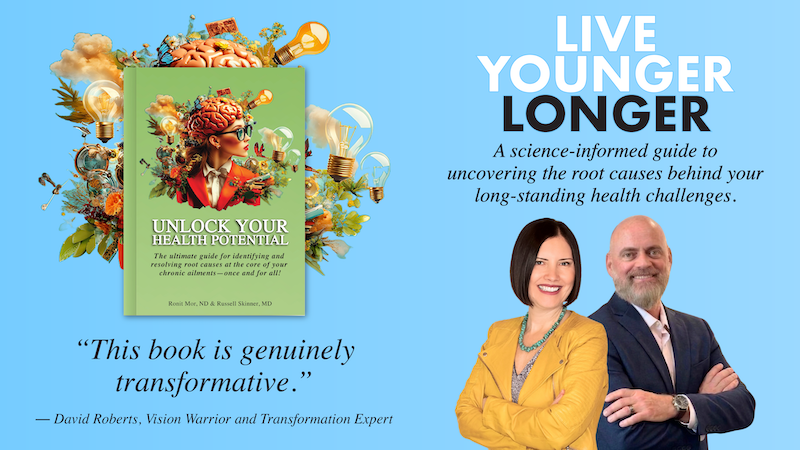
Start with the big picture. Unlock Your Health Potential, co-authored by Ronit Mor, ND, and Russell Skinner, MD, lays out the entire root-cause framework in plain, kitchen-table language — no medical degree required. This step is optional, but we highly recommend it: the more you understand why your body behaves the way it does, the more powerful every step that follows becomes.
Step two: pinpoint your root causes.
General knowledge is useful — but knowing which of the 24 major root causes are driving your symptoms is the real game-changer. That’s what the HealthPotentialAnalytics™ assessment is built to do. This isn’t a throwaway online quiz — it’s a sophisticated algorithm refined over years of expert work that acts like a detective for your body, connecting the dots across systems to reveal exactly where your trouble is hiding. You get what you pay for, and serious results come from serious tools.
Step three: go deep on what matters to you.
Now put names and faces to your results. Our free 24-video root-cause series walks you through each of the 24 root causes in clear, human language — so the ones your assessment flagged finally click into place.
Step four: turn insight into action.
Circle back to the book. With your root causes identified, Unlock Your Health Potential becomes a practical toolkit — packed with immediate tips, real-world strategies, and smart next steps to bring to your health practitioner. This is where understanding becomes a conversation, and a conversation becomes a plan.
Step five: do the work (this is where it all clicks).
Insight is the spark; transformation takes structure. Our health mastery program, Master Your Health in 8 Weeks, is the expert-led, week-by-week path that revamps your lifestyle around a proactive, root-cause approach to your health. Designed by a naturopath and an integrative, board-certified MD, each week delivers a focused health theme and three high-impact “health hacks” — the what, the why, and the how — with videos, checklists, and reflection prompts sequenced for real life and busy schedules. No extremes, no overwhelm. Just the path from “I finally understand my body” to “I feel like myself again.”
That’s the journey: understand → pinpoint → go deep → apply → master. Five steps, each one building on the last.
The Bottom Line
Functional health isn’t anti-doctor, anti-medicine, or anti-anything. It’s simply a different — and complementary — set of questions. When you break a bone, you want the firefighter. When you’ve spent years feeling not quite right and every test comes back “normal,” you want the detective.
The most powerful shift isn’t choosing one over the other. It’s realizing you’re allowed to expect more than the absence of disease. You’re allowed to aim for thriving.
So here’s your first move: jump straight to the assessment to meet your inner detective, and let’s find out what your body’s been trying to tell you all along.
Your health potential is waiting to be unlocked. Let’s go find it.
Ready to go deeper? Start with the book Unlock Your Health Potential, pinpoint your root causes with the HealthPotentialAnalytics™ assessment, explore the free 24-video root-cause series, or learn more about our approach.
Keep exploring our root-cause deep dives: why you’re always exhausted, burnout & adrenal health, brain fog, sleep issues, and blood sugar imbalance.
FAQs
Conventional medicine typically asks, “What’s the diagnosis, and what treats it?” — and it’s exceptional at acute and emergency care. Functional health asks a different question: “Why is this happening in the first place?” It looks upstream for root causes and treats the body as one connected system rather than a set of separate specialties, making it especially useful for chronic, lingering issues that never quite get explained.
Yes — its foundations are well supported. The pillars of a functional approach (nutrition, sleep, movement, stress management, and gut health) are among the most evidence-backed levers in all of health. Where quality varies is in the practitioner and the tools, which is exactly why working with credentialed experts and validated resources matters. A serious, science-informed approach is very different from generic online advice.
Chronic conditions are where a root-cause approach truly shines. Because so many long-term issues — persistent fatigue, digestive disorders, blood-sugar and metabolic imbalances, hormonal disruption, low mood, stubborn weight, and ongoing inflammation — are driven by modifiable lifestyle, dietary, and environmental factors, addressing those underlying drivers can produce meaningful, lasting, and sustainable results rather than simply muting symptoms year after year. It’s the natural fit for the persistent “everything looks normal but I feel off” concerns that conventional care often struggles to explain. That said, it works best alongside your existing medical care — as a complement to it, never a replacement for the treatment of serious or emergency conditions.
No — the two work best together. Think of conventional care as the firefighter (irreplaceable in an emergency) and functional health as the detective (the one asking why problems keep recurring). You need both. A functional approach adds depth to your existing care; it doesn’t ask you to abandon it. Always keep your physician informed and never stop prescribed treatment without medical guidance.
Start by building understanding, then make it personal, then take action. The recommended path is: (1) read Unlock Your Health Potential to ground yourself in the fundamentals (optional, but highly recommended); (2) take the HealthPotentialAnalytics™ assessment to pinpoint your personal root causes; (3) watch the free 24-video root-cause series to understand each one in depth; (4) refer back to the book for immediate tips, practical strategies, and next steps to discuss with your health practitioner; and (5) sign up for the Master Your Health in 8 Weeks health mastery program to revamp your lifestyle around a proactive, root-cause approach to your health.
This content is for educational purposes only and is not intended as medical advice.
References & Further Reading
Beidelschies M, Alejandro-Rodriguez M, Ji X, Lapin B, Hanaway P, Rothberg MB. Association of the Functional Medicine Model of Care With Patient-Reported Health-Related Quality-of-Life Outcomes. JAMA Network Open. 2019;2(10):e1914017. — Cleveland Clinic study of 7,252 patients; those treated with the functional-medicine model showed significantly greater improvements in physical-health scores at 6 months. https://jamanetwork.com/journals/jamanetworkopen/fullarticle/2753520
Droz N, Hanaway P, Hyman M, Jin Y, Beidelschies M, Husni ME. The impact of functional medicine on patient-reported outcomes in inflammatory arthritis: A retrospective study. PLoS ONE. 2020;15(10):e0240416. — Patients with rheumatoid or psoriatic arthritis who added a functional-medicine program to standard care showed improved physical and mental health outcomes.
Beidelschies M, Alejandro-Rodriguez M, Guo N, et al. Patient outcomes and costs associated with functional medicine-based care in a shared versus individual setting for patients with chronic conditions: a retrospective cohort study. BMJ Open. 2021;11:e048294. — Supports the value of a functional-medicine approach for people managing chronic conditions.
Centers for Disease Control and Prevention. About Chronic Diseases. — Roughly 6 in 10 U.S. adults live with a chronic disease, and most chronic disease is driven by a short list of modifiable risk factors: poor nutrition, physical inactivity, tobacco use, and excessive alcohol. https://www.cdc.gov/chronic-disease/about/index.html
Centers for Disease Control and Prevention. Preventing Chronic Diseases: What You Can Do Now. — Practical, evidence-based lifestyle levers for reducing chronic-disease risk. https://www.cdc.gov/chronic-disease/prevention/index.html
Gut Microbiota and Mental Health: A Comprehensive Review of Gut-Brain Interactions in Mood Disorders.National Library of Medicine (PMC), 2025. — Reviews how the gut communicates with the brain, immune, and hormonal systems via the gut–brain axis, illustrating how one system influences many. https://www.ncbi.nlm.nih.gov/pmc/articles/PMC12038870/
Note: Functional and lifestyle-based approaches complement conventional medical care; they are not a substitute for diagnosis or treatment of serious or emergency conditions. Always consult a qualified health professional.