

Longevity -> Measure It. Train It. Extend It.
SIGNAL 08 · Walking After Meals · System: Metabolic · What it measures: Whether movement is arriving at the moment your body can actually use it — the only signal on the scorecard that measures a decision rather than a capacity.
Signal 8 of 10 in The Longevity Scorecard.
In 2013, researchers ran an experiment that deserves to be far better known.
They took older adults at risk of impaired glucose tolerance and gave them the same amount of walking, distributed three different ways: forty-five minutes in the morning, forty-five minutes in the afternoon, or three fifteen-minute walks — one after each meal.
Same total movement. Same people. Same days.
The post-meal walking controlled glucose significantly better, and the advantage was most pronounced after the evening meal.
That is worth reading twice, because it is not the claim people expect. Not more walking.
The same walking, moved.
A second study three years later pointed the same direction in people with type 2 diabetes: a short walk after each main meal outperformed a considerably longer one taken at whatever time suited them. Again, the evening meal showed the largest effect.
What Actually Happens After You Eat
Your blood sugar rises after a meal.
This is not a malfunction, and it is worth saying plainly, because a good deal of the internet has taken to treating an ordinary physiological event as evidence of disease.
Food becomes glucose. Glucose enters the bloodstream. Insulin arrives and moves it into tissue. That is the system doing exactly what it was built to do, and a rise on a graph is not a symptom.
What matters is not that it rises. It is how high, how long it stays there, how often that is repeated, and how hard the system has to work to bring things back down.
Those four things separate a body handling its fuel comfortably from one that is gradually running out of patience — and they shift slowly enough that nobody notices the transition happening.
Why timing changes the result comes down to how muscle actually takes glucose out of circulation, and there is more than one route. The chapter covers the mechanism, and it explains something useful: walking an hour later still does you good, but it is not doing this.
The Most Sedentary Hour of the Day
Modern life has arranged this almost perfectly badly.
The evening meal is typically the largest, the most carbohydrate-dense, and the one followed by the longest uninterrupted stretch of sitting in the entire day. Dinner, then the couch, then bed. Three or four hours of near-total stillness placed directly on top of the day’s biggest glucose load.
If you set out to design the least helpful possible arrangement, it would look very much like the average evening.
And the symptoms this produces rarely arrive labeled. Low energy. Afternoon fog. Cravings that feel like willpower failures. Poor sleep. Waking unrested. These get treated as separate problems with separate solutions, when a fair number of them are downstream of the same thing.
There is also a mental habit worth breaking. Most people file post-meal movement under burning it off — which belongs to a punishment model of exercise, where eating creates a debt and movement repays it.
That is not what is happening. You are not offsetting the meal. You are meeting it.
The distinction is not semantic, because it changes what you actually do. Debt thinking says a large meal requires a large walk, and that if you cannot manage the large walk there is no point in a small one. Meeting thinking says a short walk, starting soon, does most of the available work.
The second is both truer and far easier to act on.
So Is There a Number?
Yes, though this signal works differently from every other one in the series.
The other nine measure a capacity — something your body can or cannot currently do, which takes weeks or months to change. This one measures a decision. Specifically: on a typical day, how many of your meals are followed by a short walk?
Which makes it the only signal on the scorecard you can move tomorrow. Not in eight weeks. Tomorrow.
In our book, The Longevity Scorecard, this is scored in three bands — Strong, Watch, or Priority — based on how many meals per day are reliably followed by movement. The book covers how long is long enough, how soon after eating to begin, what pace to use, and which single meal to prioritize if you only manage one.
The bands live in the book.
You already know your honest answer to the question. What it cannot tell you on its own is what that answer is worth — because a low count alongside strong daily steps and a strong aerobic ceiling means something different from a low count with the whole Metabolic cluster drifting together.
And if the honest answer is rarely, that is not a character assessment. It is the most fixable thing in this entire series.
Where This Signal Sits in the Pattern
Walking after meals is one of ten functional predictors in our book. The ten resolve into three interacting systems: Nervous, Metabolic, and Musculoskeletal.
And with this signal, something happens for the first time in this series.
A system is complete.
VO₂ max (Part 4), daily steps (Part 7), and walking after meals are the three Metabolic signals. You can now see an entire cluster rather than fragments of one.
That is worth pausing on, because a complete system reads very differently from a collection of parts.
Capacity. Exposure. Timing. The ceiling, the frequency, and the placement — three answers to three genuinely different questions about the same system.
Someone with strong capacity, poor exposure and no timing is a fundamentally different case from someone with modest capacity, high exposure and good timing. Both might describe themselves as reasonably healthy. They need close to opposite advice.
That distinction is invisible in any single number and obvious the moment you can see all three.
What Actually Moves It
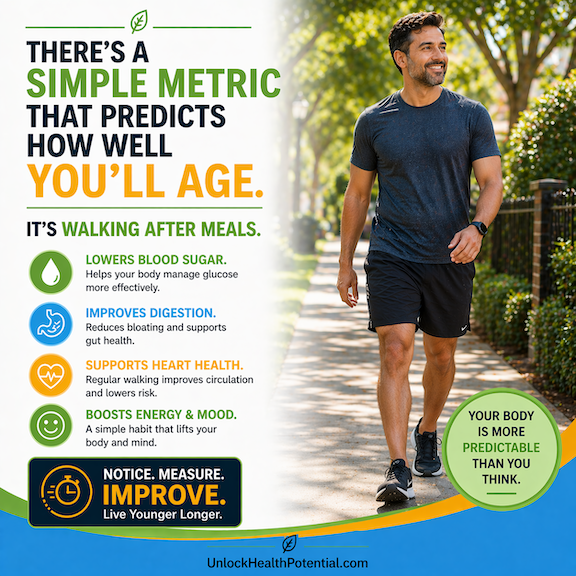
This is the cheapest intervention in the entire scorecard. No equipment, no cost, no scheduling, and no need to be fit enough for anything. Start with dinner, keep the pace easy, and attach it to something that already happens in your evening.
The harder questions are how long, how soon, and which meal to prioritize when only one is realistic.
Where This Leaves You
Of everything in this series, this is the signal that asks least and returns fastest.
It requires no capacity you do not already have. It costs a few minutes. It works on the day you start, and it is the only measure here where a person can move from Priority to Strong inside a week without becoming any fitter at all.
That is unusual enough to be worth taking seriously — particularly for anyone who read Parts 4 and 7 and concluded that the metabolic system was going to be a long project.
Some of it is. This part is not.
Which is where an article reaches its limit. How much, and how often, depends on where you are starting from — so in the book each signal’s practice section is tiered against your score, because rebuilding from a low result and protecting a strong one are genuinely different jobs. Score all ten and those tiers resolve into a plan built from your own numbers.
But do not conclude anything from one signal.
In Part 9 we return to the Musculoskeletal system and the tissue that has been quietly underneath a great deal of this already — the same tissue doing the glucose disposal you have just read about, and producing the force you measured in Part 2. It is the signal most people think they understand and almost universally misjudge.
Your body has been keeping a scorecard. It is time you read it.
Get the Book
Walking after meals is Signal 08 of 10.
The Longevity Scorecard — the new book from Ronit Mor, ND and Russell Skinner, MD — gives you a full chapter on each of the ten signals, the research benchmark for every one, and the at-home self-test to measure it.
Then it turns your ten results into a score out of 100, three system totals, and a practice plan matched to what you actually scored — so you finish knowing which system to rebuild first, and exactly what to do about it.
Order The Longevity Scorecard →
Its companion volume, Ancient Biology, Modern Life, restores the ten inputs your body receives. This book measures the ten signals your body sends. Read them in either order.
It is not too late. It has never been too late.
FAQs
Less than you would expect, and the returns are front-loaded — the difference between doing nothing and doing something is far larger than the difference between a short walk and a long one. Research in people with type 2 diabetes found a short walk after each main meal outperformed a considerably longer one taken at an unspecified time. Our book The Longevity Scorecard gives the duration and timing that the research actually supports.
While glucose is still entering circulation, which is a narrower window than most people assume. The point is to overlap movement with the period your body is actively handling the meal — walking much later is still worthwhile activity, but it is doing something different from what the research describes.
The evening meal, in most studies and for most people. It tends to be the largest, the most carbohydrate-dense, and the one followed by the longest continuous stretch of sitting. If you can only establish one post-meal walk, establish that one.
No. Glucose rising after a meal is normal physiology, and a great deal of online content has unhelpfully framed an ordinary process as evidence of disease. What matters is the magnitude, the duration, how frequently it is repeated, and how hard the system works to restore baseline — not the existence of the rise itself.
Indoors works. Pacing a hallway, moving around the house, stairs if they are available, or marching gently on the spot all produce muscle contraction, which is the mechanism that matters. Seated leg exercises or a stationary cycle serve the same purpose for anyone who cannot walk comfortably.
That is not the primary mechanism and it would be misleading to sell it that way. The benefit demonstrated in research is improved glucose handling, which supports metabolic health over time. Any effect on weight is indirect and modest — approach this as metabolic support rather than as a weight-loss strategy.
This content is for educational purposes only and is not intended as medical advice. If you have diabetes or take medication that lowers blood glucose, please discuss changes to your activity routine with your healthcare provider.
Scientific References
DiPietro L, Gribok A, Stevens MS, Hamm LF, Rumpler W. Three 15-min bouts of moderate postmeal walking significantly improve 24-h glycemic control in older people at risk for impaired glucose tolerance. Diabetes Care. 2013;36(10):3262-3268.
Reynolds AN, Mann JI, Williams S, Venn BJ. Advice to walk after meals is more effective for lowering postprandial glycaemia in type 2 diabetes mellitus than advice that does not specify timing: a randomised crossover study. Diabetologia. 2016;59(12):2572-2578.
Buffey AJ, Herring MP, Langley CK, Donnelly AE, Carson BP. The acute effects of interrupting prolonged sitting time with standing and light-intensity walking on biomarkers of cardiometabolic health. Sports Med. 2022;52(8):1765-1787.
Colberg SR, Sigal RJ, Yardley JE, et al. Physical activity/exercise and diabetes: a position statement of the American Diabetes Association. Diabetes Care. 2016;39(11):2065-2079.
Thosar SS, Bielko SL, Mather KJ, Johnston JD, Wallace JP. Effect of prolonged sitting and breaks in sitting time on endothelial function. Med Sci Sports Exerc. 2015;47(4):843-849.
Booth FW, Roberts CK, Laye MJ. Lack of exercise is a major cause of chronic diseases. Compr Physiol. 2012;2(2):1143-1211.