
The Hidden Biology of Everyday Life
INPUT 10 · Awe · Question it answers: How big am I in this? · What it restores: The proportions. Not by shrinking you — by putting the rest of it back.
Input 10 of 10 in Ancient Biology, Modern Life.
Something strange happens to your skin at the end of a great piece of music.
The hair on your arms lifts. Tiny muscles at the base of each follicle contract, exactly as they would in a cat facing down a rival. The reflex exists to raise fur — to make an animal look larger.
You have almost no fur. The response fires anyway.
Researchers put participants in a grove of eucalyptus — trees over two hundred feet tall — and asked them to look up for one minute. A control group spent it looking at a tall building.
Afterward, someone walking past “accidentally” dropped a handful of pens.
The people who had been looking at trees picked up more of them. They also reported feeling less entitled and self-important.
Sixty seconds of looking up changed how someone treated a stranger sixty seconds later. There’s more evidence than we have room for — including an eight-week study of what happens when this becomes a habit — and the chapter covers it.
The Small Self
A related line of work asked people to draw themselves and write the word “me” on a page. Those who had just experienced awe — at Yosemite, and in comparable settings abroad — drew smaller figures and wrote smaller letters. The effect appeared across cultures, and in the drawing itself, without anyone having to report it.
Researchers call this the small self, and the term is easy to misread. It doesn’t mean feeling insignificant — it means the opposite of what chronic stress does to you.
Because here’s the thing about a hard week: it makes the self enormous. Your deadlines, your symptoms, your worry about your mother expand until they fill the field of view. Excessive self-focus travels with rumination and repetitive negative thought.
Awe puts the self back into proportion. Nothing about your circumstances changes — the frame does.
It Gives You Time Back
This is the finding we most wish people knew, because it answers the objection everyone raises: I don’t have time for this.
In a series of studies, participants who experienced awe afterward reported feeling they had more time available, and became less impatient and more willing to give time away.
Awe added no hours to anyone’s day. It changed the felt experience of time scarcity — which, for most stressed people, is the actual problem. The sensation of having no time is itself a stressor, and it turns out to be remarkably responsive to a shift in perspective.
There’s a quiet irony here: the feeling that you’re too busy for a fifteen-minute walk may be precisely the symptom a fifteen-minute walk addresses.
The physiological research is younger, and we want to be careful with it. The most cited finding links awe to lower levels of an inflammatory marker — but that’s an association, not a demonstration that awe lowers inflammation. We mention it because it’s real, and bound it because presenting it as proof is the overreach that makes good research harder to trust.
So How Much Do You Actually Need?
Less than almost anyone expects, which is why this input is so badly underused.
There are worked figures — how long, how often, over what stretch of weeks before anything shows. They came from a study in older adults that measured change researchers could see in a photograph, which is a slightly extraordinary sentence to be able to write.
Those figures live in the book, along with the indoor and night-sky versions, which have their own timing and are easy to get wrong.
Awe on its own is a data point — real, but narrow. Read against the other nine it becomes a pattern. Read within its question it becomes a direction: awe missing alone is a different situation from awe missing alongside natural geometry, both answering the same question badly at once — which is what a life lived entirely at arm’s length looks like from the inside.
And read whatever you find as feedback rather than a grade. Going months without encountering anything larger than your own to-do list doesn’t mean something is wrong with you. It means a channel closed, and it takes remarkably little to open it again.
Where This Input Sits in the Pattern
Ten inputs, and this is the last. They answer four questions your biology asks continuously: Is it safe here? Can I survive here? What is the world actually like? How big am I in this?
Awe answers the fourth, sharing it with one other input: Part 9, natural geometry. Two ways of reaching the same recognition, from opposite ends.
Geometry works because your visual system processes it without effort: a fern, a coastline, nothing to resolve. A gentle statement about scale, and you happen to be made of the same pattern.
Awe works the other way. What you’re looking at cannot be processed on existing terms, and something has to give.
Same question, opposite demand. One arrives through a window on a Tuesday; the other stops you where you stand.
What Actually Restores It
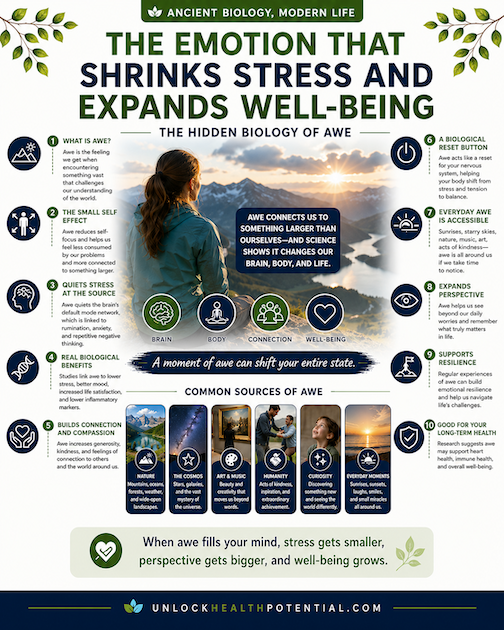
The levers are unexpectedly ordinary. Go somewhere with scale — height, distance, or age will all do, and looking up recurs throughout the research. Use non-natural sources deliberately: a symphony at full volume, a telescope image, an act of extraordinary decency. Slow down enough to be interrupted, because awe requires a mind with room to be surprised. And put the phone away, since a photograph is no substitute for the minute you spent taking it.
The harder questions are where to find scale in the life you have, and how to keep it going through a bad month — when it becomes least likely and most useful.
A note on the harder edge. Awe isn’t always gentle. Vastness can arrive as a storm, a diagnosis, or a loss, and researchers distinguish these threat-based experiences from the positive kind. If your recent encounter with something larger than yourself has been frightening rather than restorative, that deserves real support — please talk with a qualified professional. Nothing here substitutes for it.
Where This Leaves You
One minute of looking up at trees changed how people treated a stranger. Fifteen minutes a week produced changes visible in a photograph. Not a pilgrimage — a practice, and the threshold is absurdly low.
So the next time your arms go to gooseflesh under a night sky, or at a chord you didn’t see coming, notice what your body just did. It reached for fur it no longer has — something in you is still keeping score of what is vast.
Which is where an article has to hand over. Where to find scale, and how to hold onto it in a month that doesn’t want you to, depends on the life you’re living — so in the book each input’s practice is worked against that, and against the other nine, because several arrive in the same act rather than as ten separate obligations.
That’s ten inputs and four questions — the end of the series, not the end of the work. Ten articles can tell you what your biology is asking and still leave you in a kitchen on a Tuesday with no idea what to do first.
That part is the book.
Your biology never stopped asking. It is time you answered.
New to this blog series? Start with the series overview →
Get the Book
Ancient Biology, Modern Life — the new book from Ronit Mor, ND and Russell Skinner, MD — gives you a full chapter on each of the ten inputs, the research behind every one, and simple steps for restoring it. Then it shows you how the ten fit together — which arrive in the same act, in what order, and which of your four questions has gone unanswered longest — so you finish with roughly fifteen minutes a day built around your own life.
This is Book Two in the Live Younger Longer series — short books you can finish in an afternoon, each focused on the small changes that make the biggest difference to how you age. Its companion volume, The Longevity Scorecard, measures the ten signals your body sends outward. This book restores the ten inputs your body receives. Read them in either order.
FAQs
Researchers define it by two features: encountering something vast — in size, complexity, beauty, or moral force — and needing to mentally accommodate it, meaning your existing understanding has to stretch to fit. That second part is what separates awe from simple enjoyment.
Both, as best we can tell. Studies have linked awe experiences to reduced self-focused thinking, greater life satisfaction, a stronger sense of having available time, and improved well-being that persists for days. One study of veterans and at-risk youth found awe predicted reduced stress and PTSD symptoms a week later. The physiological research is younger and less conclusive.
No. In one experiment, one minute spent looking up at tall trees was enough to shift behavior measurably. Awe also arises from music, art, ideas, human kindness, and looking at the night sky. Scale matters more than scenery, and it is more available than most people assume.
There is an intriguing association. A study measuring interleukin-6, a marker of chronic inflammation, found awe showed the strongest relationship of the positive emotions examined. But this is a correlation, not proof that awe lowers inflammation, and we would not want anyone to read it as more than that.
Yes. Researchers distinguish threat-based awe — produced by storms, disasters, or overwhelming events — from the positive variety. The vastness is the same; the emotional result is not. If that is the kind you have been having, it deserves proper support rather than a walk.
This content is for educational purposes only and is not intended as medical advice.
Scientific References
Piff PK, Dietze P, Feinberg M, Stancato DM, Keltner D. Awe, the small self, and prosocial behavior. J Pers Soc Psychol. 2015;108(6):883-899.
Bai Y, Maruskin LA, Chen S, et al. Awe, the diminished self, and collective engagement: universals and cultural variations in the small self. J Pers Soc Psychol. 2017;113(2):185-209.
Rudd M, Vohs KD, Aaker J. Awe expands people’s perception of time, alters decision making, and enhances well-being. Psychol Sci. 2012;23(10):1130-1136.
Sturm VE, Datta S, Roy ARK, et al. Big smile, small self: awe walks promote prosocial positive emotions in older adults. Emotion. 2022;22(5):1044-1058.
Anderson CL, Monroy M, Keltner D. Awe in nature heals: evidence from military veterans, at-risk youth, and college students. Emotion. 2018;18(8):1195-1202.
Stellar JE, John-Henderson N, Anderson CL, et al. Positive affect and markers of inflammation: discrete positive emotions predict lower levels of inflammatory cytokines. Emotion. 2015;15(2):129-133.
Keltner D, Haidt J. Approaching awe, a moral, spiritual, and aesthetic emotion. Cogn Emot. 2003;17(2):297-314.