

Longevity -> Measure It. Train It. Extend It.
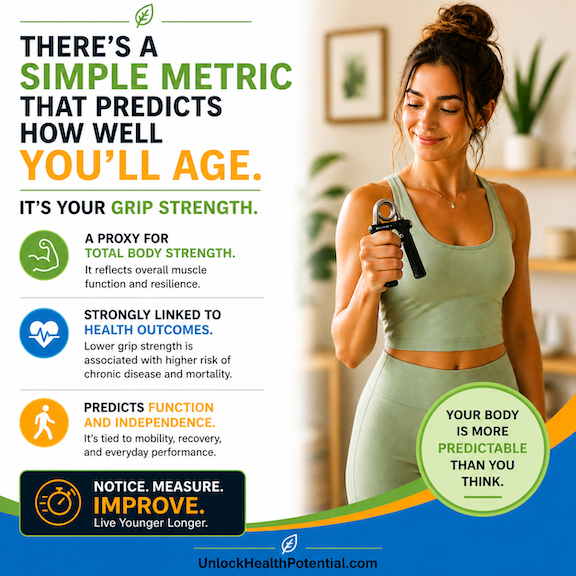
SIGNAL 02 · Grip Strength · System: Musculoskeletal · What it measures: How much force your body can still produce on demand — and how well the machinery behind it has held together.
Signal 2 of 10 in The Longevity Scorecard.
There is a moment familiar to almost everyone past a certain age. A jar that will not open. You brace it against your hip, run the lid under hot water, tap the rim with a spoon, and finally hand it to somebody else.
Then you forget about it entirely.
It is worth not forgetting about.
In 2015, The Lancet published findings from a study of nearly 140,000 adults across seventeen countries. Grip strength predicted death from any cause. It predicted cardiovascular death.
And it did so more strongly than systolic blood pressure.
Sit with that for a moment. Blood pressure is among the most consequential numbers in medicine — screened universally, treated aggressively, the subject of decades of pharmaceutical development. And in this dataset, a few seconds of squeezing a device outperformed it as a predictor of who would still be alive later.
Not because gripping something is important. Because of what has to be intact for you to do it well.
What a Handshake Actually Knows
Force is not stored anywhere. It has to be manufactured, on demand, by a chain that has no weak link to spare.
Your brain decides how much is required. Your nervous system recruits motor units and fires them in near-synchrony. Your muscle fibers must have the quality to answer. Your energy systems fund the contraction in real time.
Any of that degrades and the number falls.
This is what makes grip such a clean reading. Most physical tests are contaminated by something — technique, balance, pacing, willingness to tolerate discomfort. Squeezing is nearly pure output. There is very little to hide behind.
There is a second layer that surprises people, and it is bigger than we have room for here. Muscle is not decoration; it is an organ, and one of the most metabolically active tissues you own. The chapter covers what that means for blood sugar, and why grip strength keeps appearing in research alongside outcomes that seem to have nothing to do with hands.
Modern Life Removes This Quietly
For nearly all of human history, nobody trained grip. Life extracted it.
You carried water. You wrung cloth. You hauled, pulled, twisted, climbed, and lifted things that had no wheels. Grip was not a fitness attribute. It was a toll paid daily, without negotiation.
Now consider the last twenty-four hours of your own life. How many times did you carry something genuinely heavy, for a genuinely uncomfortable distance?
For most people the honest answer is zero, and it has been zero for years. Doors open themselves. Groceries arrive at the door. Luggage has wheels. Every friction point that used to demand force has been engineered away, one small convenience at a time, and each one felt like an improvement.
It was an improvement. That is what makes it difficult. The decline that follows is slow enough to feel like nothing, and nobody notices losing capacity they are never asked to use — until the day something asks.
So Is There a Number?
Yes. And this one is more clear-cut than most.
Validated grip strength benchmarks exist, they differ substantially between men and women, and they shift with age. Below a certain threshold, risk rises in a way the research is quite consistent about. Above another, the picture looks considerably better.
In our book, The Longevity Scorecard, grip strength is measured against those benchmarks and scored in three bands — Strong, Watch, or Priority. Measuring it properly takes an inexpensive hand dynamometer, and the book covers how to test correctly, because posture and technique shift the result more than most people expect.
The thresholds live in the book, for the same reason they did with walking speed.
A grip reading on its own tells you something real but narrow: where you stand on one measure. What it cannot tell you is whether that number is isolated or part of a pattern — and particularly whether it agrees with the other Musculoskeletal signals or contradicts them.
Weak grip alongside strong legs is one situation. Weak grip with the whole cluster drifting is a different one entirely, and it points somewhere specific.
And whatever you measure, read it as feedback rather than a grade. A lower number is not a judgment on how you have lived. It is your body naming the place where a little consistent effort will return the most.
Where This Signal Sits in the Pattern
Grip strength is one of ten functional predictors in our book. The ten resolve into three interacting systems: Nervous, Metabolic, and Musculoskeletal.
Grip sits in the Musculoskeletal cluster, alongside the sit-to-stand test and muscle mass.
Which makes it a useful contrast with Part 1. Walking speed belongs to the Nervous cluster. So these two signals — both of which look, superficially, like measures of physical fitness — are reporting on entirely different systems.
That distinction is the whole point. Someone can have respectable walking speed and poor grip. Someone else can be strong and unsteady. Those are two different situations requiring two different responses, and no single measurement can tell them apart.
One signal is a data point. Two inside one system is a cluster. Ten across three systems is a map.
What Actually Moves It
Grip answers quickly once something asks for it. Carrying, hanging, and pulling are the levers, and protein is what lets any of it stick — none of which needs a gym.
The harder questions are how much load, how often, and how you would know before a year had passed.
Where This Leaves You
Grip strength is not about your hands, and it was never really about the jar.
It is about whether your body can still produce force when something requires it — and force is what stands between you and a great many of the outcomes people fear about getting older. Catching yourself when you stumble. Getting up unaided. Carrying your own life around without arranging it in advance to avoid difficulty.
The reassuring part is that this is among the most responsive signals you have. Muscle answers when it is asked, at almost any age, which is not true of everything on this list.
Which is where an article reaches its limit. How much, and how often, depends on where you are starting from — so in the book each signal’s practice section is tiered against your score, because rebuilding from a low result and protecting a strong one are genuinely different jobs. Score all ten and those tiers resolve into a plan built from your own numbers.
But do not draw conclusions yet.
In Part 3 we turn to resting heart rate — a number most people already have on their wrist, sitting in an app, and have never once interpreted. It belongs to a different system than this one, and where those two disagree is where the interesting reading begins.
Your body has been keeping a scorecard. It is time you read it.
Get the Book
Grip strength is Signal 02 of 10.
The Longevity Scorecard — the new book from Ronit Mor, ND and Russell Skinner, MD — gives you a full chapter on each of the ten signals, the research benchmark for every one, and the at-home self-test to measure it.
Then it turns your ten results into a score out of 100, three system totals, and a practice plan matched to what you actually scored — so you finish knowing which system to rebuild first, and exactly what to do about it.
Order The Longevity Scorecard →
Its companion volume, Ancient Biology, Modern Life, restores the ten inputs your body receives. This book measures the ten signals your body sends. Read them in either order.
It is not too late. It has never been too late.
FAQs
There are validated benchmarks, and they differ substantially between men and women as well as by age — which is why a single universal figure would be useless. What the research is consistent about is the direction: below a certain threshold, risk of frailty, disability, and mortality rises measurably. Our book The Longevity Scorecard provides the benchmark bands for both sexes and the correct testing protocol, so you can place yourself accurately rather than guessing from how a jar feels.
For a real number, yes — a hand dynamometer, which costs less than a pair of running shoes and lasts indefinitely. The book covers how to test properly, because grip readings are easy to get wrong: posture, elbow angle, and which attempt you count all change the result enough to matter.
Not on the basis of one reading. Grip varies with time of day, recent activity, arthritis, injury, and how you happened to hold the device. A single low measurement is a data point, not a verdict. What carries genuine information is a pattern — several signals within the same body system moving together over time. If opening jars and carrying bags has become noticeably harder over the past year, that is worth raising with a clinician rather than testing repeatedly at home.
Yes, and this is one of the better-established findings in aging research. Resistance training produces measurable strength gains in adults in their eighties and nineties. Muscle remains responsive far longer than most people assume. Starting late is a smaller disadvantage than never starting.
Because producing force requires your brain, nervous system, muscle tissue, connective tissue, and energy systems to work together, and it is almost impossible to fake. Grip is one of the least confounded measures we have of whether that whole chain is intact. It predicts outcomes because it reflects system integrity — not because hand strength itself protects you.
They answer different questions. Weight tells you how much mass you are carrying. Grip strength tells you something about the quality and capability of the tissue carrying it, which research suggests is often the more informative of the two.
This content is for educational purposes only and is not intended as medical advice.
Scientific References
Leong DP, Teo KK, Rangarajan S, et al. Prognostic value of grip strength: findings from the Prospective Urban Rural Epidemiology (PURE) study. Lancet. 2015;386(9990):266-273.
Celis-Morales CA, Welsh P, Lyall DM, et al. Associations of grip strength with cardiovascular, respiratory, and cancer outcomes and all-cause mortality: prospective cohort study of half a million UK Biobank participants. BMJ. 2018;361:k1651.
Bohannon RW. Grip strength: an indispensable biomarker for older adults. Clin Interv Aging. 2019;14:1681-1691.
Taekema DG, Gussekloo J, Maier AB, et al. Handgrip strength as a predictor of functional, psychological and social health. Age Ageing. 2010;39(3):331-337.
Carson RG. Get a grip: individual variations in grip strength are a marker of brain health. Neurobiol Aging. 2018;71:189-222.
Volaklis KA, Halle M, Meisinger C. Muscular strength as a strong predictor of mortality: a narrative review. Eur J Intern Med. 2015;26(5):303-310.