
Longevity -> Measure It. Train It. Extend It.
SIGNAL 03 · Resting Heart Rate · System: Nervous · What it measures: How hard your body has to work to do nothing at all — and whether your nervous system can still fully stand down.
Signal 3 of 10 in The Longevity Scorecard.
There is one signal in this series you almost certainly already have.
It is sitting in an app on your phone right now, recorded every night for months, plotted on a chart you have probably never opened. Or, if you own no wearable at all, it is available in thirty seconds with two fingers and a clock.
Your resting heart rate is the most accessible number in longevity science. It is also the most widely ignored.
The Arithmetic of Ten Beats
Your heart will beat roughly a hundred thousand times today. You will notice almost none of them.
Now picture two people the same age, sitting in the same room, doing nothing in particular. One has a resting heart rate ten beats per minute higher than the other.
Ten sounds like a rounding error.
Over a day it is more than fourteen thousand extra contractions. Over a year, upward of five million. Over a decade, something close to fifty million additional beats performed by a muscle that never gets a day off, never gets a lighter week, and cannot be substituted.
That is not a small difference. It is a different working life.
And the heart beating more slowly is not the lazier heart. It is the better one — a conditioned cardiovascular system moves more blood with every contraction, so it delivers the same oxygen in fewer beats. The number goes down because the machinery improved, not because anything slowed.
It Is Not Really a Heart Measurement
Here is where this stops being cardiology and becomes something more interesting.
Your heart contains its own electrical pacemaker. Disconnect every nerve leading to it and it would keep beating on its own, at somewhere around a hundred beats per minute.
Which means everything below a hundred is your nervous system applying the brake.
That brake is largely the vagus nerve, and how firmly it holds is one of the better proxies we have for whether your body can genuinely stand down. Under sustained pressure the brake comes off by degrees — not dramatically, just persistently — and because it creeps rather than jumps, nobody notices.
So an elevated resting heart rate is usually not a heart problem at all. It is a nervous system that has not fully come out of an emergency it is not actually having.
Normal Is Not the Same as Optimal
Ask most clinicians what a normal resting heart rate is and you will hear sixty to a hundred beats per minute.
That range is real, and it is doing a specific job. It is drawn wide to catch arrhythmias and exclude pathology. It was never built to describe a cardiovascular system that is thriving — only one that is not currently broken.
Which is how a great many people come to be told their heart rate is fine while sitting near the upper end of a band that longevity research treats very differently.
Normal is a floor. It was never a target.
This distinction runs underneath the entire scorecard, and it may be the most useful idea in it: functional measures shift long before conventional markers do. Nothing abnormal and nothing to work on are not the same sentence, and the gap between them is measured in years — years in which something is still cheaply fixable.
Short sleep, a fourth coffee, wine most evenings, a day spent seated. None of that registers as a crisis. All of it registers on your pulse. And when people feel the resulting fatigue, they almost always reach for more stimulation rather than less load, which quietly raises the very number that was trying to tell them something.
So Is There a Number?
Yes. And this is the signal where the distance between normal and optimal is widest.
Validated benchmark bands exist, and they are considerably tighter than the clinical reference range most people have been quoted. They describe not the absence of disease but the presence of cardiovascular efficiency, which is a different thing entirely.
In our book, The Longevity Scorecard, resting heart rate is measured against those benchmarks and scored in three bands — Strong, Watch, or Priority. Measuring it well matters more here than almost anywhere else, and the book covers exactly how.
The bands live in the book, for the same reason as walking speed and grip strength.
A pulse read once is contaminated by whatever happened in the ten minutes before it — by how you slept, what you drank, and whether you are fighting something off. A trend across a week tells you considerably more.
But the reading that actually directs you is the one you can see against the rest of its system. An elevated resting heart rate sitting alone means one thing. The same number with balance and sleep consistency drifting alongside it means something quite different — and points at a shared cause rather than three separate problems.
Read it as feedback rather than a grade. Wherever your number sits today is simply your starting line, and this is among the most responsive signals on the list.
Where This Signal Sits in the Pattern
Resting heart rate is one of ten functional predictors in our book. The ten resolve into three interacting systems: Nervous, Metabolic, and Musculoskeletal.
Resting heart rate sits in the Nervous cluster — alongside walking speed, balance, and sleep consistency.
Which makes this the first moment in the series where two signals share a system. Walking speed, from Part 1, is also Nervous. And that changes what a reading means.
If both are strong, that is not two separate pieces of good news. It is one piece of good news, told twice, about a system that is holding.
If both are drifting, that is not two small problems to file away. That is a cluster — and a cluster is the thing worth acting on, because it points at a shared cause rather than a coincidence.
What Actually Moves It
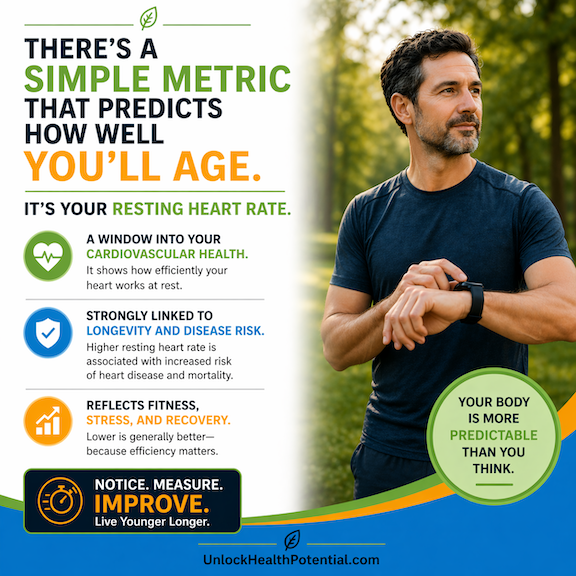
This one moves in weeks rather than years. Aerobic base, sleep, slow exhales, and an honest look at caffeine and alcohol are the levers that matter.
The harder question is measurement — because this reading depends so heavily on when and how you take it that most people are tracking noise without realizing it.
Where This Leaves You
Resting heart rate answers a question almost nobody thinks to ask: what does it cost you to do nothing?
That cost is being paid a hundred thousand times a day, whether or not anyone is reading the invoice — and unlike most of what medicine measures, this one is already in your possession. No appointment. No draw. No waiting for results.
The goal here is not obsession. Wearables have made it very easy to stare anxiously at a chart, and anxiety is itself one of the things that raises the line. The goal is awareness, held lightly, over time.
Which is where an article reaches its limit. How much, and how often, depends on where you are starting from — so in the book each signal’s practice section is tiered against your score, because rebuilding from a low result and protecting a strong one are genuinely different jobs. Score all ten and those tiers resolve into a plan built from your own numbers.
But do not conclude anything yet.
In Part 4 we turn to VO₂ max, which several researchers consider the single most powerful predictor on this entire list — and which almost nobody has ever had measured. It belongs to a different system than this one, and it sets the ceiling that resting heart rate has been quietly reporting from underneath.
Your body has been keeping a scorecard. It is time you read it.
Get the Book
Resting heart rate is Signal 03 of 10.
The Longevity Scorecard — the new book from Ronit Mor, ND and Russell Skinner, MD — gives you a full chapter on each of the ten signals, the research benchmark for every one, and the at-home self-test to measure it.
Then it turns your ten results into a score out of 100, three system totals, and a practice plan matched to what you actually scored — so you finish knowing which system to rebuild first, and exactly what to do about it.
Order The Longevity Scorecard →
Its companion volume, Ancient Biology, Modern Life, restores the ten inputs your body receives. This book measures the ten signals your body sends. Read them in either order.
It is not too late. It has never been too late.
FAQs
The conventional clinical range is wide — commonly cited as sixty to a hundred beats per minute — but that range exists to identify abnormal rhythms, not to describe cardiovascular efficiency. Longevity research draws considerably finer distinctions inside it, which is why many people are told their heart rate is normal while sitting in territory that a functional assessment would flag. Our book The Longevity Scorecard provides the benchmark bands and the correct measurement protocol.
On waking, before you sit up, before caffeine or conversation. Find your pulse at the wrist or neck, count for sixty seconds, and repeat across several consecutive mornings — the average is the number that means something. If you wear a tracker, use its overnight or waking figure rather than a spot reading taken during the day.
Not on the basis of one morning. Resting heart rate rises with poor sleep, dehydration, alcohol, stress, illness, travel, pain, and hormonal shifts, and a single elevated reading usually reflects one of those. What matters is a sustained trend. That said, a persistently high rate, a very low one accompanied by dizziness or faintness, or a pulse that feels irregular are all worth raising with a clinician rather than tracking at home.
Yes, substantially. Beta blockers and some other cardiac and blood pressure medications lower heart rate directly, so the number reflects the prescription as much as your physiology. Certain thyroid medications, decongestants, and stimulants push it the other way. If you take anything in these categories, interpret your reading with your prescriber rather than against a general benchmark.
No. Well-trained endurance athletes often sit very low and that is a healthy adaptation, but an unusually low rate that arrives with fatigue, lightheadedness, or breathlessness is a different situation and deserves evaluation. The aim is not the smallest possible number. It is an efficient system — one that delivers what the body needs without working hard to do it.
Because your heart’s own pacemaker would run at roughly a hundred beats per minute unaided, and everything below that is your nervous system applying a brake. Under sustained stress, poor sleep, or heavy stimulant use, that brake eases off. The rise is not your heart malfunctioning. It is your nervous system failing to fully stand down.
This content is for educational purposes only and is not intended as medical advice.
Scientific References
Cooney MT, Vartiainen E, Laatikainen T, et al. Elevated resting heart rate is an independent risk factor for cardiovascular disease in healthy men and women. Am Heart J. 2010;159(4):612-619.
Fox K, Borer JS, Camm AJ, et al. Resting heart rate in cardiovascular disease. J Am Coll Cardiol. 2007;50(9):823-830.
Jensen MT, Suadicani P, Hein HO, Gyntelberg F. Elevated resting heart rate, physical fitness and all-cause mortality: a 16-year follow-up in the Copenhagen Male Study. Heart. 2013;99(12):882-887.
Thayer JF, Lane RD. The role of vagal function in the risk for cardiovascular disease and mortality. Biol Psychol. 2007;74(2):224-242.
Nauman J, Janszky I, Vatten LJ, Wisløff U. Temporal changes in resting heart rate and deaths from ischemic heart disease. JAMA. 2011;306(23):2579-2587.
Jose AD, Collison D. The normal range and determinants of the intrinsic heart rate in man. Cardiovasc Res. 1970;4(2):160-167.