
Longevity -> Measure It. Train It. Extend It.
SIGNAL 04 · VO₂ Max · System: Metabolic · What it measures: The ceiling on how much energy your body can produce — and therefore how much room you have underneath it.
Signal 4 of 10 in The Longevity Scorecard.
In 2016, the American Heart Association published a scientific statement with an unusual recommendation. Cardiorespiratory fitness, it argued, should be assessed routinely in clinical practice — treated as a vital sign, alongside blood pressure and pulse.
Now ask yourself when a doctor last measured yours.
Of everything medicine knows how to evaluate, aerobic capacity has the widest gap between how much it predicts and how rarely anyone checks it.
Two years later, researchers at the Cleveland Clinic published an analysis of more than 122,000 people who had undergone treadmill testing. Fitness tracked with survival, and there appeared to be no point at which more stopped helping — a result that surprised people who assumed the benefit plateaued somewhere reasonable.
The quieter finding deserved more attention. The mortality risk associated with sitting in the least fit group was comparable in magnitude to the risk carried by smoking.
Not similar in kind. Similar in size.
One honest caveat, because it matters: these are observational findings, and people who are unwell tend also to be unfit. Some portion of the association runs that way. But the relationship has held across decades, populations, and research groups. It is among the most durable results in the field.
It Is a Ceiling, Not a Score
Here is the most useful way we know to think about this.
VO₂ max is not a score. It is a ceiling.
It describes the maximum your body can produce — which means every other capacity in this series operates somewhere underneath it. Your walking pace. Your recovery from a demanding week. How you feel at the top of two flights of stairs with groceries in both hands. None of those are the ceiling. They are how much headroom you have below it.
When the ceiling comes down, everything beneath it moves closer to the limit.
The same walk takes a larger share of what you have. The same illness costs more. The same week takes longer to recover from. The same flight of stairs requires a pause at the top that you would rather nobody noticed.
Nothing feels different at first. It simply gets more expensive.
Descend far enough into the measurement and it stops being about lungs at all — it becomes a question about how efficiently your cells turn oxygen and fuel into work. That layer is where the chapter goes, and it explains why aerobic capacity connects to so much that seems unrelated to exercise: recovery, cognitive stamina, how you handle a demanding day.
Why It Falls — and Why That Feels Like Aging
Aerobic capacity declines with age. It declines considerably faster with disuse. And from the inside, those two are almost impossible to tell apart.
What people notice is never a number. They notice they take the elevator a little more often. That they park closer. That a hill they used to walk up has quietly become a hill they walk up slowly, with a pause halfway that has become part of the route.
Each accommodation is small, sensible, and permanent.
And each one removes the very stimulus that was maintaining the capacity in the first place.
That is the trap. Reduced capacity produces avoidance, and avoidance produces further reduced capacity. Once it starts, it runs downhill under its own weight — which is precisely why it feels so much like aging, and why so many people file it under something inevitable rather than something happening.
None of which is a failure of will. It is a sequence of reasonable decisions, made by a body doing exactly what bodies do.
So Is There a Number?
Yes — and this one works differently from every other signal in the series.
VO₂ max is not judged against a fixed figure. It is ranked. Your result is placed against other people of your age and sex, because a value that would be exceptional at seventy is unremarkable at thirty.
Which changes the question being asked. Not is this good — but where do I sit among people like me. That is a considerably more uncomfortable question. It is also a considerably more useful one.
Getting a true measurement means a laboratory, a mask, and a treadmill that keeps getting harder until you stop. Very few people will ever do that, and they do not need to. Validated field estimates exist that need nothing more than a stopwatch, and modern wearables produce an approximation that is rough but genuinely informative when tracked over time.
In our book, The Longevity Scorecard, VO₂ max is scored in three bands — Strong, Watch, or Priority — against the percentile ranking for your age and sex. The book also covers which estimation methods are reliable enough to score yourself with, and which will flatter you.
The percentile cut-offs live in the book, for the same reason as the others.
A fitness ranking read in isolation tells you where you stand. It cannot tell you whether that number is isolated or part of something — and a low ceiling with strong daily movement is a different situation from a low ceiling with the whole Metabolic cluster drifting. The first is worth watching. The second tells you where to start.
And wherever you land, read it as a starting line rather than a grade. This is one of the most trainable things about you.
Where This Signal Sits in the Pattern
VO₂ max is one of ten functional predictors in our book. The ten resolve into three interacting systems: Nervous, Metabolic, and Musculoskeletal.
VO₂ max sits in the Metabolic cluster, alongside daily steps and walking after meals — which means all three systems are now on the table.
That placement puzzles people. Aerobic fitness looks like a heart measurement, and surely belongs with resting heart rate.
But consider what is actually being measured. VO₂ max describes how much fuel and oxygen your body can convert into work. That is an energy question. The cardiovascular system is how the answer gets delivered, not what is being asked.
And this is where reading across systems starts to earn its keep. Someone can have an excellent resting heart rate — a Nervous signal — while their aerobic ceiling is quietly falling, because those two answer to different things. One reflects how well the body stands down. The other reflects how much it can produce when asked.
What Actually Moves It
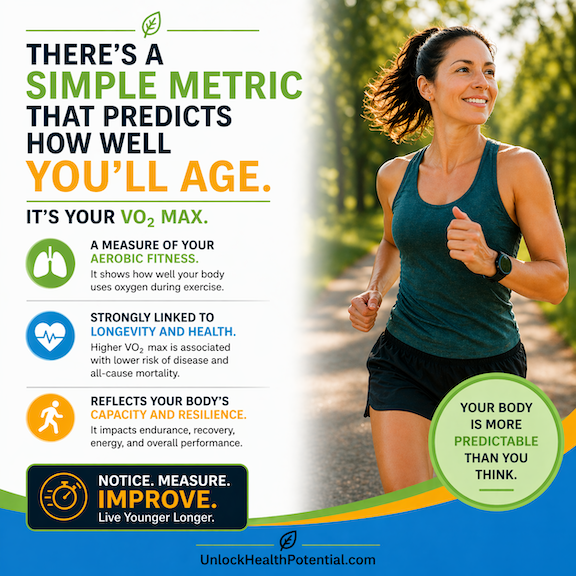
Aerobic capacity responds at any starting point, including in people beginning in their sixties and seventies. The levers are an unremarkable aerobic base first, then short efforts, with hills doing more than speed does.
The harder questions are how much base before intensity, how hard those efforts should actually be, and how to progress without asking more than your recovery can pay for.
Where This Leaves You
Aerobic fitness has an image problem. The word conjures athletes, and the measurement sounds like something you would need a reason to care about.
It is nothing of the kind. It is the size of the account everything else is drawn from — the difference between a life you move through and a life you manage around. Whether you can carry your own bags up the stairs. Whether an unexpected week costs you a fortnight. Whether you take the walk or make an excuse.
The encouraging part is how unfussy the remedy is. Not punishment. Not performance. Just enough regular demand that your body has a reason to keep the capacity it has, and a reason to build a little more.
Which is where an article reaches its limit. How much, and how often, depends on where you are starting from — so in the book each signal’s practice section is tiered against your score, because rebuilding from a low result and protecting a strong one are genuinely different jobs. Score all ten and those tiers resolve into a plan built from your own numbers.
But do not conclude anything from one signal.
In Part 5 we come back down to something you can test in your kitchen, in about thirty seconds, using nothing but a chair. It belongs to the third system — and it is the signal that most reliably predicts whether people keep living independently.
Your body has been keeping a scorecard. It is time you read it.
Get the Book
VO₂ max is Signal 04 of 10.
The Longevity Scorecard — the new book from Ronit Mor, ND and Russell Skinner, MD — gives you a full chapter on each of the ten signals, the research benchmark for every one, and the at-home self-test to measure it.
Then it turns your ten results into a score out of 100, three system totals, and a practice plan matched to what you actually scored — so you finish knowing which system to rebuild first, and exactly what to do about it.
Order The Longevity Scorecard →
Its companion volume, Ancient Biology, Modern Life, restores the ten inputs your body receives. This book measures the ten signals your body sends. Read them in either order.
It is not too late. It has never been too late.
FAQs
There is no single figure, because VO₂ max is ranked rather than scored against a fixed value — your result is compared with others of your age and sex, since a number that would be excellent at seventy is ordinary at thirty. The useful question is which percentile band you fall into. Our book The Longevity Scorecard provides those bands and explains how to place yourself in them.
Laboratory testing with a mask and treadmill is the gold standard, but validated field estimates exist that need only a stopwatch and a measured distance or a set of stairs. Wearables from the major manufacturers also produce an estimate, which is approximate in absolute terms but reasonably useful for tracking direction over months. The book covers which methods are reliable enough to score with and which consistently overestimate.
It is among the strongest we have, and several researchers argue it is the single strongest. In large cohort studies, low cardiorespiratory fitness has carried mortality risk comparable in magnitude to major established risk factors. That said, these are observational findings — illness reduces fitness as well as the reverse — so the honest framing is that fitness is powerfully associated with survival rather than proven to cause it.
No. Most of the improvement available to most people comes from consistent moderate aerobic activity — brisk walking, cycling, swimming — with occasional short efforts added once a base exists. Intensity accelerates progress but is neither the entry requirement nor the largest share of the benefit.
Yes. Aerobic capacity responds to training at every age studied, and people beginning in their sixties and seventies show meaningful gains. Progress is slower than at thirty, and the trajectory still bends upward. Build gradually rather than aggressively, particularly if you have been inactive for a long period.
Because VO₂ max functions as a ceiling rather than a symptom. As it falls, ordinary demands take up a larger share of what you have available — and that registers as things simply feeling harder rather than as anything identifiably wrong. Most people accommodate the change without noticing they are doing it, which is precisely why it is worth measuring rather than sensing.
If you have a diagnosed heart condition, chest pain or breathlessness on exertion, uncontrolled blood pressure, or you have been largely sedentary for a long stretch, yes — a conversation first is sensible. For most other people, adding brisk walking and gradually building is low risk. The principle is progression, not proving a point.
This content is for educational purposes only and is not intended as medical advice.
Scientific References
Ross R, Blair SN, Arena R, et al. Importance of assessing cardiorespiratory fitness in clinical practice: a case for fitness as a clinical vital sign. Circulation. 2016;134(24):e653-e699.
Mandsager K, Harb S, Cremer P, et al. Association of cardiorespiratory fitness with long-term mortality among adults undergoing exercise treadmill testing. JAMA Netw Open. 2018;1(6):e183605.
Kodama S, Saito K, Tanaka S, et al. Cardiorespiratory fitness as a quantitative predictor of all-cause mortality and cardiovascular events in healthy men and women: a meta-analysis. JAMA. 2009;301(19):2024-2035.
Blair SN, Kohl HW, Paffenbarger RS, et al. Physical fitness and all-cause mortality: a prospective study of healthy men and women. JAMA. 1989;262(17):2395-2401.
Levine BD. VO₂max: what do we know, and what do we still need to know? J Physiol. 2008;586(1):25-34.
Booth FW, Roberts CK, Laye MJ. Lack of exercise is a major cause of chronic diseases. Compr Physiol. 2012;2(2):1143-1211.