
Longevity -> Measure It. Train It. Extend It.
SIGNAL 07 · Daily Steps · System: Metabolic · What it measures: Not how fit you are, but how often — across an ordinary day — your body is asked to do anything at all.
Signal 7 of 10 in The Longevity Scorecard.
In 1965, a Japanese company called Yamasa began selling a pedometer.
They needed a name for it. They settled on manpo-kei — which translates roughly as “ten-thousand-step meter” — partly because ten thousand is a satisfying round number, and partly because the Japanese character for it, 万, looks rather like a person mid-stride.
It was an excellent name.
It was not a finding.
Sixty years later, that marketing decision is embedded in wearables, insurance schemes, corporate wellness programs, and the quiet private guilt of several hundred million people who did not reach it today.
The number was never exactly wrong. It simply never had anything behind it. And when researchers eventually went looking, what they found was considerably more useful — and considerably kinder.
What the Research Actually Found
In 2022, a meta-analysis published in Lancet Public Health pooled fifteen international cohorts to ask the question properly.
Mortality fell as steps rose. But the benefit began appearing at levels far below ten thousand, and the curve flattened well before reaching it. The steepest gains belonged to the people moving least — the distance from very little to somewhat more mattered far more than the distance from a lot to slightly more.
An earlier analysis had added something genuinely surprising. Once total step count was accounted for, the intensity of those steps — how briskly they were walked — showed no further association with mortality.
Which contradicts almost everything fitness culture has ever told you.
It was not the pace. It was the amount.
Steps Are Not Exercise. They Are Exposure.
This is where step counts stop being a fitness metric and become something else entirely.
In Part 4 we looked at VO₂ max, which measures capacity — the ceiling on what your body can produce when pushed. Steps measure something completely different. They measure exposure: how frequently, across an ordinary day, your physiology is asked to do anything at all.
Capacity is what you could do. Exposure is what you actually did.
And your metabolism, it turns out, responds to the second far more than most people expect. There is a mechanism underneath this involving how muscle handles fuel — one that operates on frequency rather than total volume, and explains why a single block of activity cannot substitute for movement spread through a day. The chapter covers it, along with why the sitting research has proved so awkward for anyone hoping one workout settles the account.
So Is There a Number?
Yes — and this is the easiest signal in the series to measure, because something in your pocket has been counting all along without being asked.
The difficult part was never getting the number. It is knowing what to compare it against.
Here the research offers real reassurance: benefit begins far below the famous figure, and there is no cliff edge you are falling off. But there is a catch worth naming.
Mortality is a low bar.
It is simply the outcome researchers can measure most reliably — not the outcome you actually care about. Nobody’s genuine ambition is to merely not die this decade. The step level at which the survival curve flattens and the step level associated with functioning well, handling glucose properly, and holding onto the other nine signals are not the same number.
In our book, The Longevity Scorecard, daily steps are scored in three bands — Strong, Watch, or Priority — against the exposure level associated with thriving rather than merely surviving. The book also covers how to read a step count honestly: why you should average several days including a weekend, and why your phone and your wrist will disagree with each other by a surprising margin.
The bands live in the book.
You almost certainly know your number already. What it cannot tell you on its own is whether it stands alone or belongs to a pattern — because low steps with a strong aerobic ceiling is a different situation from low steps with the whole Metabolic cluster drifting together.
And if the number is lower than you hoped, that is not a verdict on your discipline. The research is emphatic that the largest gains belong to people starting exactly where you are.
Where This Signal Sits in the Pattern
Daily steps is one of ten functional predictors in our book. The ten resolve into three interacting systems: Nervous, Metabolic, and Musculoskeletal.
Daily steps sits in the Metabolic cluster, alongside VO₂ max and walking after meals — which gives you a pair in this system too.
And the disagreement case here is common enough that researchers have given it a name: the active couch potato.
Someone who trains hard for forty-five minutes, then sits almost without interruption for the remaining fifteen hours. Their VO₂ max may be genuinely excellent. Their exposure is poor. Ask them about exercise and they answer confidently. Ask about movement and the picture changes entirely.
That combination is particularly common among people who consider themselves fit — which is precisely why a single measurement misses it.
The reverse pattern exists too: high steps, modest aerobic capacity. Someone on their feet all day at unremarkable intensity. Well exposed, under-challenged.
Those are two different problems requiring two different responses, and no single number distinguishes between them.
What Actually Moves It
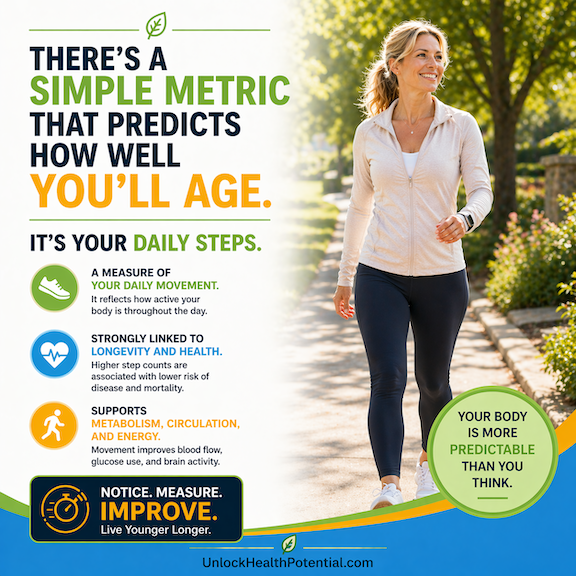
This is the least demanding signal to improve, because the target is frequency rather than effort. Add to your baseline, interrupt long sitting, and attach walking to things you already do.
The harder questions are how much more actually matters, and how to read a count that your phone and your watch will disagree about.
Where This Leaves You
The ten thousand figure has done a curious amount of damage for something invented to sell a pedometer.
It has convinced people that anything short of it barely counts — which is exactly backwards, because the research is emphatic that the largest gains belong to people moving least. The distance from three thousand to five thousand steps matters far more than the distance from nine to ten.
If you have been treating a step target as something you fail at daily, you can put that down. It was a slogan.
What replaces it is more demanding but far more honest: your body is not asking for a number. It is asking to be used regularly, throughout the day, in the unglamorous way it was built around long before anyone thought to count.
Which is where an article reaches its limit. How much, and how often, depends on where you are starting from — so in the book each signal’s practice section is tiered against your score, because rebuilding from a low result and protecting a strong one are genuinely different jobs. Score all ten and those tiers resolve into a plan built from your own numbers.
But do not conclude anything from one signal.
In Part 8 we stay in the Metabolic system and ask a different question — not how much you move, but when. Because ten minutes placed at exactly the right moment does something that an hour placed at the wrong one does not. Same activity, same system, entirely different mechanism.
Your body has been keeping a scorecard. It is time you read it.
Get the Book
Walking after meals is Signal 08 of 10.
The Longevity Scorecard — the new book from Ronit Mor, ND and Russell Skinner, MD — gives you a full chapter on each of the ten signals, the research benchmark for every one, and the at-home self-test to measure it.
Then it turns your ten results into a score out of 100, three system totals, and a practice plan matched to what you actually scored — so you finish knowing which system to rebuild first, and exactly what to do about it.
Order The Longevity Scorecard →
Its companion volume, Ancient Biology, Modern Life, restores the ten inputs your body receives. This book measures the ten signals your body sends. Read them in either order.
It is not too late. It has never been too late.
FAQs
From a pedometer launched in Japan in 1965, marketed as the manpo-kei or “ten-thousand-step meter.” The figure was chosen for its memorability, not derived from research. It has since become globally embedded despite never having had an evidence base of its own. The research that followed decades later found benefit beginning at considerably lower levels.
Research consistently shows benefit starting well below ten thousand, with the largest gains going to those currently moving least. But mortality studies answer a narrower question than most people are asking — the step level associated with not dying sooner and the level associated with functioning well are not the same figure. Our book The Longevity Scorecard provides the bands, along with guidance on averaging and device accuracy.
For mortality outcomes, the evidence suggests not. A large 2020 study found that once total daily steps were accounted for, step intensity carried no additional association with mortality. That said, pace matters for other things — aerobic capacity in particular — so briskness is not irrelevant, just not the lever most people assume it is for this signal.
Only partly, and it takes more than most people think. A pooled analysis of roughly a million people found that very high activity levels — closer to an hour daily of moderate activity than a single gym session — appeared to offset the mortality risk of prolonged sitting. Even then, television time remained associated with elevated risk. A workout helps substantially. It does not settle the account.
Because muscle clears glucose from your bloodstream through two routes, and one of them depends on contraction rather than insulin. That mechanism responds to how often muscle is used, not only how much movement accumulates. Frequent short interruptions engage it repeatedly through the day in a way a single block of activity cannot.
Then steps are the wrong measurement for you, and that is a limitation of the metric rather than of you. What matters physiologically is frequency of muscle contraction and interruption of prolonged stillness, which can be achieved through seated movement, resistance work, water-based activity, or adapted exercise. A physical therapist can identify what applies to your situation — the underlying principle holds regardless of whether it registers on a pedometer.
This content is for educational purposes only and is not intended as medical advice.
Scientific References
Paluch AE, Bajpai S, Bassett DR, et al. Daily steps and all-cause mortality: a meta-analysis of 15 international cohorts. Lancet Public Health. 2022;7(3):e219-e228.
Lee IM, Shiroma EJ, Kamada M, et al. Association of step volume and intensity with all-cause mortality in older women. JAMA Intern Med. 2019;179(8):1105-1112.
Saint-Maurice PF, Troiano RP, Bassett DR, et al. Association of daily step count and step intensity with mortality among US adults. JAMA. 2020;323(12):1151-1160.
Ekelund U, Steene-Johannessen J, Brown WJ, et al. Does physical activity attenuate, or even eliminate, the detrimental association of sitting time with mortality? A harmonised meta-analysis. Lancet. 2016;388(10051):1302-1310.
Erickson KI, Voss MW, Prakash RS, et al. Exercise training increases size of hippocampus and improves memory. Proc Natl Acad Sci U S A. 2011;108(7):3017-3022.
Booth FW, Roberts CK, Laye MJ. Lack of exercise is a major cause of chronic diseases. Compr Physiol. 2012;2(2):1143-1211.