
Longevity -> Measure It. Train It. Extend It.
SIGNAL 05 · Sit-to-Stand · System: Musculoskeletal · What it measures: Whether your legs can still move your body against gravity without help — and how much of the job has quietly been handed to something else.
Signal 5 of 10 in The Longevity Scorecard.
Watch someone rise from a low armchair and you can see something they cannot see about themselves.
Somewhere in the last few years, without any decision ever being made, their hands started helping.
A palm on the armrest. A push off the knee. A small forward rock to gather momentum first. None of it is conscious. None of it gets remarked upon. And all of it is the body quietly outsourcing a job its legs used to do alone.
This is what makes the sit-to-stand test so useful, and so easy to fail without noticing. The question was never whether you can get out of a chair. Almost everyone can get out of a chair.
The question is what it costs you, and who is paying.
Why It Predicts Independence Better Than Almost Anything
Of the ten signals in this series, this is the one that maps most directly onto whether people continue living in their own homes.
Think about what sits downstream of it. Getting out of bed. Getting off the toilet. Getting out of a car. Getting up from the floor after a fall — a harder problem, but running on the same machinery.
These are not activities. They are the preconditions for activities.
Lose this capacity and the geography of a life contracts, quietly and without announcement, to whatever can be reached without having to stand up from something. Research has consistently linked poorer sit-to-stand performance with higher fall risk, frailty, and loss of independence — not because the movement is magical, but because it sits underneath everything else.
Strength Is Only Part of the Story
In 2002, a research group led by Stephen Lord examined what actually determines sit-to-stand performance in older adults.
Strength mattered, as expected. But so did sensation. So did movement speed. So did balance.
And so did psychological status.
That last finding deserves far more attention than it gets. How a person expects the movement to go affects how it goes — independent of the muscle available to perform it.
Someone who is apprehensive rises differently. More slowly. With a wider base. With a hand hovering near the armrest, ready. The caution is not irrational; it is a sensible response to genuine uncertainty.
It is simply expensive.
Which produces one of the more difficult patterns in aging. The movement feels less secure, so it gets performed less often and with more assistance. The systems that produce it receive less stimulus and decline a little further. The next attempt feels less secure still.
Nothing in that sequence is a mistake. Every individual step is reasonable. The sum of them only moves in one direction.
Meanwhile, the Furniture Has Been Helping
The environment has been quietly adapting to all of this.
Chairs have arms. Seats have got higher. Beds have got higher. There are grab bars beside the toilet, and lift chairs advertised on daytime TV as the solution to a problem nobody says out loud.
Every one of these is genuinely useful. Several are necessary, and there is no argument here against any of them.
But collectively they do something worth noticing. They remove the last remaining repetitions of a movement most people once performed thirty or forty times a day without thinking about it.
Nobody ever trained this capacity deliberately. It was maintained by the ordinary friction of getting up off things. Remove the friction and there is nothing holding it in place.
So Is There a Number?
Yes — and of all ten signals, this is the one you can measure yourself right now.
You need a chair without arms, a timer, and about half a minute. Sit with your feet flat, cross your arms over your chest so they cannot help, and stand fully up and sit fully down as many times as you can in thirty seconds.
Count them.
Go and do it, if you like. It takes less time than finishing this section.
Then come back — because a count on its own is just a count.
In our book, The Longevity Scorecard, that number is placed against validated benchmarks and scored in three bands: Strong, Watch, or Priority. The book also covers chair height, foot position, and what counts as a completed repetition, all of which shift the result enough to move someone between bands.
The thresholds live in the book — and you now have a number without them, which is an honest reflection of the situation.
A raw count tells you what you did on one attempt. What it cannot tell you is whether that number stands alone or belongs to a pattern — and a modest count with strong grip is a different situation entirely from a modest count with the whole Musculoskeletal cluster drifting the same way.
Whatever you counted, read it as a starting line rather than a grade. If you needed your hands, that is not a failure. It is information, and it is among the fastest things on this list to turn around.
Where This Signal Sits in the Pattern
Sit-to-stand is one of ten functional predictors in our book. The ten resolve into three interacting systems: Nervous, Metabolic, and Musculoskeletal.
Sit-to-stand sits in the Musculoskeletal cluster, alongside grip strength and muscle mass — which means you now have a pair, because grip strength was Part 2.
And the instructive case is when a pair disagrees.
Strong grip with a poor chair-stand is common, and it has an obvious explanation once you see it. Upper body strength is maintained incidentally by daily life — carrying, lifting, opening, holding. Lower body strength is maintained by standing, walking, and climbing, which are precisely the demands modern life has engineered away.
So the arms keep their capacity almost by accident, while the legs quietly lose theirs. And someone in that position, judging themselves by how strong they feel, will conclude they are fine.
That disagreement is information. It says the system is not failing uniformly, which is exactly the kind of thing that tells you where to begin.
What Actually Moves It
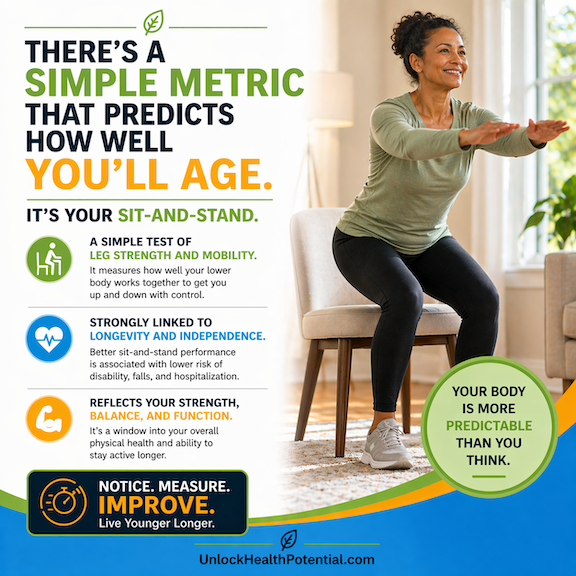
This is among the most trainable signals here, partly because the training is the test. Every stand you take without pushing off is a repetition, and lowering slowly trains the same muscles as rising.
The harder questions are how to progress once the basic movement is comfortable, how to practice getting off the floor safely, and what to do about the part that is confidence rather than strength.
Where This Leaves You
The ability to stand up from a chair is not an impressive thing to be good at. Nobody has ever admired anyone for it.
But it is the hinge that a great deal of ordinary life turns on — and unlike most measures of decline, it announces itself early, in a form anyone can read, if they are willing to look at what their hands are doing.
The hands are not the problem. They are the report.
And this responds fast. Not in years. In weeks, because the movement trains itself every time you refuse the shortcut.
Which is where an article reaches its limit. How much, and how often, depends on where you are starting from — so in the book each signal’s practice section is tiered against your score, because rebuilding from a low result and protecting a strong one are genuinely different jobs. Score all ten and those tiers resolve into a plan built from your own numbers.
But do not conclude anything from one signal.
In Part 6 we take up balance, which is the other half of what you just measured and belongs to an entirely different system. It is also the signal where the gap between what people assume about themselves and what they can actually do is widest — and the test takes ten seconds.
Your body has been keeping a scorecard. It is time you read it.
Get the Book
Sit-to-stand is Signal 05 of 10.
The Longevity Scorecard — the new book from Ronit Mor, ND and Russell Skinner, MD — gives you a full chapter on each of the ten signals, the research benchmark for every one, and the at-home self-test to measure it.
Then it turns your ten results into a score out of 100, three system totals, and a practice plan matched to what you actually scored — so you finish knowing which system to rebuild first, and exactly what to do about it.
Order The Longevity Scorecard →
Its companion volume, Ancient Biology, Modern Life, restores the ten inputs your body receives. This book measures the ten signals your body sends. Read them in either order.
It is not too late. It has never been too late.
FAQs
Validated benchmarks exist and they vary by age and sex, which is why a single universal figure would mislead. What the research is consistent about is that performance below a defined threshold is associated with meaningfully higher fall risk and loss of independence. Our book The Longevity Scorecard provides the bands along with the full testing protocol, since chair height and repetition standards change the result enough to matter.
It usually means lower body strength, coordination, or confidence has declined enough that your body has recruited help — often gradually enough that you never noticed the change. It is common and it is not a verdict on anything. It is also among the most responsive things on this list, because every unassisted stand is itself a repetition of the training.
For most people, yes. Use a stable chair without arms placed against a wall so it cannot slide, and have something solid nearby to hold. Stop if you feel pain, dizziness, or genuine unsteadiness. If you have had recent falls, significant joint problems, recent surgery, or you already need help to stand, do this with a clinician or physical therapist rather than alone.
Because it requires strength, balance, coordination, joint mobility, and neurological timing to work together, and because it sits underneath most of daily life. When it fails, people move less, and moving less accelerates the decline of every system involved. It is less a prediction about the movement than about the trajectory it sets in motion.
Yes. Lower body strength and neuromuscular coordination remain responsive to training well into later decades, and this particular movement improves unusually quickly because it can be practiced throughout the day rather than in dedicated sessions. Progress is often noticeable within weeks.
That is worth taking seriously rather than pushing through. Research has found that psychological factors affect sit-to-stand performance independently of strength, and fear of falling is recognized as a risk factor for falls in its own right. Working with a physical therapist addresses both the capacity and the confidence, which is faster than trying to address either alone.
This content is for educational purposes only and is not intended as medical advice.
Scientific References
Jones CJ, Rikli RE, Beam WC. A 30-s chair-stand test as a measure of lower body strength in community-residing older adults. Res Q Exerc Sport. 1999;70(2):113-119.
Lord SR, Murray SM, Chapman K, Munro B, Tiedemann A. Sit-to-stand performance depends on sensation, speed, balance, and psychological status in addition to strength in older people. J Gerontol A Biol Sci Med Sci. 2002;57(8):M539-M543.
Bohannon RW. Reference values for the five-repetition sit-to-stand test: a descriptive meta-analysis of data from elders. Percept Mot Skills. 2006;103(1):215-222.
Tiedemann A, Shimada H, Sherrington C, Murray S, Lord S. The comparative ability of eight functional mobility tests for predicting falls in community-dwelling older people. Age Ageing. 2008;37(4):430-435.
Brito LBB, Ricardo DR, Araújo DSMS, Ramos PS, Myers J, Araújo CGS. Ability to sit and rise from the floor as a predictor of all-cause mortality. Eur J Prev Cardiol. 2014;21(7):892-898.
Booth FW, Roberts CK, Laye MJ. Lack of exercise is a major cause of chronic diseases. Compr Physiol. 2012;2(2):1143-1211.