

Longevity -> Measure It. Train It. Extend It.
SIGNAL 09 · Muscle Mass · System: Musculoskeletal · What it measures: Not how much muscle you have, but which direction it is traveling — the only signal on the scorecard scored as a trend.
Signal 9 of 10 in The Longevity Scorecard.
Ask most people why they should keep their muscle and the answer will be about appearance, or lifting things, or staying active.
Here is the answer that changes the conversation.
Muscle is the tissue your body spends when something goes wrong.
When you are ill, injured, recovering from surgery, or fighting an infection, your body needs amino acids urgently — for immune cells, for repair. It cannot wait for dinner and it has no dedicated protein store to draw on.
So it takes what it needs from muscle. Without asking.
Which reframes the entire question. You are not building muscle for this year. You are building it for the week you cannot get out of bed — and the moment you discover how much you had is precisely the moment you can no longer do anything about it.
What Ten Nonagenarians Proved
That is the sobering half. Here is the other one, and it is genuinely remarkable.
In 1990, researchers led by Maria Fiatarone published a study in JAMA that geriatric medicine has never entirely got over.
They recruited ten frail nursing home residents. Average age ninety. The oldest was ninety-six.
The prevailing view at the time was that these were people to be handled gently — that resistance training would be ineffective at best and unsafe at worst. Exercise advice for the very old meant chair-based movement and not much else.
Instead, the researchers put them on supervised progressive resistance training three times weekly, at loads approaching eighty percent of each participant’s maximum.
After eight weeks, average strength had increased by 174 percent. Thigh muscle area had measurably grown, meaning this was genuine tissue change rather than people simply getting better at the exercise. Walking speed improved by nearly half. Several participants needed less support from walking aids. One who had previously required both arms to rise from a chair could stand unaided.
The result sat so far outside expectation that some questioned whether it would hold up. Four years later the same team ran a randomized controlled trial in around a hundred frail nursing home residents.
It replicated.
The finding was never really that old people can get stronger. It was that the machinery responsible for adaptation does not switch off with age.
It waits.
Muscle Is Not Lost to Time. It Is Released.
Muscle is expensive tissue — costly to build, costly to maintain, and metabolically demanding to keep on the books. Your body is scrupulous about not paying for capacity it is not using.
So when the demands stop arriving, it draws an entirely reasonable conclusion: this is no longer required.
That is not decay. It is administration.
And administration is reversible in a way that decay is not.
The trouble is that the process is quiet. Nobody notices losing something they are never asked to use. What people notice, years later, is that the groceries feel heavier. That stairs require a pause. That gardening on Saturday now costs them Sunday.
Then they say the thing almost everyone says.
I’m getting older.
Age is genuinely part of it. But a substantial share of what gets filed under aging is decades of accumulated instruction — a body that was repeatedly told the muscle was surplus, and complied. That is not a failure of discipline. It is a body doing precisely what bodies are built to do.
So Is There a Number?
Yes, and this signal works differently from every other one in the series.
The other nine ask where are you. This one asks which way are you going.
There is a sound reason for that. Absolute muscle mass is difficult to measure well outside a clinic, and it varies so much with frame, height, and sex that a single figure would tell you remarkably little on its own. Direction, by contrast, is both observable and more predictive.
So the bands here are: gaining, holding, or losing.
Which sounds simpler than it is — because most people genuinely do not know which of the three they are currently doing. Muscle change is slow enough to be invisible month to month and unmistakable across five years, and almost nobody is tracking anything that would reveal it in between.
In our book, The Longevity Scorecard, this is scored in three bands — Strong, Watch, or Priority — based on that direction. The book covers how to establish yours honestly: the practical markers that reveal which way you are traveling without a scan, and the early indicators that show loss well before a mirror does.
Those markers live in the book.
You probably have a suspicion about your own answer. A suspicion is not the same as knowing, and this is one signal where the difference matters — because the direction you are traveling now compounds for the rest of your life, and because a suspicion cannot tell you whether this is an isolated drift or the whole Musculoskeletal cluster moving together.
Where This Signal Sits in the Pattern
Muscle mass is one of ten functional predictors in our book. The ten resolve into three interacting systems: Nervous, Metabolic, and Musculoskeletal.
And with this signal, a second system is complete.
Grip strength (Part 2), sit-to-stand (Part 5), and muscle mass are the three Musculoskeletal signals.
Look at what those three actually ask. Grip measures output — can the system still generate force. Sit-to-stand measures application — can that force be organized into something useful against gravity. Muscle mass measures the substrate — the tissue itself, and which way it is heading.
Output, application, substrate.
Which is the same three-part logic the Metabolic system used: capacity, exposure, timing.
That is not accidental. Each system is interrogated from three angles because one angle is never sufficient. Someone can have adequate substrate and poor application. Someone can have good output and a substrate quietly draining away underneath it. Those are different problems, and the difference is invisible in any single measurement.
Which leaves one system — and it is the largest. Nervous carries four signals, and you have already met three of them.
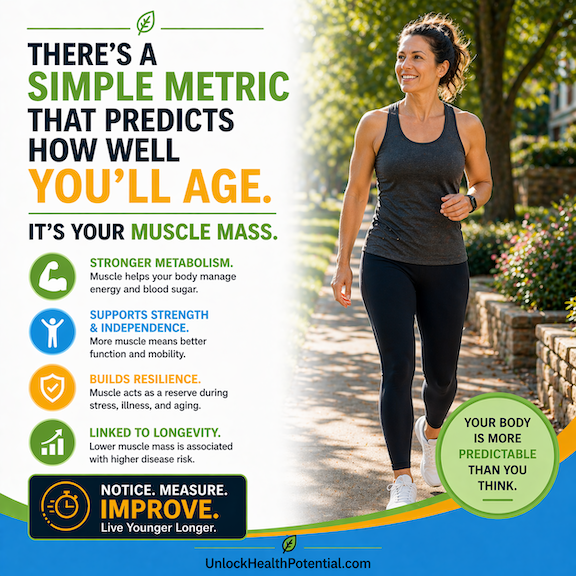
What Actually Moves It
If a group of frail ninety-year-olds can add 174 percent to their strength in eight weeks, the question was never whether your body can respond. Resistance training two or three times weekly is the lever, protein is what lets it stick, and walking will not do this particular job however much of it you do.
The harder questions are how much protein and when, how to keep training progressive rather than merely repetitive, and how to protect what you have during illness — which is the moment almost nobody plans for.
Where This Leaves You
Muscle is the most honest tissue you have. It reflects what you have repeatedly asked of it, over years, with no interest at all in your intentions.
But the reason to keep it has very little to do with strength as most people picture it. It is a reserve — the buffer between an ordinary setback and a permanent one, the difference between a bad month and a changed life.
And the most encouraging thing in this entire series is that the biological machinery never closes. It has been sitting there, waiting for a reason, possibly for decades.
Which is where an article reaches its limit. How much, and how often, depends on where you are starting from — so in the book each signal’s practice section is tiered against your score, because rebuilding from a low result and protecting a strong one are genuinely different jobs. Score all ten and those tiers resolve into a plan built from your own numbers.
But do not conclude anything from one signal.
In Part 10 we finish — with the signal that quietly governs whether any of the previous nine actually work. It completes the Nervous system, it completes the scorecard, and it is the one where the research surprised us most. Because it turns out that when you sleep matters more than how long.
Your body has been keeping a scorecard. It is time you read it.
Get the Book
Muscle mass is Signal 09 of 10.
The Longevity Scorecard — the new book from Ronit Mor, ND and Russell Skinner, MD — gives you a full chapter on each of the ten signals, the research benchmark for every one, and the at-home self-test to measure it.
Then it turns your ten results into a score out of 100, three system totals, and a practice plan matched to what you actually scored — so you finish knowing which system to rebuild first, and exactly what to do about it.
Order The Longevity Scorecard →
Its companion volume, Ancient Biology, Modern Life, restores the ten inputs your body receives. This book measures the ten signals your body sends. Read them in either order.
It is not too late. It has never been too late.

FAQs
Rarely from a mirror, and rarely from the scale — muscle can decline while weight stays flat or rises. The reliable indicators are functional: things that used to be easy taking more effort, recovery from physical activity stretching longer, grip weakening, or difficulty rising from low chairs. Our book The Longevity Scorecard covers the practical markers that reveal your direction of travel without needing a scan.
Yes. The landmark demonstration involved frail nursing home residents averaging ninety years old, who increased strength by an average of 174 percent over eight weeks of supervised progressive resistance training — with measurable growth in thigh muscle, not merely improved technique. The result was replicated four years later in a larger randomised trial. Gains come more slowly with age, but the capacity to adapt does not close.
No, and this is one of the most consequential misunderstandings in healthy aging. Walking maintains cardiovascular function, metabolic health, and movement quality, and it is genuinely valuable. But muscle responds to load, and walking does not supply enough of it to preserve tissue over decades. Resistance training is a separate requirement, not an optional upgrade.
More than you did at thirty, because older muscle responds less readily to the same amount — and distributed across meals rather than concentrated in one. Precise targets depend on body size, activity level, and health status. If you have kidney disease or reduced kidney function, discuss protein intake with your clinician before increasing it.
Because three things happen simultaneously: illness raises the body’s demand for amino acids, immobility removes the signal to preserve muscle, and appetite usually falls. Research placing healthy older adults on strict bed rest has found substantial losses of leg muscle within around ten days. This is why moving as much as is safe during an admission, and eating protein even without appetite, matters considerably more than it appears to at the time.
For most people yes, and frailty is a reason to train rather than a reason to avoid it — but supervision matters. The nonagenarian studies used supervised, progressively loaded programs rather than unstructured effort. If you have cardiac conditions, uncontrolled blood pressure, significant joint disease, or osteoporosis, start with a physical therapist or a qualified trainer experienced with older adults.
This content is for educational purposes only and is not intended as medical advice. Speak with a qualified healthcare provider before beginning resistance training if you have existing health conditions, and before significantly increasing protein intake if you have kidney disease.
Scientific References
Fiatarone MA, Marks EC, Ryan ND, Meredith CN, Lipsitz LA, Evans WJ. High-intensity strength training in nonagenarians: effects on skeletal muscle. JAMA. 1990;263(22):3029-3034.
Fiatarone MA, O’Neill EF, Ryan ND, et al. Exercise training and nutritional supplementation for physical frailty in very elderly people. N Engl J Med. 1994;330(25):1769-1775.
Kortebein P, Ferrando A, Lombeida J, Wolfe R, Evans WJ. Effect of 10 days of bed rest on skeletal muscle in healthy older adults. JAMA. 2007;297(16):1772-1774.
Cruz-Jentoft AJ, Bahat G, Bauer J, et al. Sarcopenia: revised European consensus on definition and diagnosis. Age Ageing. 2019;48(1):16-31.
Peterson MD, Rhea MR, Sen A, Gordon PM. Resistance exercise for muscular strength in older adults: a meta-analysis. Ageing Res Rev. 2010;9(3):226-237.
Fragala MS, Cadore EL, Dorgo S, et al. Resistance training for older adults: position statement from the National Strength and Conditioning Association. J Strength Cond Res. 2019;33(8):2019-2052.
Liu CJ, Latham NK. Progressive resistance strength training for improving physical function in older adults. Cochrane Database Syst Rev. 2009;(3):CD002759.
Westcott WL. Resistance training is medicine: effects of strength training on health. Curr Sports Med Rep. 2012;11(4):209-216.