

Burnout is not simply about having “too much stress.”
Modern life has normalized exhaustion to such a degree that many people no longer recognize burnout as a physiological warning sign.
Feeling wired but tired, needing caffeine to function, struggling to recover from stress, waking up exhausted despite sleeping, losing motivation, feeling emotionally depleted, or experiencing constant mental and physical fatigue has become so common that many people assume it is simply the unavoidable consequence of a busy and demanding life.
But burnout is not simply about having “too much stress.”
And chronic exhaustion is not a personal weakness.
More often, burnout and adrenal dysfunction represent the body’s attempt to adapt to prolonged overload, chronic nervous system activation, poor recovery, metabolic instability, and deeper physiological imbalances that have been accumulating beneath the surface for years.
This is where the contrast between conventional medicine and functional medicine becomes especially important.
Because while both paradigms recognize fatigue and burnout symptoms, they often approach them in profoundly different ways—with very different long-term outcomes.
Two Approaches. Two Very Different Outcomes.
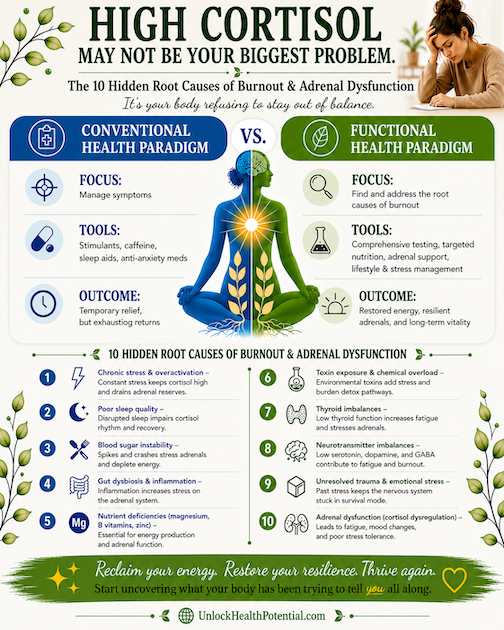
The Conventional Health Paradigm
Conventional medicine excels in acute care, disease diagnosis, and crisis management. It is incredibly valuable for identifying serious pathology and stabilizing severe symptoms.
But when it comes to chronic burnout and adrenal dysfunction, the conventional approach often centers primarily around symptom management.
The focus is frequently placed on:
- Improving short-term energy
- Managing anxiety
- Improving sleep
- Reducing discomfort
- Increasing functionality
Common interventions may include:
- Stimulants
- Caffeine
- Sleep medications
- Anti-anxiety medications
- Antidepressants
These tools can absolutely provide relief and may be appropriate in certain situations. But many people quickly discover something frustrating: The exhaustion keeps coming back.
That’s because symptom suppression does not necessarily restore the systems responsible for energy production, stress resilience, hormonal balance, and nervous system regulation.
The central question often becomes: “How do we improve the symptom?”
Functional medicine asks a different question: “Why is the body struggling to maintain resilience in the first place?”
And that question changes the entire conversation.
The Functional Health Paradigm
Functional medicine views burnout as a systems-level issue rather than an isolated problem. Instead of seeing exhaustion simply as a lack of motivation or stress tolerance, it recognizes burnout as the downstream consequence of multiple systems operating under chronic strain.
Energy production and resilience depend on:
- Stable blood sugar
- Healthy cortisol rhythms
- Nutrient sufficiency
- Nervous system balance
- Restorative sleep
- Mitochondrial function
- Hormonal regulation
- Gut health
- Inflammation control
- Emotional recovery capacity
When these systems become chronically dysregulated, the body adapts by conserving energy and shifting into survival mode.
This may initially appear as fatigue, poor recovery, anxiety, irritability, brain fog, low motivation, sleep disruption, and declining stress tolerance. Over time, the body’s adaptive systems become increasingly overwhelmed.
The goal of functional medicine is not simply temporary symptom relief. The goal is restoring resilience.
Why Root Causes Matter
Your body is not designed to operate under constant pressure indefinitely. Stress itself is not inherently harmful. In fact, short-term stress is adaptive and necessary. The problem begins when stress becomes chronic while recovery remains insufficient.
At that point, the body begins prioritizing survival over optimization. Hormones shift. Inflammation rises. Sleep quality declines. Energy production decreases. Recovery slows. The nervous system becomes hypervigilant.
What many people call “burnout” is often the body’s attempt to protect itself from prolonged overload. And unless the deeper drivers are addressed, the body continues repeating the same patterns no matter how much stimulation or willpower is added on top.erving energy. And that signal deserves investigation—not dismissal.
The 10 Hidden Root Causes of Burnout & Adrenal Dysfunction
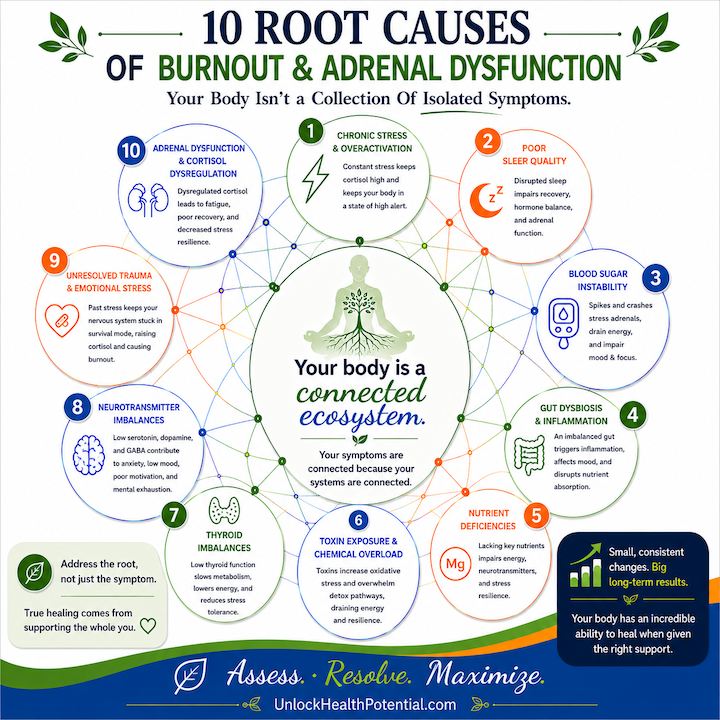
1. Chronic Stress & Overactivation
The human nervous system was designed for temporary stress—not nonstop activation. Modern life keeps many people in a constant state of urgency, overstimulation, emotional pressure, and mental overload.
This chronic stress keeps cortisol elevated for prolonged periods, eventually disrupting energy regulation, recovery, and resilience.
The body can adapt for a while. But eventually, prolonged stress begins draining the very systems responsible for maintaining energy and stability.
2. Poor Sleep Quality
Sleep is where restoration occurs. It is during deep sleep that the body:
- Recalibrates cortisol rhythms
- Repairs tissues
- Restores neurotransmitters
- Regulates inflammation
- Recovers metabolically
When sleep becomes fragmented or insufficient, the body never fully exits survival physiology.
Many people with burnout feel exhausted precisely because their nervous system no longer knows how to fully recover.
3. Blood Sugar Instability
Energy stability depends heavily on stable glucose regulation. Frequent spikes and crashes in blood sugar place enormous stress on cortisol regulation, adrenal signaling, and nervous system balance. This often creates a repeating cycle of:
- Fatigue
- Cravings
- Irritability
- Brain fog
- Energy crashes
Many people trying to “push through” burnout are unknowingly amplifying the problem through unstable metabolic patterns.
4. Gut Dysbiosis & Inflammation
The gut and nervous system are deeply interconnected. An unhealthy gut environment can contribute to inflammation, nutrient malabsorption, immune activation, neurotransmitter disruption, and nervous system stress.
This is one reason many people with burnout also experience bloating, digestive symptoms, food sensitivities, or chronic inflammation.
5. Nutrient Deficiencies
The body cannot sustain energy production without adequate nutritional support. Deficiencies in magnesium, zinc, B vitamins, iron, and other micronutrients can impair:
- Mitochondrial function
- Neurotransmitter production
- Cortisol regulation
- Recovery capacity
Modern lifestyles often deplete nutrients faster than they are replenished.
6. Toxin Exposure & Chemical Overload
Environmental burden is one of the most overlooked contributors to burnout. Exposure to mold, pesticides, heavy metals, industrial chemicals, and poor indoor air quality can increase oxidative stress and overwhelm detoxification pathways.
The body must divert enormous resources toward protection and detoxification, leaving fewer resources available for energy production and resilience.
7. Thyroid Imbalances
The thyroid plays a central role in:
- Metabolism
- Body temperature
- Energy production
- Cellular activity
Low thyroid function can contribute to fatigue, low motivation, brain fog, poor recovery, and reduced stress tolerance. Even subtle thyroid dysfunction can dramatically affect energy levels and resilience.
8. Neurotransmitter Imbalances
Neurotransmitters such as serotonin, dopamine, and GABA help regulate:
- Motivation
- Calmness
- Focus
- Emotional stability
- Nervous system balance
Chronic stress and inflammation can disrupt neurotransmitter production and signaling, contributing to emotional exhaustion, anxiety, low motivation, and burnout symptoms.
9. Unresolved Trauma & Emotional Stress
The nervous system stores experiences. Past emotional stress, chronic hypervigilance, unresolved trauma, or prolonged emotional overload can keep the body locked in a persistent stress-response state even when immediate danger is no longer present.
This creates:
- Nervous system dysregulation
- Elevated cortisol
- Sleep disruption
- Chronic exhaustion
Burnout is often not just physical. It is neurological and emotional as well.
10. Adrenal Dysfunction & Cortisol Dysregulation
Over time, prolonged stress can significantly disrupt cortisol rhythms. Instead of following healthy daily patterns, cortisol may become excessively elevated, poorly timed, flattened, or dysregulated. This contributes to:
- Fatigue
- Poor recovery
- Brain fog
- Mood instability
- Declining resilience
The body loses flexibility. And resilience begins disappearing.

How to Start Restoring Balance & Resilience (Without Overwhelm)
Reading about burnout is important. But sustainable change begins with creating an environment where the body finally feels safe enough to recover.
The goal is not perfection. The goal is reducing the stress burden your systems have been carrying for too long. Here’s where to begin:
1. Prioritize Sleep Like Recovery Depends On It—Because It Does
Focus on:
- Consistent sleep timing
- Reducing evening stimulation
- Morning sunlight exposure
- Creating a calmer nighttime routine
Why this matters: Deep sleep is one of the body’s most important restorative processes.
2. Stabilize Blood Sugar Throughout the Day
Build meals around:
- Protein
- Healthy fats
- Fiber
- Stable energy intake
Avoid long periods of under-eating or fasting followed by large crashes.
Why this matters: Blood sugar instability places enormous stress on cortisol and adrenal regulation.
3. Reduce Nervous System Overload
Build moments of recovery into your day:
- Walking
- Deep breathing
- Slower evenings
- Quiet time
- Less overstimulation
Why this matters: The nervous system cannot restore resilience while remaining in constant survival mode.
4. Support Nutrient Density
Prioritize whole foods and nutrient-rich meals that replenish magnesium, B vitamins, minerals, and protein.
Why this matters: Energy production is biochemical. The body cannot sustain resilience without proper nutritional support.
5. Stop Glorifying Constant Output
Burnout recovery often begins with one powerful realization: Rest is not weakness. Recovery is productive. And healing requires periods of safety—not just endless performance.
Final Thought
If there’s one message to take away from this article, it’s this: High cortisol may not be your biggest problem.
More often, it’s your body’s response to deeper physiological imbalances that have been building quietly over time.
Burnout is rarely caused by a single hormone or a single stressful week. It’s usually the result of multiple interconnected systems struggling to keep up with months—or even years—of chronic overload.
Poor sleep. Blood sugar instability. Gut dysfunction. Inflammation. Nutrient deficiencies. Thyroid imbalance. Nervous system dysregulation. Environmental toxins. Each places additional demands on your body’s stress-response system until resilience begins to disappear.
The goal isn’t simply to lower cortisol.
The goal is to restore the internal environment that allows your body to regulate cortisol naturally, produce sustainable energy, recover from stress, and rebuild resilience from the inside out.
Because your body isn’t working against you. It’s adapting to the inputs it’s receiving.
When you change those signals, your body often responds in remarkable ways.
Your symptoms are connected because your systems are connected.
Okay — So What Do I Actually Do With All This?
General knowledge is useful — but knowing which of the 24 major root causes are driving your symptoms is the real game-changer. That’s what the HealthPotentialAnalytics™ assessment is built to do. This isn’t a throwaway online quiz — it’s a sophisticated algorithm refined over years of expert work that acts like a detective for your body, connecting the dots across systems to reveal exactly where your trouble is hiding. You get what you pay for, and serious results come from serious tools.

FAQs
Not usually. High cortisol is an important part of the body’s stress response, but it is rarely the only reason someone develops burnout. Poor sleep, blood sugar instability, gut dysfunction, chronic inflammation, nutrient deficiencies, thyroid imbalances, toxin exposure, and nervous system dysregulation can all contribute to chronic exhaustion. Cortisol is often a signal that the body’s stress-response system is under strain—not the entire explanation.
Stress is something the body is designed to handle in short bursts. Burnout occurs when stress becomes chronic and recovery becomes insufficient. If you’re feeling persistently exhausted, emotionally depleted, less resilient, struggling to recover, or feeling “wired but tired,” your body may be signaling that its stress-response systems have been under strain for too long.
Because caffeine may increase stimulation without addressing the reason your energy is low in the first place. If poor sleep, chronic stress, nutrient deficiencies, blood sugar instability, inflammation, or cortisol dysregulation are driving burnout, stimulants can sometimes mask the symptoms while the underlying dysfunction continues. Sustainable energy comes from restoring physiology—not simply increasing stimulation.
Focus on recovery before optimization. Prioritize sleep, stabilize blood sugar, reduce chronic stress load, nourish your body with nutrient-dense foods, and create regular opportunities for your nervous system to feel safe. Burnout recovery is rarely about pushing harder—it’s about restoring the systems that allow resilience to return naturally.
Supporting healthy cortisol levels starts with addressing the factors that keep your stress-response system activated. Prioritize restorative sleep, stabilize blood sugar, manage chronic stress, eat nutrient-dense foods, move your body regularly, and support gut health. Rather than focusing on cortisol alone, the goal is to restore balance across the interconnected systems that regulate your body’s stress response.
This content is for educational purposes only and is not intended as a substitute for professional medical advice, diagnosis, or treatment. Individual results vary.
References & Further Reading
McEwen BS. Protective and Damaging Effects of Stress Mediators. New England Journal of Medicine. 1998;338(3):171–179.
https://www.nejm.org/doi/full/10.1056/NEJM199801153380307
Chrousos GP.Stress and Disorders of the Stress System.Nature Reviews Endocrinology. 2009;5(7):374–381.
https://www.nature.com/articles/nrendo.2009.106
Spiegel K, Leproult R, Van Cauter E. Impact of Sleep Debt on Metabolic and Endocrine Function. The Lancet. 1999;354(9188):1435–1439.
https://pubmed.ncbi.nlm.nih.gov/10543671/
Hotamisligil GS. Inflammation and Metabolic Disorders. Nature. 2006;444(7121):860–867.
https://www.nature.com/articles/nature05485
Cani PD, Amar J, Iglesias MA, et al. Metabolic Endotoxemia Initiates Obesity and Insulin Resistance. Diabetes. 2007;56(7):1761–1772.
https://diabetesjournals.org/diabetes/article/56/7/1761/12878/Metabolic-Endotoxemia-Initiates-Obesity-and
Biondi B, Cooper DS. The Clinical Significance of Subclinical Thyroid Dysfunction. Endocrine Reviews. 2008;29(1):76–131.
https://academic.oup.com/edrv/article/29/1/76/2354954
Selye H. The Stress of Life. McGraw-Hill. 1956.
https://archive.org/details/stressoflife00hans