

Your thinking isn’t broken. It’s under-resourced.
You reread the same sentence three times and still don’t absorb it. You walk into a room and forget why. A familiar word vanishes mid-sentence — right in front of the person you’re talking to. You’re still functioning, still working, still holding it together for everyone who depends on you. But everything costs more mental effort than it used to.
It feels like a thin layer of static has settled between you and your own mind.
If you’ve ever quietly wondered whether something is wrong with your brain, read this first: you’re not losing it, and you’re not imagining it. You’re noticing a real change — and noticing is the beginning of the answer, not the beginning of the decline.
Here’s the reframe that changes the entire search. Brain fog is not a diagnosis. It’s an output. It’s the visible cognitive effect of something interfering with the systems that make clear thinking possible: sleep, fuel, circulation, hormones, nutrients, immune activity, medications, and stress load.
Which means the goal is not to find a supplement that promises sharper focus. The goal is to find the pattern producing the fog.
This is your map.
What Your Brain Fog Is Actually Telling You
Let’s name what you may have already been told, out loud or between the lines — that you’re distracted, unmotivated, disorganized, or “just getting older.” None of it is the whole story.
Brain fog isn’t one specific biological malfunction. It’s a cluster of cognitive symptoms — difficulty concentrating, slower processing, forgetfulness, reduced mental stamina, word-finding trouble, a sense of disconnection — that many different biological conditions can produce.
And clear cognition depends on something most people never think about: available capacity.
At any given moment your brain is filtering sensory input, regulating emotion, retrieving memories, predicting outcomes, making decisions, and coordinating your body. All of it requires energy, oxygen, nutrients, stable signaling, restorative sleep, and a workable balance between alertness and calm.
When too much of that budget is diverted toward stabilizing blood sugar, managing inflammation, running a stress response, compensating for fragmented sleep, or working around a nutrient gap — higher-order thinking gets deprioritized. Not deleted. Deprioritized.
That’s why the experience feels so uneven. You can still do the familiar things. It’s the flexible thinking, the fast recall, the sustained focus, the complex decision that suddenly costs more than it should.
Brain fog is rarely an intelligence problem. It’s usually a bandwidth problem.
A quick safety note
Most brain fog builds gradually. Some cognitive changes need prompt attention. If your symptoms are sudden, severe, or worsening quickly — or come with weakness or numbness on one side, facial drooping, trouble speaking or understanding speech, vision loss, severe headache, fainting, confusion about time or place, chest pain, shortness of breath, high fever, a head injury, or a significant change in behavior or awareness — seek care right away. Sudden cognitive change is a medical question, not a wellness question.
For everyone else, here are the seven patterns standard checkups most often miss.
7 Root-Cause Patterns That Can Keep Your Brain in the Fog
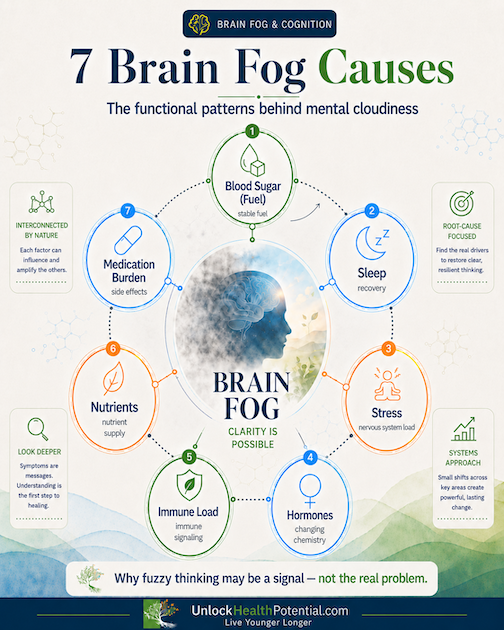
1. Your Brain Isn’t Getting Stable Fuel
Your brain is a small fraction of your body weight and a large fraction of your energy demand. Unlike a muscle, it never gets to rest — which makes it unusually sensitive to swings in fuel delivery.
The pattern often looks like this: a breakfast built on refined carbohydrates, several hours without eating, coffee to paper over the fatigue, and then a late-morning or mid-afternoon collapse in focus. Shakiness. Irritability. Cravings. A brain that suddenly won’t cooperate. Or the opposite version — the heavy, dulled, sluggish feeling that follows a large starch-dominant meal.
The insight is that your brain doesn’t love dramatic swings in either direction. Research using continuous glucose monitoring has linked glucose variability with performance in domains like executive function and working memory, particularly in people with impaired glucose regulation.
This doesn’t mean every afternoon slump is a blood sugar disorder, and it doesn’t mean carbohydrates are the enemy. It means meal composition, meal timing, metabolic health, stress hormones, movement, and sleep all interact to determine whether your thinking stays consistent.
Hydration belongs here too. Controlled studies have found that even mild dehydration can affect vigilance, working memory, fatigue, and mood. Dehydration alone rarely explains persistent brain fog — but in someone who starts the day on coffee, forgets water entirely, trains hard, travels often, or works in a warm environment, it’s one more finger on the scale.
Here’s the shift: what looks like a concentration problem is often a fuel-delivery pattern. Adding another stimulant masks it — and often sharpens the cycle underneath.
Pattern clues: Your fog has a schedule. It shows up after high-sugar meals, after skipped meals, during long meetings without food, or a couple of hours after coffee. Thinking briefly improves after eating, then fades again.
Next step: For one week, note what you ate and how your thinking felt at 30, 60, and 120 minutes. Pair carbohydrates with protein, fat, and fiber and watch what changes. Then go deeper with our post on the root causes of blood sugar imbalance — and consider whether walking after meals smooths your afternoon.
2. You’re Sleeping — but Your Brain Isn’t Recovering
Most people evaluate sleep by the clock: I was in bed seven hours, so sleep can’t be the problem.
But time in bed and neurologically restorative sleep are not the same thing.
Sleep is when memory gets consolidated, emotion gets regulated, learning gets filed, and the day’s information gets reorganized. Experimental sleep deprivation reliably degrades attention, reaction time, and mental stamina — and the NIH’s National Heart, Lung, and Blood Institute notes the deficit spills into your work, your driving, and your relationships.
The less obvious problem is fragmented sleep. You can log adequate hours while frequent awakenings, alcohol near bedtime, night sweats, pain, restless legs, disrupted breathing, an inconsistent schedule, late-night light, or an activated nervous system quietly prevent recovery.
This creates one of the most common brain-fog mismatches: you think the problem is daytime motivation, but the disruption happened overnight.
Morning is where the clue lives. Waking with a headache, a dry mouth, heavy fatigue, or the distinct sense that sleep “didn’t count” deserves attention — and so does needing substantial caffeine before you feel mentally present. Snoring, gasping, and severe daytime sleepiness should be discussed with a qualified professional, because they may point to a sleep-related breathing problem that needs proper assessment.
The honest read: the answer isn’t always “sleep longer.” It’s usually sleep timing, sleep continuity, and asking why your nervous system stays on alert when it’s supposed to be off duty.
Pattern clues: You wake unrefreshed, run on caffeine, get morning headaches, snore or wake gasping, wake repeatedly at night, or nod off sitting still.
Next step: Track bedtime, wake time, night wakings, alcohol and caffeine timing, screens, and morning clarity for 7–10 days. Then read our deeper guide on why sleep issues are rarely just about sleep and why a consistent sleep schedulemay matter as much as sleep duration.
3. Chronic Stress Is Occupying Your Working Memory
Stress doesn’t just make you feel overwhelmed. It changes how your brain allocates resources.
Under acute pressure, your nervous system prioritizes threat, urgency, and immediate action. Useful in an emergency. Poorly suited to reflection, creativity, nuanced judgment, and flexible recall. Experimental research has shown that acute psychological stress can reduce activity in the prefrontal regions that support working memory, redirecting resources away from executive-function networks.
Which explains an experience you almost certainly recognize: you know the information, and you cannot reach it while under pressure. The missing word returns after the meeting. The solution arrives during a walk. The detail surfaces the moment the perceived threat passes.
Read that again, because it matters: the information isn’t gone. Access to it is temporarily restricted.
Chronic stress adds a second layer. When your mind is continuously tracking unfinished tasks, money, family, health worries, notifications, deadlines, and unresolved tension, part of your working memory stays permanently occupied. Too many open loops. What feels like memory failure is often an encoding problem — the information was never fully registered, because your attention was already spoken for when it arrived.
This is also why “just lower your cortisol” is an incomplete strategy. Cortisol isn’t a toxin to eliminate; it’s part of an adaptive system doing its job. The better question is: what keeps signaling to your body that vigilance is required?Sometimes psychological. Sometimes sleep loss, blood sugar instability, pain, inflammation, overtraining, or under-eating. Usually a combination.
Pattern clues: You’re wired and foggy at the same time. You lose words under pressure, reread things you already read, feel mentally “full” before the day starts, or find clarity only on vacation.
Next step: Reduce open loops before you optimize focus — externalize the mental list, protect one uninterrupted block a day, and treat recovery as an input rather than a reward. Then read The Cortisol Myth for why chasing lower cortisol may be the wrong goal, and our post on burnout and adrenal dysfunction. If the mental static travels with dread or restlessness, the hidden root causes of anxiety is worth your time.

4. Hormonal Change Is Altering the Cognitive Environment
Brain fog frequently arrives during hormonal transition — and perimenopause is where it’s most often dismissed. Women describe changes in verbal recall, concentration, learning efficiency, processing speed, and the ability to hold several streams of information at once.
These experiences are real. They’re also routinely oversimplified.
Hormones influence cognition directly — and they also influence sleep, temperature regulation, mood, vascular function, energy, and stress reactivity. A woman waking four times a night from night sweats may be experiencing brain fog from the combination of hormonal fluctuation and fractured sleep, not from one isolated mechanism.
Studies across the menopause transition have found measurable changes in aspects of learning efficiency, even though subjective brain fog and formal cognitive testing don’t always line up neatly. That mismatch doesn’t make your symptoms imaginary. A quiet testing room rarely reproduces the complex, high-demand environment where you actually notice the difficulty.
Thyroid function belongs in this conversation too. Thyroid hormones set your metabolic pace throughout the body, and altered thyroid status is associated with changes in cognition, energy, mood, and temperature tolerance — often developing so gradually that you simply adjust to a duller version of yourself.
What this actually means: “hormonal brain fog” is rarely one pattern. It’s overlapping effects from shifting sex hormones, thyroid regulation, disrupted sleep, iron loss, and stress — which is why addressing one piece alone can leave you still not feeling like yourself.
Pattern clues: Your fog tracks with your cycle, postpartum period, or menopausal transition — or travels with night sweats, cycle changes, mood swings, temperature intolerance, thinning hair, or unexplained weight change.
Next step: Track cognitive symptoms against your cycle or hormonal stage so the pattern becomes visible on paper. Ask whether a fuller thyroid evaluation fits your picture. Then read our post on the root causes of hormonal imbalance— and, if weight has shifted alongside the fog, weight loss resistance.
5. Your Immune System Is Consuming the Resources
Your brain and immune system are in constant conversation. When your body is responding to infection, injury, or sustained immune activation, reduced cognitive efficiency becomes part of the response — not a side effect of it.
Anyone who’s had the flu already understands this. The body pulls the drive for complex activity offline and redirects resources toward recovery. The problem begins when the signal doesn’t resolve on schedule.
Long COVID made this connection impossible to ignore. Cognitive symptoms may include impaired attention, slower processing, memory difficulty, reduced mental endurance, and — importantly — worsening symptoms after physical or cognitive exertion. Similar complaints appear alongside autoimmune conditions, chronic infections, and post-viral syndromes, though the mechanisms and evidence differ meaningfully across diagnoses.
One pattern worth naming: post-exertional malaise — a crash that follows effort that used to feel manageable, often surfacing hours later or the next day and taking days to lift. The delay is exactly why the connection gets missed.
The point isn’t to blame everything on “inflammation.” That word has been used so loosely in wellness culture that it’s nearly lost its clinical meaning. The useful question is whether your brain fog arrived alongside other signs of systemic change.
The clue most people miss: your brain may be reflecting an immune-system priority shift — not a failure of willpower.
Pattern clues: The fog began after an illness and never fully lifted. It worsens after exertion, errands, or demanding mental work. It travels with unusual fatigue, joint or muscle pain, headaches, digestive changes, altered smell or taste, swollen glands, or a flu-like feeling.
Next step: Resist pushing through repeated crashes — that pattern is itself diagnostic information. Log activity and delayed symptoms, then bring it to a clinician experienced with complex fatigue. Our posts on chronic inflammationand chronic fatigue go deeper.
6. Oxygen and Nutrients Are Available — but Not in Adequate Supply
Clear thinking takes more than calories. Your brain needs oxygen, iron, vitamin B12, folate, and a long list of cofactors to run cellular energy production, build neurotransmitters, form blood, and maintain nerve function.
Iron is the one most often missed — particularly in people who menstruate heavily, eat restrictively, have digestive or absorption conditions, donate blood frequently, or have been through pregnancy and postpartum depletion. Crucially, iron-related cognitive effects appear along a spectrum; they don’t politely wait for full-blown anemia. In a randomized trial in young women, improving iron status was associated with measurable changes in cognitive performance — with anemia most affecting processing speed and iron deficiency most affecting accuracy.
Vitamin B12 can produce neurological and neuropsychiatric symptoms as well, sometimes before the classic picture is recognized. Risk is shaped by dietary intake, age, gastrointestinal conditions, certain medications, and absorption capacity.
This is precisely why indiscriminate supplementation isn’t a strategy. A person can take a nutrient for years without knowing whether a deficiency exists, why it developed, whether it’s being absorbed, or whether something else entirely is driving the symptom.
A functional evaluation doesn’t start by assuming you need a longer supplement list. It starts by asking whether there’s evidence of inadequate intake, increased demand, blood loss, impaired digestion, reduced absorption, medication interference, or a condition affecting how you use the nutrient.
That distinction is the difference between replacement and resolution.
Pattern clues: Fog paired with breathlessness on stairs, dizziness, restless legs, hair shedding, feeling cold, unusual cravings, tingling or numbness, pale skin, or heavy periods.
Next step: Ask your clinician whether iron studies, ferritin, B12, folate, and vitamin D make sense for your situation — and whether a single “in range” value is really answering the question. Because absorption starts upstream, our free Gut Intelligence ebook and our post on digestive dysfunction are the natural next reads.

7. The Medicine Cabinet Is Part of the Clinical Picture
Sometimes the cause of the symptom is sitting inside the treatment plan for another symptom.
Brain fog can be an unintended effect of a single medication, an interaction between two, or the combined dulling weight of several taken together. The list is broader than most people expect: certain sleep aids, antihistamines, bladder medications, pain medications, anti-anxiety drugs, and more — depending on the specific product and dose. Alcohol, cannabis, and supplements belong on the list too.
Here’s the mechanism in plain terms. A surprising number of everyday medications quietly block acetylcholine — a messenger chemical your brain relies on for memory, attention, and learning. Any one of them may be barely noticeable. Three or four together are a different story, because the effect stacks. Clinicians have a name for that combined load — anticholinergic burden — and it’s worth knowing, because it’s the phrase that gets a real answer when you ask about it. Longitudinal research has found that a higher cumulative load predicts poorer cognitive performance over time, with executive function among the most affected areas. Older adults are especially vulnerable, but this is not an elderly-only phenomenon.
And here’s the part that surprises people: a medication you tolerated beautifully for years can feel completely different after weight changes, a hormonal transition, an illness, a shift in liver or kidney function, or the addition of one more prescription.
None of this means stopping anything abruptly. It means a complete brain-fog evaluation should include everything you take — prescription, over-the-counter, and otherwise.
Pattern clues: Your fog began or deepened within weeks of a new prescription, a dose change, a new allergy or sleep aid, or an added supplement. Or you’ve simply accumulated more products than you had five years ago.
Next step: Bring every bottle — prescriptions, OTC, sleep and allergy aids, supplements — to your clinician or pharmacist for a formal medication review. Ask one specific question: “Is anything on this list adding to my anticholinergic burden?” It signals you’re asking about the combined effect, not just one drug.
Why Brain Fog Usually Has More Than One Cause
Here’s the principle that reframes everything: these patterns don’t live in separate rooms.
Poor sleep destabilizes blood sugar. Blood sugar swings amplify stress signaling. Chronic stress fragments sleep and disrupts digestion. Hormonal change alters sleep, glucose regulation, mood, and iron status. An infection reduces activity, alters appetite, and raises inflammatory signaling. Then a sedating medication gets added to help with the sleep — and quietly taxes tomorrow’s thinking.
By the time brain fog becomes disruptive, you’re rarely dealing with one cause. You’re dealing with several reinforcing loops.
This is why searching for the single “best supplement for brain fog” ends in frustration. The same symptom can emerge from completely different biology. Two people with nearly identical complaints may need entirely different next steps.
One needs iron studies. One needs a sleep evaluation. One needs a medication review. One is in perimenopause. One is recovering from a virus. One is trying to do cognitively demanding work while chronically under-fueled, overstimulated, and under-slept.
The symptom is the same. The pattern is not.
What Standard Care Can Miss
Conventional medicine is essential. It rules out the urgent and the clearly treatable, and you should never skip that step — especially with cognitive symptoms.
But most visits are built around short appointments and standard screening, not pattern recognition across a whole life. There often isn’t time in fifteen minutes to connect dots you’ve been collecting for months: the timing of your fog, your post-meal crashes, your unrefreshing sleep, your cycle pattern, your delayed crashes after exertion, your “low-normal” ferritin, your growing medication list, your invisible workload.
So instead of asking “What single thing is wrong with my brain?” ask “What conditions is my brain currently being asked to work under?”
That one shift turns a dead end into a map you can follow — and it’s the heart of a root-cause approach to health.
How HealthPotentialAnalytics™ Connects the Dots
At Unlock Health Potential, we built a proprietary online assessment to help you move from scattered symptoms to a clear pattern. To be clear about what it is — and isn’t: it’s not a diagnosis, and not a replacement for medical care. It’s a structured way to view your cognition through multiple lenses at once: sleep, stress, hormones, blood sugar, nutrition, immune load, medications, recovery, and daily function.
That matters because brain fog is so often multi-factorial. You might have fragmented sleep and low ferritin. Blood sugar swings and a hormonal transition. A post-viral immune load and a sedating medication added to help you rest.
Examine one piece at a time and the pattern stays hidden.
HealthPotentialAnalytics™ is our premium clinical assessment tool, refined over years of clinical work — mapping 54 epigenetic markers, 37 lifestyle markers, and 215 chronic symptoms into a personalized picture of your root-cause patterns. It takes about ten minutes, and it gives you something a symptom search never will: a starting point that belongs to you.
It helps you organize what your body has been trying to tell you — so you can walk into your next conversation informed.

Your Path From Foggy to Clear
You don’t have to keep pushing through the static or guessing your way forward. Lasting mental clarity rarely comes from one quick fix — it comes from understanding your own root causes and addressing them with the right tools and expert guidance. Here’s the path we’d recommend:
1. Build your foundation (optional, but highly recommended). Start with our book, Unlock Your Health Potential, to understand how your body’s systems connect — and why “normal labs” so often miss the real story behind cognitive symptoms.
2. Pinpoint your patterns. Take the HealthPotentialAnalytics™ assessment — our proprietary premium tool, developed over years of clinical work — to see which root-cause patterns are clouding your thinking. This is the step that turns scattered symptoms into a clear map.
3. Go deeper, root cause by root cause. Work through our free 24-video series, which breaks down the major root causes one at a time. And because gut health quietly underpins so much of this — from nutrient absorption to blood sugar stability to inflammatory signaling — download our free Gut Intelligence ebook to understand one of the most overlooked drivers of mental cloudiness. Our free 25 Nutrition Truths ebook covers the fueling side.
4. Prepare for your practitioner. Return to the book for practical strategies and next steps you can bring into an informed conversation with your health professional.
5. Rebuild your clarity for good. When you’re ready to turn insight into lasting change, our Master Your Health in 8 Weeks health mastery program guides you through a structured, expert-led plan to rebuild the lifestyle inputs behind your cognitive symptoms.
Want to go deeper on a specific pattern first? Keep reading on sleep issues and insomnia, blood sugar imbalance, hormonal imbalance, burnout and adrenal dysfunction, and why you’re always exhausted. And for the low-cost inputs that quietly support cognition, see why nature calms your brain, why your brain is drawn to water, and why walking barefoot is good for your brain.
Your brain fog is not a verdict. It’s a message. And with the right pattern map in hand, that message becomes your first real step back toward clarity, focus, and confidence.
FAQs
Brain fog is most often caused by unstable blood sugar, unrestorative sleep, chronic stress, hormonal transitions such as perimenopause or thyroid change, ongoing immune activity, nutrient deficiencies like low iron or vitamin B12, or medication side effects. Brain fog is not a diagnosis in itself — it’s a cluster of cognitive symptoms produced when the systems supporting clear thinking are under strain. Most cases involve more than one of these patterns reinforcing each other, which is why a single supplement rarely resolves it and why identifying the specific pattern matters more than treating the symptom.
In most cases, no. Brain fog typically reflects reduced biological capacity rather than progressive cognitive decline, and it commonly fluctuates — worse after a poor night’s sleep or a skipped meal, better after rest or recovery. Dementia-related change tends to be persistent and progressive rather than variable. That said, cognitive symptoms that are sudden, severe, rapidly worsening, or accompanied by weakness on one side, facial drooping, trouble speaking, vision loss, severe headache, confusion about time or place, or a significant change in behavior require prompt medical evaluation.
Normal screening labs can be reassuring and still not explain your symptoms. Standard panels are designed to detect disease thresholds, not to capture patterns — they won’t show your post-meal crashes, your fragmented sleep, your delayed crashes after exertion, your cycle-linked changes, or the combined effect of several medications. A value can also sit at the low end of “normal” while still being insufficient for you; ferritin and vitamin B12 are common examples, since cognitive effects can appear along a spectrum well before a formal deficiency is diagnosed.
Yes. Many women report changes in word recall, concentration, processing speed, and the ability to manage multiple streams of information during perimenopause and menopause. The mechanism is usually layered rather than singular: shifting estrogen and progesterone affect cognition directly, and they also disrupt sleep, temperature regulation, mood, and stress reactivity. A woman waking repeatedly from night sweats may experience fog from the combination of hormonal change and fractured sleep. Thyroid function and iron status are worth evaluating alongside sex hormones, since they frequently shift during the same period of life.
Yes, and it’s one of the most overlooked causes. Certain sleep aids, antihistamines, bladder medications, pain medications, and anti-anxiety drugs can dull memory and attention — and the effect stacks when several are taken together. Many of these block acetylcholine, a messenger chemical the brain relies on for memory and learning; clinicians call the combined load “anticholinergic burden,” and research links a higher cumulative load to poorer cognitive performance over time. A medication tolerated well for years can also feel different after weight change, a hormonal transition, illness, or changes in liver or kidney function. Never stop a prescribed medication abruptly — bring every product, including over-the-counter items and supplements, to your clinician or pharmacist for a formal review.
This article is for education and is not a substitute for medical care. Individual results vary. If you’re experiencing any of the urgent warning signs described above, seek medical attention promptly.
References & Further Reading
MedlinePlus, U.S. National Library of Medicine. Memory. https://medlineplus.gov/memory.html
MedlinePlus Medical Encyclopedia, U.S. National Library of Medicine. Memory loss.https://medlineplus.gov/ency/article/003257.htm
National Heart, Lung, and Blood Institute (NHLBI), NIH. Sleep Deprivation and Deficiency.https://www.nhlbi.nih.gov/health/sleep-deprivation
National Heart, Lung, and Blood Institute (NHLBI), NIH. How Sleep Affects Your Health.https://www.nhlbi.nih.gov/health/sleep-deprivation/health-effects
U.S. Food and Drug Administration (FDA). Always Tired? You May Have Sleep Apnea.https://www.fda.gov/consumers/consumer-updates/always-tired-you-may-have-sleep-apnea
Ganio MS, Armstrong LE, Casa DJ, et al. Mild dehydration impairs cognitive performance and mood of men. British Journal of Nutrition. 2011;106(10):1535–1543.
Armstrong LE, Ganio MS, Casa DJ, et al. Mild dehydration affects mood in healthy young women. Journal of Nutrition. 2012;142(2):382–388.
National Institute of Diabetes and Digestive and Kidney Diseases (NIDDK), NIH. Low Blood Glucose (Hypoglycemia). https://www.niddk.nih.gov/health-information/diabetes/overview/preventing-problems/low-blood-glucose-hypoglycemia
National Institute of Diabetes and Digestive and Kidney Diseases (NIDDK), NIH. Type 2 Diabetes.https://www.niddk.nih.gov/health-information/diabetes/overview/what-is-diabetes/type-2-diabetes
Qin S, Hermans EJ, van Marle HJF, Luo J, Fernández G. Acute psychological stress reduces working memory-related activity in the dorsolateral prefrontal cortex. Biological Psychiatry. 2009;66(1):25–32.
Arnsten AFT. Stress signalling pathways that impair prefrontal cortex structure and function. Nature Reviews Neuroscience. 2009;10(6):410–422.
Greendale GA, Huang MH, Wight RG, et al. Effects of the menopause transition and hormone use on cognitive performance in midlife women. Neurology. 2009;72(21):1850–1857.
Maki PM, Jaff NG. Brain fog in menopause: a health-care professional’s guide for decision-making and counseling on cognition. Climacteric. 2022;25(6):570–578.
Office on Women’s Health (OWH), U.S. Department of Health and Human Services. Menopause symptoms and relief. https://womenshealth.gov/menopause/menopause-symptoms-and-relief
National Institute of Diabetes and Digestive and Kidney Diseases (NIDDK), NIH. Hypothyroidism (Underactive Thyroid). https://www.niddk.nih.gov/health-information/endocrine-diseases/hypothyroidism
Centers for Disease Control and Prevention (CDC). Long COVID Basics. https://www.cdc.gov/covid/long-term-effects/index.html
MedlinePlus, U.S. National Library of Medicine. Myalgic encephalomyelitis/chronic fatigue syndrome (ME/CFS). https://medlineplus.gov/myalgicencephalomyelitischronicfatiguesyndrome.html
Office on Women’s Health (OWH), U.S. Department of Health and Human Services. Iron-deficiency anemia.https://womenshealth.gov/a-z-topics/iron-deficiency-anemia
Murray-Kolb LE, Beard JL. Iron treatment normalizes cognitive functioning in young women. American Journal of Clinical Nutrition. 2007;85(3):778–787.
NIH Office of Dietary Supplements. Vitamin B12 — Fact Sheet for Health Professionals.https://ods.od.nih.gov/factsheets/VitaminB12-HealthProfessional/
Gray SL, Anderson ML, Dublin S, et al. Cumulative use of strong anticholinergics and incident dementia: a prospective cohort study. JAMA Internal Medicine. 2015;175(3):401–407.
American Geriatrics Society Beers Criteria® Update Expert Panel. American Geriatrics Society Beers Criteria® for Potentially Inappropriate Medication Use in Older Adults. Journal of the American Geriatrics Society.2023;71(7):2052–2081.
National Institute of Mental Health (NIMH), NIH. Depression.https://www.nimh.nih.gov/health/topics/depression