

Weight Loss Resistance Isn’t About Willpower
Few things are more frustrating than doing “everything right” and still feeling stuck.
You eat less.
You exercise more.
You count calories.
You try another diet.
You push harder.
And yet the scale barely moves—or the weight comes right back.
For many people, this experience eventually becomes deeply discouraging. And unfortunately, the conversation around weight loss is often reduced to one oversimplified message: “You just need more discipline.”
But weight loss resistance is rarely just about willpower. More often, it reflects deeper physiological imbalance occurring throughout the body. Because metabolism is not simply about calories. It is deeply connected to:
- Hormones
- Inflammation
- Blood sugar regulation
- Gut health
- Stress physiology
- Thyroid function
- Nutrient status
- Detoxification
- Sleep quality
- Nervous system regulation
This is why so many people experience weight struggles alongside fatigue, cravings, hormonal symptoms, inflammation, poor sleep, anxiety, digestive dysfunction, and low energy.
The body functions as an interconnected ecosystem. And when multiple systems become dysregulated simultaneously, fat loss often becomes far more difficult than most people realize.
This is where the contrast between conventional medicine and functional medicine becomes especially important. Because while both paradigms recognize weight concerns, they often approach them in profoundly different ways—with very different long-term outcomes.
Two Approaches. Two Very Different Outcomes.
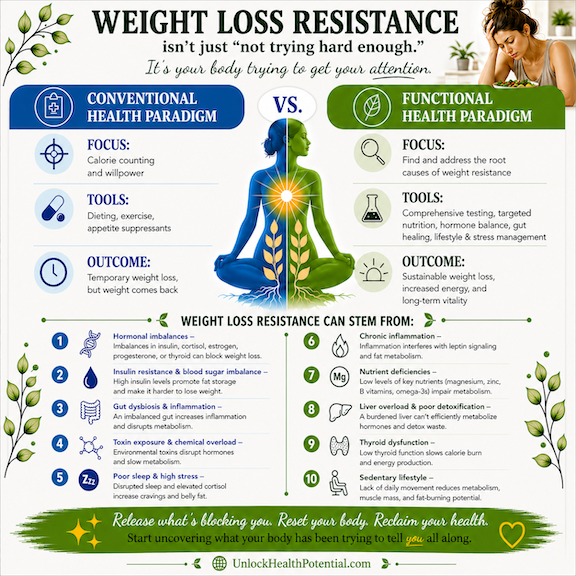
The Conventional Health Paradigm
Conventional medicine is highly valuable for identifying serious disease, metabolic disorders, cardiovascular risk, and obesity-related complications. But when it comes to chronic weight loss resistance, the conventional approach often centers primarily around calorie restriction and symptom management.
The focus frequently becomes:
- Eating less
- Exercising more
- Restricting calories
- Increasing willpower
Common interventions may include:
- Diet plans
- Exercise programs
- Appetite suppressants
- Calorie tracking
- Symptom-focused strategies
And while these approaches can sometimes produce short-term results, many people eventually notice something frustrating: The weight often returns. That’s because body weight is regulated by far more than calorie math alone.
The central question often becomes: “How do we force fat loss?”
Functional medicine asks something very different: “Why is the body resisting fat loss in the first place?”
That shift changes the entire framework.
The Functional Health Paradigm
Functional medicine views weight loss resistance through a systems-biology lens. Instead of seeing excess weight simply as a failure of discipline, it recognizes that the body often adapts metabolically when systems become chronically stressed or dysregulated.
The body continuously responds to blood sugar stability, cortisol levels, inflammation, sleep quality, thyroid function, gut health, toxin burden, hormonal signaling, and nervous system safety. When these systems become imbalanced, the body may shift toward:
- Fat storage
- Energy conservation
- Increased cravings
- Metabolic slowdown
- Reduced resilience
In many cases, the body is not “broken.” It is adapting. And unless the deeper drivers are addressed, many people remain trapped in repetitive cycles of restriction, frustration, temporary progress, rebound weight gain, and exhaustion.
The goal of functional medicine is not simply forcing temporary weight loss. The goal is restoring the systems that allow metabolism to function efficiently again.
Why Root Causes Matter
Weight loss resistance is often the body’s way of signaling that something deeper requires attention. This may involve:
- Insulin resistance
- Inflammation
- Hormonal imbalance
- Poor sleep
- Gut dysfunction
- Chronic stress
- Toxin burden
- Nutrient deficiencies
- Thyroid dysfunction
- Nervous system dysregulation
And unless those deeper drivers are addressed, the body often continues prioritizing survival and energy conservation over fat loss.
The body does not care about aesthetic goals. It cares about safety, stability, and survival.
10 Major Root Causes of Weight Loss Resistance
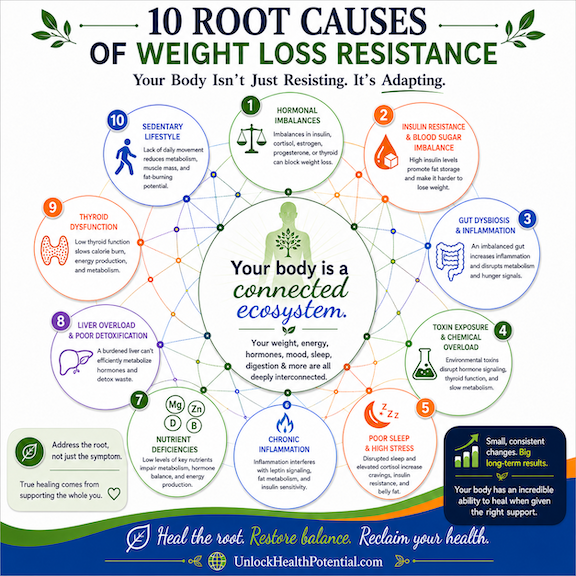
1. Hormonal Imbalances
Hormones strongly influence:
- Appetite
- Metabolism
- Fat storage
- Cravings
- Energy production
Imbalances involving cortisol, insulin, estrogen, progesterone, and thyroid hormones may significantly impair the body’s ability to lose weight efficiently.
Hormonal signaling matters far more than most calorie-based models acknowledge.
2. Insulin Resistance & Blood Sugar Imbalance
Insulin is one of the body’s primary fat-storage hormones. When insulin remains chronically elevated due to repeated glucose spikes, the body becomes more likely to:
- Store fat
- Increase cravings
- Experience energy crashes
- Resist fat burning
Many individuals struggling with weight resistance are also experiencing metabolic dysfunction beneath the surface.
3. Gut Dysbiosis & Inflammation
The gut microbiome strongly influences:
- Metabolism
- Inflammation
- Hunger signaling
- Insulin sensitivity
- Energy extraction from food
An unhealthy gut environment may contribute to increased inflammation, cravings, poor metabolic regulation, and fat storage.
The gut and metabolism are deeply interconnected.
4. Toxin Exposure & Chemical Overload
Environmental toxins may interfere with:
- Hormone signaling
- Mitochondrial function
- Thyroid activity
- Fat metabolism
Many chemicals act as endocrine disruptors capable of altering the body’s metabolic regulation. In some individuals, toxin burden may significantly impair weight-loss efforts.
5. Poor Sleep & High Stress
The body interprets chronic stress and sleep deprivation as survival threats. Poor sleep may increase:
- Cortisol
- Hunger hormones
- Cravings
- Insulin resistance
- Inflammation
Many people trying hardest to lose weight are simultaneously living in chronic physiological stress states that actively impair fat loss.
6. Chronic Inflammation
Inflammation strongly affects metabolism. Chronic inflammatory signaling may impair:
- Insulin sensitivity
- Leptin signaling
- Mitochondrial function
- Fat oxidation
Inflammation also contributes to fatigue, making movement and recovery more difficult.
7. Nutrient Deficiencies
The body requires nutrients for:
- Metabolism
- Thyroid function
- Mitochondrial activity
- Energy production
Deficiencies in magnesium, zinc, B vitamins, omega-3 fatty acids, and vitamin D may impair metabolic efficiency and increase fatigue and cravings.
The body cannot optimize metabolism without adequate resources.
8. Liver Overload & Poor Detoxification
The liver plays a major role in:
- Hormone metabolism
- Blood sugar regulation
- Toxin elimination
- Fat metabolism
When detoxification pathways become overwhelmed, metabolic regulation may suffer.
The liver is one of the body’s central metabolic organs.
9. Thyroid Dysfunction
The thyroid strongly influences:
- Metabolic rate
- Energy production
- Body temperature
- Fat burning
Even subtle thyroid dysfunction may contribute to fatigue, weight gain, sluggish metabolism, and poor recovery.
The thyroid does not operate independently from the rest of the body’s systems.
10. Sedentary Lifestyle
Movement affects:
- Insulin sensitivity
- Mitochondrial health
- Muscle mass
- Circulation
- Metabolic flexibility
Modern lifestyles often involve prolonged sitting and low movement volume, both of which may impair metabolic efficiency over time.
Movement is one of the body’s most important metabolic signals.

How to Start Supporting Your Metabolism Naturally
The goal is not perfection. The goal is creating an environment where the body feels safer, more nourished, and more capable of regulating metabolism naturally. Here’s where to begin:
1. Stabilize Blood Sugar
Build meals around:
- Protein
- Healthy fats
- Fiber
- Balanced meal timing
Stable blood sugar helps reduce insulin spikes, cravings, and metabolic stress.
2. Prioritize Sleep & Recovery
Focus on:
- Consistent sleep timing
- Morning sunlight exposure
- Reducing nighttime stimulation
- Creating recovery opportunities
The body cannot optimize metabolism while chronically sleep-deprived.
3. Reduce Chronic Stress Load
Incorporate nervous system support practices such as:
- Walking
- Breathwork
- Outdoor time
- Slower evenings
- Recovery-focused habits
The body is less likely to release stored energy while perceiving chronic threat.
4. Support Nutrient Density
Prioritize:
- Whole foods
- Minerals
- Protein
- Fiber-rich foods
- Nutrient-dense meals
Metabolism is biochemical—not simply mathematical.
5. Focus on Long-Term Healing
Avoid constantly cycling between:
- Extreme restriction
- Overtraining
- Short-term fixes
The goal is not punishing the body into fat loss. The goal is restoring the systems that allow healthy metabolism to occur naturally.
Final Thought
Weight loss resistance is rarely just about “trying harder.” More often, it reflects deeper physiological imbalance occurring beneath the surface.
The body is constantly responding to the environment it has been given. And when stress, inflammation, hormonal imbalance, poor sleep, metabolic dysfunction, and nutrient depletion accumulate long enough, the body may prioritize survival over fat loss.
The goal is not simply forcing the body to lose weight temporarily. The goal is restoring the systems that allow the body to feel safe enough to release excess weight naturally.
Because your body is not working against you. It is adapting to the signals it’s receiving.
Okay — So What Do I Actually Do With All This?
General knowledge is useful — but knowing which of the 24 major root causes are driving your symptoms is the real game-changer. That’s what the HealthPotentialAnalytics™ assessment is built to do. This isn’t a throwaway online quiz — it’s a sophisticated algorithm refined over years of expert work that acts like a detective for your body, connecting the dots across systems to reveal exactly where your trouble is hiding. You get what you pay for, and serious results come from serious tools.

FAQs
Because weight loss is about more than calories. Factors such as insulin resistance, hormonal imbalances, chronic stress, poor sleep, inflammation, thyroid dysfunction, and gut health can all influence how your body stores and burns energy. If these systems are out of balance, your body may resist fat loss despite your best efforts.
Possibly. Weight loss resistance often reflects deeper metabolic adaptation rather than a lack of effort. The body may be responding to chronic stress, inflammation, nutrient deficiencies, poor sleep, hormonal shifts, or blood sugar instability by conserving energy and prioritizing survival. Understanding why the body is adapting this way is often more important than simply trying harder.
Start by focusing on metabolic foundations: stabilize blood sugar, improve sleep quality, manage stress, support gut health, and prioritize nutrient-dense foods. Sustainable fat loss is often the result of restoring balance to the systems that regulate metabolism rather than relying on restriction alone.
Because many diets focus on reducing calories without addressing the root causes of weight loss resistance. If insulin resistance, inflammation, hormonal imbalance, poor sleep, chronic stress, thyroid dysfunction, or gut issues remain unresolved, the body may eventually return to its previous patterns. Long-term success usually requires improving the environment that drives metabolism—not just reducing food intake.
Absolutely. The body regulates weight through a complex network of systems that constantly communicate with one another. Hormones influence appetite and fat storage. Sleep affects hunger hormones and insulin sensitivity. Stress influences cortisol and metabolic regulation. Gut health affects inflammation, cravings, and energy extraction from food. Your weight is often a reflection of how these systems are functioning together. Your symptoms are connected because your systems are connected.
This content is for educational purposes only and is not intended as a substitute for professional medical advice, diagnosis, or treatment. Individual results vary.
References & Further Reading
Hotamisligil GS. Inflammation and Metabolic Disorders. Nature. 2006;444(7121):860–867.
https://www.nature.com/articles/nature05485
Spiegel K, Leproult R, Van Cauter E. Impact of Sleep Debt on Metabolic and Endocrine Function. The Lancet. 1999;354(9188):1435–1439.
https://pubmed.ncbi.nlm.nih.gov/10543671/
Cani PD, Amar J, Iglesias MA, et al. Metabolic Endotoxemia Initiates Obesity and Insulin Resistance.Diabetes. 2007;56(7):1761–1772.
https://diabetesjournals.org/diabetes/article/56/7/1761/12878/Metabolic-Endotoxemia-Initiates-Obesity-and
Chrousos GP. Stress and Disorders of the Stress System. Nature Reviews Endocrinology. 2009;5(7):374–381.
https://www.nature.com/articles/nrendo.2009.106
Biondi B, Cooper DS. The Clinical Significance of Subclinical Thyroid Dysfunction. Endocrine Reviews.2008;29(1):76–131.
https://academic.oup.com/edrv/article/29/1/76/2354954
Heindel JJ, Blumberg B. Environmental Obesogens: Mechanisms and Controversies. Annual Review of Pharmacology and Toxicology. 2019;59:89–106.
https://www.annualreviews.org/doi/10.1146/annurev-pharmtox-010818-021304
Hall KD, Kahan S. Maintenance of Lost Weight and Long-Term Management of Obesity. Medical Clinics of North America. 2018;102(1):183–197.
https://www.sciencedirect.com/science/article/pii/S0025712517300990