
The Hidden Biology of Everyday Life
INPUT 04 · Water · Question it answers: Can I survive here? · What it restores: The oldest evidence your nervous system has that the place you are standing in can keep you alive.
Input 4 of 10 in Ancient Biology, Modern Life.
Watch what people do when they reach the edge of the sea.
They stop. Almost everyone stops. Conversation thins out, then goes quiet. Bodies turn to face the water without anyone deciding to, and stay there — looking at a surface that is, in strict informational terms, doing the same thing over and over.
It happens at lakes, at rivers, at the low wall of a fountain where people late for something sit down anyway.
Most of us file this under liking the view.
In 2015, a team led by Gregory Bratman tested that. Participants walked for ninety minutes — half through a natural setting, half beside heavy traffic. Afterward the nature group reported less rumination, the looping self-critical replay so many people carry.
That much you might have predicted. Here’s what made people look twice.
The nature walkers also showed reduced activity in the subgenual prefrontal cortex — a brain region repeatedly implicated in brooding and in depression. The urban walkers showed no such change.
Same duration. Same effort. Different input.
Water Is Not a Metaphor
Every reaction that keeps you alive takes place in water. Not near it — in it. Your enzymes fold into shape because of how water molecules arrange around them; your neurons fire by moving ions through fluid. The chemistry of being you happens in solution, and it has never once happened anywhere else.
Life began in water and never really left. It simply learned to carry a supply along — a membrane wrapped around a small volume of ancient sea, taken inland.
A brief evidence check, since this attracts a popular myth: human blood does not match the salinity of seawater. Seawater is roughly four times saltier. The real story needs no exaggeration.
Why the Brain Settles
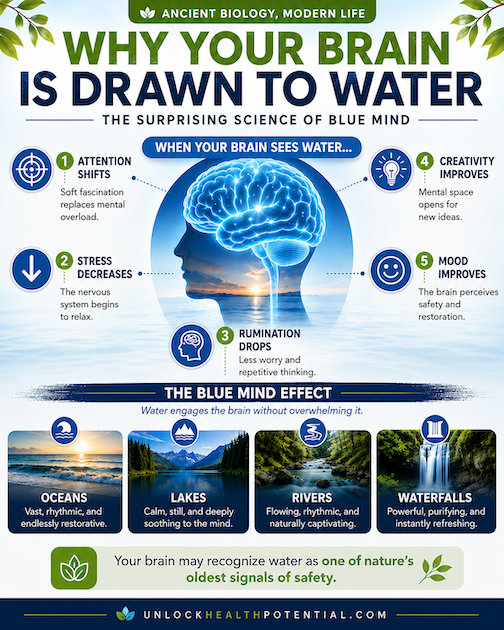
You may have heard this called Blue Mind, a phrase from marine biologist Wallace J. Nichols. It describes a state, not a diagnosis — but the research underneath is substantial. Systematic reviews of blue space find consistent associations between water exposure and better mental health, some holding even after accounting for physical activity.
The caveat any careful reader deserves: much of this work is observational, and people who live near water differ in income, air quality, and much else. It isn’t a closed case.
Two mechanisms have the strongest support.
Attention. Moving water is endlessly varied and completely predictable at once. No two waves are identical; every wave is unmistakably a wave. That combination holds the eye without requiring a decision — what psychologists call soft fascination. Nothing to interpret, nothing to resolve. Your effortful attention stands down while your eyes stay open.
Sound. Flowing water produces a broad wash of noise with no sudden onsets. The auditory system evolved to flag abrupt change, because abrupt change once meant something was coming. Water offers almost none — and in filling the acoustic space, it masks what would.
A third possibility, which we’ll flag as speculative: for most of human history, a landscape with water in it was a landscape where life was possible. Some researchers propose the nervous system still reads that signal — which may explain why the feeling near water is so often not just calm, but relief.
So How Much Do You Actually Need?
There is a number, and it’s better news than most people expect.
A study of nearly twenty thousand people found that around 120 minutes a week in natural settings was associated with better self-reported health and wellbeing. Below that the benefits were unclear; above it they held steady. And it could be accumulated in short visits, not one long trip.
Two hours across a whole week — most people can hit that.
What the research doesn’t tell you is how to spend it — sit or walk, face the water or move alongside it, how long before the effect arrives, what changes when sound is added deliberately. Nor does it cover the landlocked version, which for many readers is the version that matters. Those live in the book.
Water on its own is a data point — real, but narrow. Read against the other nine it becomes a pattern. Read within its own question it becomes a direction: water missing alone, among nine healthy inputs, is a different situation entirely from water missing alongside the shared table, both answering the same question badly at once.
And read whatever you find as feedback rather than a grade. Living an hour from open water doesn’t mean something is wrong with you — it means one channel is quiet, and it’s among the cheapest to reopen.
Where This Input Sits in the Pattern
Ten inputs, and not one stands alone. Each answers one of four questions your biology puts to the world around it, over and over: Is it safe here? Can I survive here? What is the world actually like? How big am I in this?
Water belongs to the second, and it shares that question with only one other input: the shared table. Two inputs, one question, answered from opposite directions.
Water is the landscape saying this place can sustain you. A table is other people saying and we will. One is a fact about where you stand; the other about who stands there with you.
Someone can live on a harbor and eat every meal alone. Someone else has a full table and hasn’t seen open water in a year. No single input tells them apart.
What Actually Restores It
The levers are cheap and unglamorous. Find your nearest water and go on purpose rather than passing by — a creek, a reservoir path, a fountain in a plaza, because movement and sound matter far more than scale. Sit a while without a task and let attention drift rather than steering it, since the drifting is the mechanism working. Take the route with water on it. And stop treating it as a reward for finishing the work, because it’s one of the conditions under which the work goes better.
The harder questions are how long, in what posture, and what to do when the nearest water is an hour away.
A caution. If you’re considering cold-water immersion, talk with your physician first, particularly if you have any cardiovascular condition. The cold-shock response is a genuine risk and deserves respect rather than bravado.
Where This Leaves You
Nothing stands between most people and this one except the habit of not going. No equipment, no fitness, no permission — a canal, a creek behind a shopping center, and a plaza fountain have all appeared in the research literature.
An article takes you to the water’s edge and no further. How to spend the time, and whether the landlocked version works, depends on where you actually live — so in the book each input’s practice is worked against that, and against the other nine, because several of these arrive in the same act rather than as ten separate obligations.
Then keep going, because one input is never the whole picture.
In Part 5 we take up the other half of this question: the shared table, and a cohort of more than thirty-seven thousand adults in which living with others did not protect the ones who still ate alone.
Your biology never stopped asking. It is time you answered.
New to this blog series? Start with the series overview →
Get the Book
Ancient Biology, Modern Life — the new book from Ronit Mor, ND and Russell Skinner, MD — gives you a full chapter on each of the ten inputs, the research behind every one, and simple steps for restoring it. Then it shows you how the ten fit together — which arrive in the same act, in what order, and which of your four questions has gone unanswered longest — so you finish with roughly fifteen minutes a day built around your own life.
This is Book Two in the Live Younger Longer series — short books you can finish in an afternoon, each focused on the small changes that make the biggest difference to how you age. Its companion volume, The Longevity Scorecard, measures the ten signals your body sends outward. This book restores the ten inputs your body receives. Read them in either order.
FAQs
Several things at once. Moving water holds attention gently rather than demanding it, which lets effortful focus recover. Its sound is broad and steady, with none of the abrupt onsets that trigger alertness. And research on natural environments has found reduced rumination afterward, alongside improvements in heart rate, blood pressure, and cortisol.
Less than you might expect. Oceans, lakes, rivers, canals, and urban water features have all shown benefit. Movement, sound, and open sightlines seem to matter more than scale, which is good news if the nearest ocean is far away.
Research points to a weekly minimum in natural settings, and it is lower than most people assume — reachable in short visits rather than one long trip. What the research cannot tell you is how to structure that time, or how water fits alongside the other nine inputs. Ancient Biology, Modern Life sets out the daily practice in full.
More is available than most people assume — moving water you can hear rather than only see, a route adjusted rather than added, and the placement of what you look at all day. None is equivalent to a shoreline. The book covers the landlocked version of this chapter properly, because for many readers it is the version that matters.
No. Seawater is roughly four times saltier than human blood, which is why drinking it is dangerous rather than hydrating. The genuinely remarkable fact is better: every cell in your body maintains its own carefully governed interior fluid, against constant osmotic pressure, every second of your life.
This content is for educational purposes only and is not intended as medical advice.
Scientific References
Bratman GN, Hamilton JP, Hahn KS, Daily GC, Gross JJ. Nature experience reduces rumination and subgenual prefrontal cortex activation. Proc Natl Acad Sci U S A. 2015;112(28):8567-8572.
White MP, Alcock I, Grellier J, et al. Spending at least 120 minutes a week in nature is associated with good health and wellbeing. Sci Rep. 2019;9(1):7730.
Gascon M, Zijlema W, Vert C, White MP, Nieuwenhuijsen MJ. Outdoor blue spaces, human health and well-being: a systematic review of quantitative studies. Int J Hyg Environ Health. 2017;220(8):1207-1221.
Britton E, Kindermann G, Domegan C, Carlin C. Blue care: a systematic review of blue space interventions for health and wellbeing. Health Promot Int. 2020;35(1):50-69.
MacKerron G, Mourato S. Happiness is greater in natural environments. Glob Environ Change. 2013;23(5):992-1000.
Kaplan S. The restorative benefits of nature: toward an integrative framework. J Environ Psychol. 1995;15(3):169-182.
Nichols WJ. Blue Mind. New York: Little, Brown and Company; 2014.