
The Hidden Biology of Everyday Life
INPUT 09 · Natural Geometry · Question it answers: How big am I in this? · What it restores: A visual world your brain reads without effort — and a quiet statement about your own place inside it.
Input 9 of 10 in Ancient Biology, Modern Life.
Stand at the edge of a forest and let your gaze wander. Nothing asks anything of you — the eye moves from canopy to trunk to undergrowth without effort, and something loosens.
Now picture a parking garage. Same light, roughly the same visual detail. Yet ten minutes there leaves you subtly depleted in a way the forest never does.
Most of us file that under preference: some like trees, some like cities.
Fractal patterns can be measured. Researchers describe their complexity with a number called fractal dimension — roughly, how densely a pattern fills the space it occupies.
You might predict preference splits by temperament: some drawn to simplicity, others to richness.
That is not what the research found. Across studies of landscape silhouettes, natural scenes, and abstract patterns, human preference clusters in a middle range — precisely the range occupied by coastlines, tree canopies, cloudscapes, and mountain horizons.
Not the emptiness of a blank wall, not the overload of visual noise. The particular density the natural world happens to produce.
The Signature Nature Signs Everything With
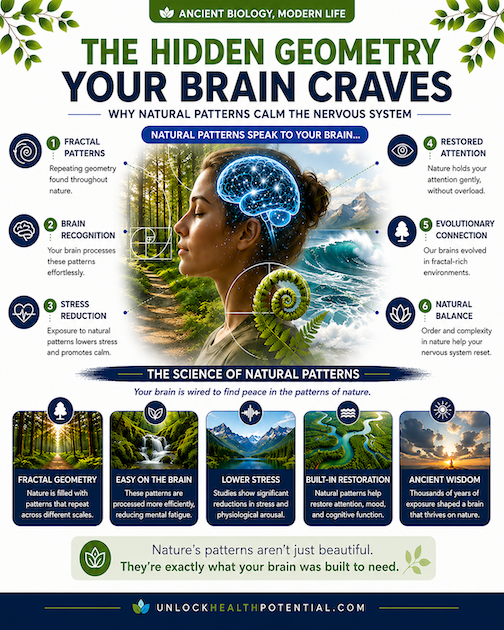
Look closely at a fern. The whole frond has a shape; each leaflet repeats it smaller; each division repeats it smaller still. The pattern holds as you zoom in.
Once you know the signature, you find it wherever nature has been at work — the branching of an oak, the ragged edge of a coastline, river deltas, lightning, the piled architecture of a cloud.
And then, if you keep looking, somewhere unexpected: inside yourself.
Your lungs branch this way — a trunk dividing into ever-finer passages until the surface area folded inside your chest rivals a tennis court. Your blood vessels branch this way. So do the dendrites of your neurons.
This isn’t a metaphor. It’s the same geometry, arrived at independently, because it solves a problem both trees and lungs face: how to fill a space thoroughly with limited material.
You are, in a real structural sense, built out of the thing you’re looking at.
Why the Brain Finds It Easy
Physicist Richard Taylor has spent decades on this, and his work points toward an elegant explanation: the visual system may be tuned to the statistical properties of the environments it evolved to navigate.
There’s a widely circulated figure attached to this literature — a large percentage reduction in stress markers — and we’d rather bound it than repeat it. It comes from early, relatively small studies. We mention it because you’ll meet it elsewhere, and flag it because integrity matters more than a good statistic. The chapter handles it properly, along with the EEG work that has since looked at what the brain actually does in front of these patterns.
What the broader evidence supports more firmly is simpler: your brain processes natural patterns with unusual efficiency. Less effort decoding a scene means more capacity left for everything else — which may be exactly what restful feels like from the inside.
Environmental psychologist Stephen Kaplan described two kinds of attention. Directed attention is the effortful focus you use to read a contract or ignore a notification — finite, and when it runs low you get the fog of a long day indoors. Soft fascination is attention held without being demanded: clouds moving, water over stones. It lets the directed system recover while you stay awake and looking.
So How Much Do You Actually Need?
This input is unusual, because the research answers what rather than how much.
It’s specific about the visual density that works — a measurable middle range, neither bare nor chaotic. It’s far less specific about duration, and we won’t invent a figure the literature hasn’t produced.
What matters more is placement. Most people can’t add hours outdoors, but almost everyone can change what’s in front of their eyes during the hours they already spend inside — a design problem with a right answer and several wrong ones. How to judge whether a view or object actually carries the pattern lives in the book.
Natural geometry on its own is a data point — real, but narrow. Read against the other nine it becomes a pattern. Read within its question it becomes a direction: missing alone is a different situation from missing alongside awe, both answering the same question badly at once.
And read whatever you find as feedback rather than a grade. Working in a room of flat planes and right angles doesn’t mean something is wrong with you — the building was designed for other priorities, and you can put something in front of yourself that wasn’t.
Where This Input Sits in the Pattern
Ten inputs, and their arrangement carries more than their number. They answer four questions your biology asks continuously: Is it safe here? Can I survive here? What is the world actually like? How big am I in this?
Natural geometry belongs to the fourth, which surprises people. Surely a pattern you process easily belongs under what is the world actually like?
Look again at what a fractal is. A pattern repeating across scales — the same structure at the size of a tree, a branch, a twig, a vein in a leaf, all at once. That is a statement about scale itself: the world is nested, size is relative, the same rules operating at every level.
And because your own lungs and vessels and neurons follow that rule, the pattern says something further: you are not observing this structure from outside. You are made of it.
Its sibling is Part 10. Awe is the loud version of that recognition; natural geometry is the quiet one — through a window, on an ordinary Tuesday, at no emotional cost.
What Actually Restores It
The levers cost almost nothing. Take the twenty-minute version — a park, a greenbelt, a tree-lined street — and let your eyes wander rather than directing them, because the wandering is the active ingredient. Claim the seat with something living in view. Bring the geometry indoors: plants with complex leaf structure, wood with visible grain, stone. And watch something that moves slowly, which is soft fascination in its purest form.
The harder question is which of those actually carry the pattern and which merely look like they do — a difference more specific than it appears, and the one that decides whether any of this works.
Where This Leaves You
You don’t need wilderness. This is the one input you can restore without going anywhere — the right view, the right objects, the right seat.
Which is also its trap: being easy to arrange makes it easy to keep postponing.
And that’s where an article stops being enough. What separates a view that works from one that merely looks nice is a judgment you have to make yourself — so in the book each input’s practice is worked against that, and against the other nine, because several arrive in the same act rather than as ten separate obligations.
Then keep going, because one input is never the whole picture.
In Part 10 we close the series with awe — what happens when the thing in front of you is too large for your existing frame of reference, and why one minute of it changed how people treated a stranger sixty seconds later.
Your biology never stopped asking. It is time you answered.
New to this blog series? Start with the series overview →
Get the Book
Ancient Biology, Modern Life — the new book from Ronit Mor, ND and Russell Skinner, MD — gives you a full chapter on each of the ten inputs, the research behind every one, and simple steps for restoring it. Then it shows you how the ten fit together — which arrive in the same act, in what order, and which of your four questions has gone unanswered longest — so you finish with roughly fifteen minutes a day built around your own life.
This is Book Two in the Live Younger Longer series — short books you can finish in an afternoon, each focused on the small changes that make the biggest difference to how you age. Its companion volume, The Longevity Scorecard, measures the ten signals your body sends outward. This book restores the ten inputs your body receives. Read them in either order.
FAQs
Patterns whose structure repeats at different scales. You see them in ferns, tree branches, coastlines, rivers, clouds, and mountain ranges — and inside your own body, in the branching of your lungs, blood vessels, and neurons.
Research suggests the brain processes natural fractal patterns more efficiently than many built environments. Interpreting the scene takes less effort, which may free up mental resources and support a state of relaxed alertness.
Studies of natural environments and fractal-rich imagery have found measurable improvements in physiological stress markers, mood, and mental restoration. The research is still developing, and effect sizes vary between studies — but the overall direction of the evidence is consistent
A term from psychologist Stephen Kaplan for attention held gently rather than demanded. Moving water, drifting clouds, and rustling leaves occupy the eye while leaving the mind free to wander, which allows your effortful, directed attention to recover.
Less well than being outside, but meaningfully better than nothing — which matters, because this is the one input in the series that can reach you indoors. What separates a view that works from one that doesn’t is more specific than most people assume, and Ancient Biology, Modern Life sets out how to judge it.
This content is for educational purposes only and is not intended as medical advice.
Scientific References
Hagerhall CM, Purcell T, Taylor R. Fractal dimension of landscape silhouette outlines as a predictor of landscape preference. J Environ Psychol. 2004;24(2):247-255.
Hagerhall CM, Laike T, Taylor RP, et al. Investigations of human EEG response to viewing fractal patterns. Perception. 2008;37(10):1488-1494.
Spehar B, Clifford CWG, Newell BR, Taylor RP. Universal aesthetic of fractals. Comput Graph. 2003;27(5):813-820.
Taylor RP, Spehar B, Van Donkelaar P, Hagerhall CM. Perceptual and physiological responses to Jackson Pollock’s fractals. Front Hum Neurosci. 2011;5:60.
Kaplan S. The restorative benefits of nature: toward an integrative framework. J Environ Psychol. 1995;15(3):169-182.
Berman MG, Jonides J, Kaplan S. The cognitive benefits of interacting with nature. Psychol Sci. 2008;19(12):1207-1212.
Ulrich RS, Simons RF, Losito BD, et al. Stress recovery during exposure to natural and urban environments. J Environ Psychol. 1991;11(3):201-230.