Longevity -> Measure It. Train It. Extend It.
SIGNAL 06 · Balance · System: Nervous · What it measures: How well three separate streams of sensory information are still being reconciled — and how much of the work one of them has quietly taken over.
Signal 6 of 10 in The Longevity Scorecard.
In 2022, researchers published a study in the British Journal of Sports Medicine that reduced a great deal of complexity to a single, uncomfortable question.
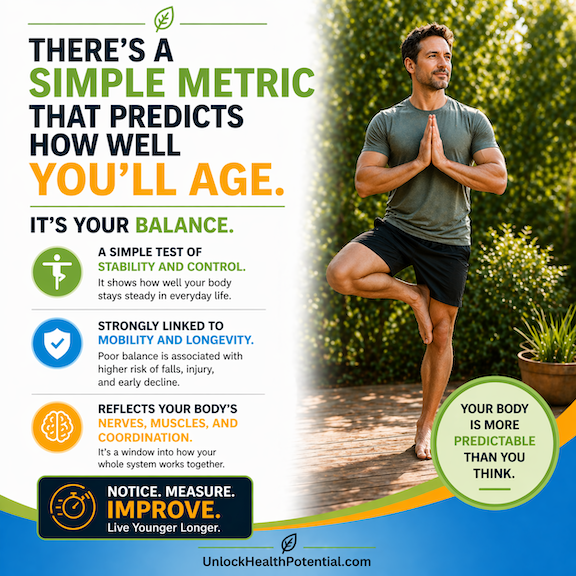
Can you stand on one leg for ten seconds?
They followed middle-aged and older adults for years, and the answer turned out to predict survival. Ten seconds. No equipment. No laboratory. Just whether you could hold the position.
Now ask almost anyone whether their balance is good and they will say yes.
They are not being boastful. They are reporting honestly on the only evidence available to them, which is that they have not fallen over recently.
The difficulty is that not falling over is a remarkably low bar in a world specifically engineered to make falling difficult. Flat floors. Level sidewalks. Handrails on both sides of the stairs. Uniform risers, good lighting, non-slip mats.
You are not passing a test. You are being graded very generously indeed.
Three Systems, One Job
Staying upright is not one skill. It is three streams of information being reconciled several times a second.
Your eyes report where the horizon is. Your vestibular system — the fluid-filled canals in your inner ear — reports acceleration and the position of your head. And proprioception, the sense of where your limbs are without looking at them, reports continuously from your joints, your muscles, and the soles of your feet.
Your brain takes all three, notices where they disagree, decides which to trust, and issues corrections to a few dozen muscles. Continuously, while you think about something else entirely.
Here is the part that explains why decline goes unnoticed for so long.
Those three inputs are not equal partners. When one degrades, the others absorb the extra work — and vision is by far the most willing to volunteer.
So a vestibular system that has quietly become less precise, or proprioception dulled by decades of cushioned shoes and flat surfaces, can be almost entirely concealed by a functioning pair of eyes. You stay upright. Nothing feels wrong. The compensation is invisible, including to the person performing it.
Until the lights go out.
This is why people who feel completely steady all day find themselves touching the wall on the way to the bathroom at three in the morning. The darkness did not make them unsteady. The darkness removed the input that had been doing most of the work.
In Part 5 we looked at how the hands quietly take over from the legs. This is the same story with one important difference. You can watch someone push off an armrest. Nobody — including you — can see your eyes covering for your inner ear.
There is more to this than staying upright, and the chapter covers it: balance draws on attention, which is why it tracks so closely with cognitive measures, and why the way someone walks while holding a conversation turns out to be clinically informative.
A World That Removed the Practice
Most people assume balance declines because of age. Age is part of it. Disuse is a much larger part.
We have built an environment in which balance is almost never genuinely required. Level ground, predictable surfaces, handrails within reach, and shoes with thick cushioned soles that muffle the very feedback the bottoms of your feet evolved to supply.
None of this is a mistake. It is the accumulated product of a century of sensible safety engineering, and it has prevented an enormous number of injuries.
It has also quietly removed the daily practice.
The system was never trained deliberately. It was maintained by uneven ground and by a world that did not level itself for your convenience. Take that away and there is nothing holding the capacity in place.
And once someone does begin to feel unsteady, the sensible response accelerates the problem. Avoid the uneven path. Take the elevator. Stay on level ground. Stay in. Each of those reduces risk today and reduces capacity for tomorrow.
So Is There a Number?
Yes — and like the chair test, this one you can do standing where you are.
Position yourself near a wall or a countertop, close enough to catch yourself. Lift one foot a few inches from the floor. Time how long you can hold it before the raised foot touches down or you need to grab something.
Then do the other side, and keep your better time.
In our book, The Longevity Scorecard, single-leg balance is placed against validated benchmarks and scored in three bands: Strong, Watch, or Priority. The book covers arm position, what ends an attempt, and how the benchmark shifts with age — because it shifts considerably.
The thresholds live in the book — so you now have a number without them, which is the honest position.
A single-leg time tells you what you managed today. What it cannot tell you is whether that number stands alone or belongs to a pattern. A modest time with a strong resting heart rate and steady sleep is one situation. The same time with the whole Nervous cluster drifting is a different one, and it points somewhere specific.
And read the number as a starting line, not a grade. Balance is among the most responsive capacities you have — this is one of the few signals where people routinely see change within a fortnight.
Where This Signal Sits in the Pattern
Balance is one of ten functional predictors in our book. The ten resolve into three interacting systems: Nervous, Metabolic, and Musculoskeletal.
Balance sits in the Nervous cluster, alongside walking speed, resting heart rate, and sleep consistency — which means you now have three of that system’s four signals.
And here the falls research offers something that maps almost exactly onto how the scorecard reads.
In 1988, Mary Tinetti and colleagues published a study in the New England Journal of Medicine examining what predicts falls among older people living independently. The most useful finding was not which single risk factor mattered most.
It was that risk rose steeply with the number of risk factors present. People with none were at low risk. People carrying several were at dramatically higher risk — and not in a simple additive way. The factors compounded.
That is the cluster principle, demonstrated in a separate literature decades before anyone assembled this scorecard. No individual measure told the story. The count did.
What Actually Moves It
Balance responds faster than almost anything else on this list, because the nervous system is built to adapt to exactly this kind of stimulus. Varied ground and short daily single-leg practice are the levers, and lower body strength is what lets a correction actually get executed.
The harder questions are how to progress the challenge safely, and how much practice it actually takes to move the number.
Where This Leaves You
Balance is not a fitness attribute and it is not simply a matter of avoiding falls, though it will do that too.
It is the quality of the conversation between your brain and your body — how quickly information arrives, how accurately it is reconciled, and how fast a correction can be issued when something is not where you expected it to be. That conversation is either being maintained or it is not, and almost nothing in an ordinary week will tell you which.
The encouraging part is how quickly it answers. Not months. Weeks. The nervous system was designed for exactly this, and it has simply been waiting to be asked.
Which is where an article reaches its limit. How much, and how often, depends on where you are starting from — so in the book each signal’s practice section is tiered against your score, because rebuilding from a low result and protecting a strong one are genuinely different jobs. Score all ten and those tiers resolve into a plan built from your own numbers.
But do not conclude anything from one signal.
In Part 7 we step back out to the Metabolic system and the most ordinary measurement in the entire series: how many steps you take in a day. Including the reason the famous number attached to it was never a scientific finding in the first place.
Your body has been keeping a scorecard. It is time you read it.
Get the Book
Balance is Signal 06 of 10.
The Longevity Scorecard — the new book from Ronit Mor, ND and Russell Skinner, MD — gives you a full chapter on each of the ten signals, the research benchmark for every one, and the at-home self-test to measure it.
Then it turns your ten results into a score out of 100, three system totals, and a practice plan matched to what you actually scored — so you finish knowing which system to rebuild first, and exactly what to do about it.
Order The Longevity Scorecard →
Its companion volume, Ancient Biology, Modern Life, restores the ten inputs your body receives. This book measures the ten signals your body sends. Read them in either order.
It is not too late. It has never been too late.
FAQs
Validated benchmarks exist and they shift considerably with age, so a single universal figure would mislead. Research consistently links shorter single-leg times with higher fall risk and reduced independence. Our book The Longevity Scorecard provides the benchmark bands along with the full protocol, including arm position and what ends an attempt — details that change the result enough to matter.
Stand beside a wall, worktop, or sturdy chair, close enough to catch yourself instantly. Lift one foot a few inches from the floor and time how long you hold it before the foot touches down or you reach for support. Test both sides. Stop immediately if you feel dizzy or genuinely unsteady, and have someone with you if you have fallen in the past year.
Because vision has been doing more of the work than you realized. Balance draws on three inputs — vision, the vestibular system in your inner ear, and proprioception from your joints and feet — and when one weakens, the others compensate. Vision compensates most readily, which means it can conceal decline in the other two for years. Removing it reveals what was actually underneath. Only attempt the eyes-closed version if the eyes-open version felt comfortable, and always within reach of support.
Balance and cognition are consistently associated in research, though neither causes the other in any simple way. Staying upright consumes attention, and when sensory information becomes less reliable it consumes considerably more — leaving less available for other tasks. A well-known clinical observation is that older people who stop walking in order to answer a question have a notably higher risk of falling.
Yes, and typically faster than most other capacities on this list. The nervous system adapts readily to balance stimulus, and meaningful improvement often appears within two to three weeks of consistent daily practice. Structured programs such as tai chi have among the strongest evidence for reducing falls in older adults.
Because modern environments almost never test it. Level floors, handrails, good lighting, and cushioned shoes remove both the challenge and the sensory feedback that maintained the system. Decline under those conditions produces no symptoms at all — which is exactly why it goes unnoticed until the circumstances change, usually at night, on uneven ground, or during an unexpected stumble.
This content is for educational purposes only and is not intended as medical advice. If you have experienced falls, dizziness, vertigo, or unexplained unsteadiness, please speak with a qualified healthcare provider.
Scientific References
Araújo CGS, de Souza e Silva CG, Laukkanen JA, et al. Successful 10-s one-legged stance performance predicts survival in middle-aged and older individuals. Br J Sports Med. 2022;56(17):975-980.
Lord SR, Sherrington C, Menz HB, Close JCT. Falls in Older People: Risk Factors and Strategies for Prevention. Cambridge University Press; 2007.
Tinetti ME, Speechley M, Ginter SF. Risk factors for falls among elderly persons living in the community. N Engl J Med. 1988;319(26):1701-1707.
Agmon M, Belza B, Nguyen HQ, et al. The association between balance and cognitive function in older adults. J Geriatr Phys Ther. 2014.
Muehlbauer T, Gollhofer A, Granacher U. Associations between measures of balance and neuromuscular performance in older adults. Sports Med. 2012;42(4):317-346.
Booth FW, Roberts CK, Laye MJ. Lack of exercise is a major cause of chronic diseases. Compr Physiol. 2012;2(2):1143-1211.